WhatsApp:+86 18005022363 WeChat: +86 18005022363
  Email:
Application Scenarios:
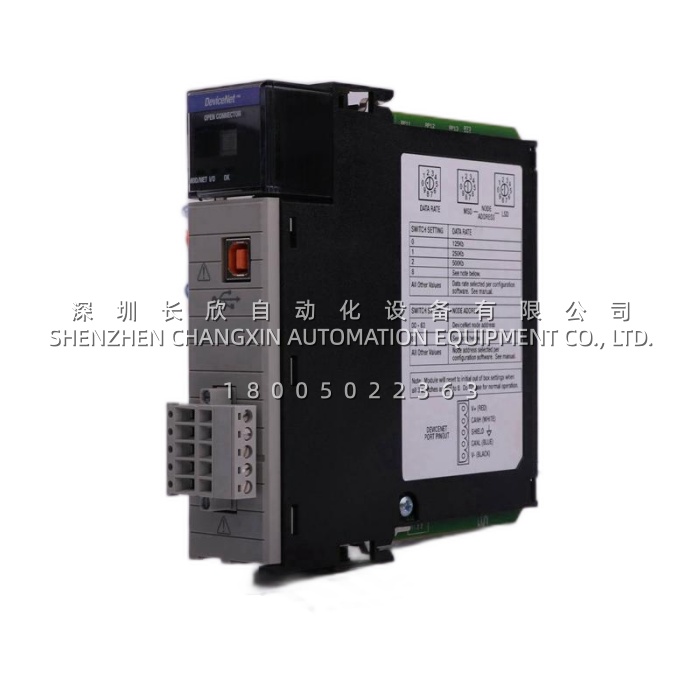
A specialty chemicals plant monitors reactor temperature, jacket pressure, feed flow and level on a single skid — four loops, four transmitters, and a cabinet that also houses three variable frequency drives. The existing SLC 500 analog input card worked adequately at commissioning, but as the VFDs were added, the readings began drifting. The pressure loop in particular showed a slow, unexplained oscillation, and the instrument technician had already replaced the transmitter twice without solving it.The real problem was ground loops and common-mode noise between channels sharing a common, and the standard fix would have been four external isolation transmitters — roughly a day of panel modification, new DIN rail space that did not exist, and a small but real accuracy penalty on every signal. Installing a single 1746sc-INI4VI solved it in one slot: each of the four channels is galvanically isolated from the others and from the backplane, so the ground potential difference between the reactor thermocouple assembly and the flow transmitter stops mattering. The 1746sc-INI4VI‘s 150 dB common mode rejection at 60 Hz also means the VFD-induced noise that had been coupling into the loop is rejected before it ever reaches the A/D converter.The same scenario plays out in any plant where analog signals travel long distances or share conduits with power wiring: water and wastewater lift stations with level and flow transmitters, food and beverage plants with mixed 4–20 mA and 0–10 V instrumentation, and OEM skids where the transmitter types are not known until late in the design. Because each channel on the 1746sc-INI4VI can be configured independently — say, 4–20 mA on channels 0 and 1, ±10 V on channel 2, 0–5 V on channel 3 — one module covers an instrumentation mix that would otherwise require multiple cards.
Parameter:
| Main Parameters | Value/Description |
|---|---|
| Product Model | 1746sc-INI4VI |
| Manufacturer | Spectrum Controls (compatible with Allen-Bradley SLC 500) |
| Product Category | 4-channel isolated analog input module, voltage/current selectable |
| Number of Inputs | 4 differential inputs, individually isolated — no shared common between channels |
| Current Input Ranges | 0–20 mA, 4–20 mA, selectable per channel |
| Voltage Input Ranges | 0–5 V, 1–5 V, 0–10 V, ±10 V DC, selectable per channel |
| Resolution | 16-bit — 312.8 nA per count (current), 312.8 µV per count (voltage) |
| Accuracy | Current: 0.10% of full scale at 25 °C, 0.25% at 60 °C; Voltage: 0.25% at 25 °C — stability across cabinet temperature swings |
| Channel Isolation | 750 VDC channel-to-channel and field wiring-to-backplane — eliminates external isolation blocks |
| Common Mode Rejection | 150 dB at 60 Hz, 99 dB at 1 kHz — the number that matters next to VFDs and welders |
| Normal Mode Rejection | 98 dB at 50/60 Hz — removes mains-frequency interference on the signal pair |
| Input Impedance | Current: less than 250 Ω; Voltage: greater than 220 kΩ — minimal loading on transmitters |
| Conversion Method | Sigma-Delta A/D with programmable notch filters (13.1 / 15.7 / 65.5 / 131 Hz cut-off) |
| Channel Update Time | 14 ms (current), 18 ms (voltage) with 500 Hz filter, all channels enabled; 8 ms step response |
| Input Protection | Overcurrent 33 mA continuous / 70 mA transient; overvoltage 50 VDC continuous (voltage inputs) |
| Backplane Current | 550 mA at 5V DC, 0 mA at 24V DC; backplane power 2.75 W typical, 3.25 W max thermal dissipation |
| Calibration | Factory calibrated, auto-calibrating every 10 seconds when enabled, with on-board ambient temperature compensation |
| Connection Interface | Removable terminal block (supplied), 12–24 AWG wire, Belden 8761 or equivalent shielded twisted pair |
| Communication / Data Formats | SLC 500 backplane; selectable formats include scaled engineering units, scaled-for-PID, proportional counts, 1746-NI4 format and user-defined scaling |
| Diagnostics | Four green channel status LEDs plus module status LED; startup self-test and open-circuit detection via status bits |
| Environmental Adaptability | 0 to 60 °C operating, –40 to 85 °C storage, 5–95% non-condensing humidity |
| Certifications | UL/cUL Listed ANSI ISA 12.12.01 (Class I, Div 2, Groups A–D), CE, UKCA, FCC, CMIM |
| Installation Method | Any 1746 I/O slot except slot 0; chassis mount in local, expansion or remote SLC 500 racks |
Technical Principles and Innovative Values:
- Innovation Point 1 — Per-channel isolation that replaces external hardware: Most multi-channel analog input cards share a common reference, which means a ground potential difference between two transmitters shows up directly as measurement error. Every channel on the 1746sc-INI4VI is isolated at 750 VDC both from adjacent channels and from the backplane. In practice this deletes the external isolation blocks from the bill of materials entirely — saving rail space, wiring labour and the accuracy loss each isolation stage introduces.
- Innovation Point 2 — Six input ranges, independently selectable per channel: The 1746sc-INI4VI accepts 0–20 mA, 4–20 mA, 0–5 V, 1–5 V, 0–10 V and ±10 V, and crucially each channel is configured on its own. A single module can therefore read a 4–20 mA pressure transmitter, a 0–10 V drive speed feedback and a ±10 V position signal simultaneously, without the usual compromise of buying separate cards or wasting channels.
- Innovation Point 3 — Sigma-Delta conversion with selectable notch filters: Using oversampling Sigma-Delta conversion combined with four programmable filter frequencies, the 1746sc-INI4VI lets the engineer choose where to sit on the speed-versus-noise curve — a 131 Hz cut-off giving 8 ms step response for fast loops, or a 50/60 Hz notch delivering maximum rejection for slow process variables. Few modules in this class expose that trade-off as a per-channel software choice.
- Innovation Point 4 — Continuous auto-calibration with temperature compensation: The module re-calibrates itself every ten seconds when enabled and compensates for ambient temperature on board. Where a conventional card drifts as the cabinet heats up over a summer afternoon, the 1746sc-INI4VI tracks its own offset and gain, which is why it holds 0.10% accuracy without anyone opening the panel to trim a potentiometer.
- Innovation Point 5 — 150 dB common mode rejection: This is the specification that decides whether an analog card survives next to variable frequency drives, welders and large contactors. The 1746sc-INI4VI rejects 150 dB of 60 Hz common-mode signal, meaning noise that would swamp a lesser input simply does not appear in the converted value.
- Innovation Point 6 — Drop-in SLC 500 compatibility with multiple data formats: The 1746sc-INI4VI installs in a standard 1746 slot, is configured through ladder register settings or RSLogix 500, and can present data in 1746-NI4 format — so an existing program written for a native Allen-Bradley card often needs no logic changes at all. It also ships with Rockwell TechConnect support at no additional cost, which is unusual for a third-party module.