WhatsApp:+86 18005022363 WeChat: +86 18005022363
 Email:

Description
Technical Specifications
| Parameter Name | Parameter Value |
|---|---|
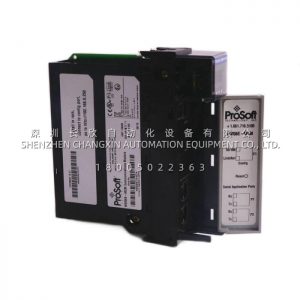
| Product Model | 1756-EN2TR |
| Manufacturer | Allen-Bradley (Rockwell Automation) |
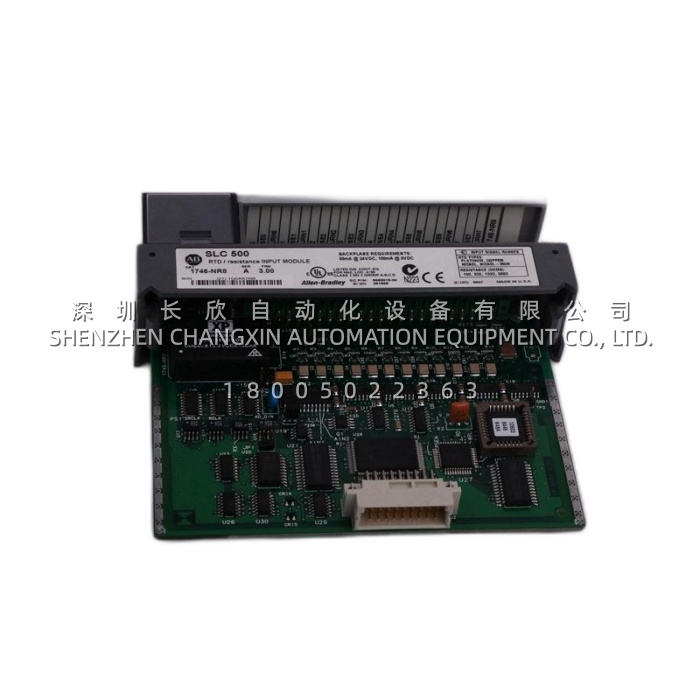
| Product Type | EtherNet/IP Communication Bridge Module |
| Ethernet Ports | 2 × Copper RJ45, 10/100 Mbps |
| Communication Protocol | EtherNet/IP, TCP/IP |
| Max TCP Connections | 128 |
| Max CIP Connections | 256 |
| Backplane Current (5.1V DC) | 1 A |
| Backplane Current (24V DC) | 3 mA |
| Power Dissipation | 5.1 W |
| Thermal Dissipation | 17.4 BTU/hr |
| Isolation Voltage | 30V continuous (Ethernet to Backplane) |
| Operating Temperature | 0°C to 60°C (32°F to 140°F) |
| Storage Temperature | -40°C to 85°C (-40°F to 185°F) |
| Relative Humidity | 5% to 95% non-condensing |
| Slot Width | 1 |
| Redundancy Support | Yes (Enhanced Redundancy) |
| DLR Support | Yes (Single-fault tolerant ring) |
| Linear Topology Support | Yes |
| Enclosure Type | Open-style |
| Wire Category | Category 2 (Ethernet ports), Category 3 (USB ports) |
Main Features and Advantages
Dual-Port DLR and Linear Topology Support: The 1756-EN2TR’s defining feature is its two-port Ethernet interface, which enables Device Level Ring topology without external switches. In a DLR configuration, devices are connected in a ring, and the 1756-EN2TR detects and recovers from a single cable break by redirecting traffic through the alternate path, maintaining network continuity for I/O control. The same two ports also support daisy-chain linear topology, reducing cabling and switch count in applications where devices are distributed along a line. This flexibility allows system designers to choose the topology that best matches the physical layout of the machine or process, whether that is a centralized control cabinet or a distributed line of drives and I/O blocks .
High Connection Capacity for Demanding Applications: With 128 TCP and 256 CIP connections, the 1756-EN2TR provides ample headroom for applications that combine I/O control with extensive explicit messaging. A single module can simultaneously manage I/O connections to multiple adapter modules, service programming and HMI sessions, and exchange data with other controllers via produced/consumed tags. The CIP connection pool is shared between explicit and implicit applications, giving engineers the flexibility to allocate capacity based on the specific communication profile of the application . This capacity is particularly valuable in larger ControlLogix systems where a single chassis serves as the communication gateway for an entire process area.
Redundancy and High-Availability Support: The 1756-EN2TR supports ControlLogix Enhanced Redundancy configurations, where a primary and secondary chassis pair maintains synchronized control and communication. In the event of a primary chassis failure, the secondary chassis assumes control with minimal interruption, and the 1756-EN2TR modules in both chassis participate in the redundancy switchover. This capability is essential for continuous process applications in power generation, oil and gas, and other industries where even brief control interruptions carry significant economic or safety consequences. The module’s support for redundancy is a key differentiator from lower-tier communication modules in the ControlLogix lineup.
CIP Security and Time Synchronization: The 1756-EN2TR supports CIP Security, an open standard defined by ODVA that enables devices to authenticate each other before transmitting data, protecting against malicious communication on the EtherNet/IP network. The module also supports PTP (Precision Time Protocol) time synchronization via UDP ports 319 and 320, allowing I/O modules and devices across the network to maintain synchronized timestamps for sequence-of-events recording and coordinated motion control . These security and synchronization capabilities position the 1756-EN2TR for modern industrial networks where both data integrity and temporal precision are required.