WhatsApp:+86 18005022363 WeChat: +86 18005022363
 Email:

Description
Application Scenarios
Picture a dairy bottling line where four pressure transmitters monitor fill-level, capping torque, pasteurization pressure, and cleaner-in-place (CIP) return flow — all mounted directly on the filler frame, only metres from high-pressure hot-water jets. Running four separate shielded analog cables back to a stainless steel cabinet in a washdown bay is not only expensive but also a known source of signal drift and ground-loop trouble. The 1738-IE4CM12 changes that equation: install the module on the machine, plug the transmitters in with M12 connectors, and let the 16-bit, 0.1%-accurate conversion happen right at the source. Maintenance crews can read channel health from six LEDs without opening a panel, and a broken transmitter loop shows up as a clean out-of-range value in the controller logic instead of a mysterious process deviation. For system integrators, that means fewer cabinets, less conduit, and far shorter commissioning time.
Parameter
| Main Parameters | Value / Description |
|---|---|
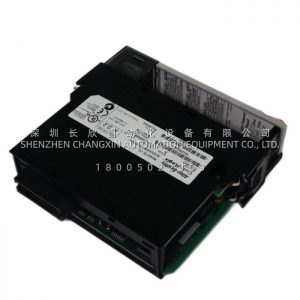
| Product Model | 1738-IE4CM12 |
| Manufacturer | Allen-Bradley (Rockwell Automation) |
| Product Category | Analog current input module, 4 single-ended, non-isolated channels |
| Product Series | ArmorPoint I/O, Bulletin 1738, Series A |
| Input Signal Range | 4…20 mA and 0…20 mA (current loops, not voltage) |
| Input Resolution | 16-bit over 0…21 mA; 0.32 µA per count — fine enough for tight PID loops |
| Absolute Accuracy | 0.1% full scale @ 25 °C — drift only 30 ppm/°C with temperature |
| Conversion Type | Sigma-Delta (Σ-Δ) converter; signed integer data format |
| Input Impedance | 60 Ω — keeps the loop load within transmitter drive capability |
| Notch Filter | Selectable 50 / 60 (default) / 100 / 120 / 200 / 240 / 300 / 400 / 480 Hz; step response 6.25–60 ms, update rate 25–200 ms |
| Digital Filter | Time constant 0…10,000 ms (default 0 ms), independently stackable on the notch filter |
| Common Mode / Normal Mode Rejection | 120 dB CMRR, -60 dB NMRR — rejects noise on long sensor leads |
| Connector Type | DC Micro (M12), 5-pin, metal coupling ring — sealed quick-disconnect |
| External DC Supply | 24V DC nominal, 10…28.8V DC range; 15 mA @ 24V DC; fault protected to 28.8V DC |
| POINTBus Current | 75 mA @ 5V DC |
| Power / Thermal Dissipation | 0.6 W maximum @ 28.8V DC / 2.0 BTU/hr maximum |
| Isolation Voltage | 50V continuous, reinforced insulation, tested at 1250V AC for 60 s (field-side to system); no isolation between individual channels |
| Status Indication | 1 green/red module status LED, 1 green/red network status LED, 4 green/red input status LEDs |
| Enclosure Rating | IP65 / IP66 / IP67 / IP69K when properly mated — sealed for high-pressure washdown |
| Dimensions (H × W × D) | 71.6 × 33.1 × 111.6 mm (2.82 × 1.30 × 4.39 in.) |
| Weight | Approximately 290 g (10.2 oz) |
| Operating Temperature | -20…60 °C (-4…140 °F) |
| Storage Temperature | -40…85 °C (-40…185 °F) |
| Relative Humidity | 5…95% non-condensing |
| Vibration / Shock | 5 g @ 10…500 Hz / 30 g operating, 50 g non-operating |
| EMC Immunity | 6 kV contact / 8 kV air ESD; ±3 kV EFT/B on signal ports; ±1 kV differential / ±2 kV common-mode surge |
| Certifications | CE, C-Tick, EN 61326, EN 61000-6-2/4, EN 61131-2 |
| Key Switch Position | 3 (base mechanical keying) |
| Lifecycle Status | Discontinued as of December 31, 2025; no planned Rockwell Automation replacement |
| Country of Origin | Singapore |
| Standard Warranty | 1 year |
Technical Principles and Innovative Values
Innovation Point 1 — Conversion where the signal is cleanest. The 1738-IE4CM12 digitizes the 4–20 mA loop with a 16-bit Sigma-Delta converter right at the sensor, so the fragile analog value never travels hundreds of metres as a voltage. At 0.32 µA per count, a 16 mA process signal resolves to roughly one part in 50,000 — well beyond what most transmitters can justify, but the headroom pays off in stable PID action and less dithering in slow loops such as weighing or tank level.Innovation Point 2 — Two-stage filtering you can actually tune. A hardware notch filter with nine frequency steps (50 Hz through 480 Hz) knocks out the local mains hum and its harmonics, while a completely separate software digital filter, adjustable from 0 to 10 seconds, smooths turbulent readings from mixers, pumps, and belt scales. Because the two filters stack, you can reject 50 Hz buzz and still slow the displayed value for a weigh-feeder without adding a single external signal conditioner — a tangible saving on parts and panel space.Innovation Point 3 — IP69K sealing with no cabinet tax. The housing, M12 metal-coupling connectors, and internal gaskets are rated IP65, IP66, IP67 and IP69K when properly mated, meaning the module survives high-pressure, high-temperature washdown, dust, oil mist and mechanical knocks. Compared with mounting equivalent 1734 POINT I/O in a stainless cabinet plus glands and shielded cable, the 1738-IE4CM12 eliminates an entire enclosure and the labour of pulling analog home runs — historically the largest hidden cost on an analog I/O job.Innovation Point 4 — Diagnostics that reach into the program. Each channel has its own green/red LED, and under-range/over-range behaviour is reported as signed integer data. An open wire, a burnt-out transmitter, or a loop driven below 3.6 mA reads as a distinct fault value in the controller, not as a plausible-but-wrong process number. Combined with the module and network LEDs, electricians can separate “field device dead” from “network down” in seconds, before a single screw is loosened.Innovation Point 5 — Shared DNA with POINT I/O. The 1738 backplane uses the same CIP assembly model and EDS profile as the 1734 POINT I/O family, so the 1738-IE4CM12 drops into a Studio 5000 / RSLogix 5000 project through the usual Add-On Profile workflow. The difference is purely mechanical and environmental: sealed M12 housing instead of an open terminal block, so existing Logix code and tag structures carry over unchanged.