WhatsApp:+86 18005022363 WeChat: +86 18005022363
 Email:

Description
Application Scenarios
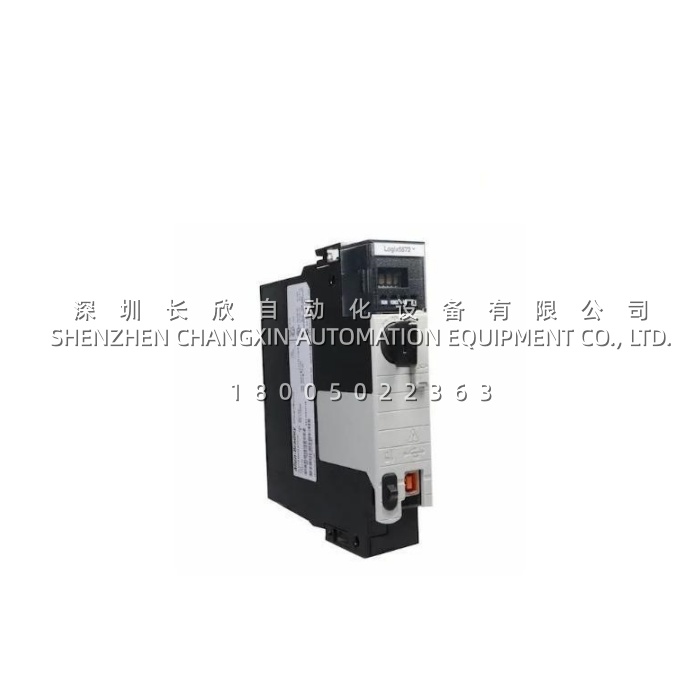
Consider a regional chemical plant running a DCS for its continuous process and a collection of standalone PLC-5 racks for batch reactors, utilities and packaging lines. Corporate wants one engineering environment, one spare-parts pool and one training curriculum, but the budget cannot justify replacing the entire DCS at once. The 1756-L71 is the pragmatic bridge: install the controller in a 1756-A7 or 1756-A10 chassis with an 1756-EN2T Ethernet bridge, and it drops into the existing PlantPAx / FactoryTalk View architecture over EtherNet/IP while the legacy DH+ and Remote I/O links stay alive through an 1756-DHRIO module. The 2 MB memory is enough for a mid-size reactor batch with equipment-phase logic, a small motor control center and a PID block for each loop, while the 0.2 ms I/O response keeps the fast interlocks local. When the plant is ready to grow, a second 1756-L71 in the same chassis forms a redundant pair with no change to the application code. For the engineering team, that means one Logix project, one revision-control workflow and a migration that happens skid by skid instead of plant by plant.
Parameter
| Main Parameters | Value / Description |
|---|---|
| Product Model | 1756-L71 (ControlLogix 5570 family) |
| Manufacturer | Allen-Bradley / Rockwell Automation |
| Product Category | Rack-based programmable automation controller (processor) |
| Product Family | ControlLogix 5570, Bulletin 1756 |
| User Memory | 2 MB — sufficient for mid-size batch, machine and process applications |
| Built-in Ports | 1 Ethernet port (10/100 Mbps, 1756 backplane bridge) + 2 USB ports |
| Number of I/O Modules | Up to 128 I/O modules — large enough for a complete skid or small plant area |
| Total I/O Points | Up to 4000 I/O points |
| I/O Response Time | 0.2 ms — deterministic, independent of program size |
| Programming Languages | Ladder, Structured Text, Function Block, Sequential Function Chart |
| Engineering Software | Studio 5000 Logix Designer / RSLogix 5000 (version-dependent) |
| Redundancy Capability | Yes — a second 1756-L71 can form a redundant controller pair |
| Local Chassis Capacity | Up to 16 I/O modules in a single local chassis |
| Communication Protocols | EtherNet/IP, ControlNet, DeviceNet (via communication modules), DH+, Remote I/O |
| Data Table Size | 2 MB (shared user/data memory) |
| Task Execution | Up to 32 tasks; multiple programs and equipment phases supported |
| Motion Capability | Yes — integrated motion over Sercos and EtherNet/IP |
| Energy Savings | Energy-saving feature supported (low-power idle modes) |
| Automatic Tuning | Autotune feature for PID loops |
| Operating Temperature | 0…60 °C (32…140 °F) |
| Storage Temperature | −40…85 °C |
| Relative Humidity | 5…95% non-condensing |
| Dimensions (H × W × D) | 14 × 12.4 × 11.3 cm (5.51 × 4.88 × 4.45 in.) |
| Weight | Approx. 0.41 kg (0.9 lb) |
| Certifications | UL, CSA, CE, C-Tick |
| Country of Origin | United States / Singapore (batch-dependent) |
| Lifecycle Status | Discontinued; no direct replacement — procure as verified spare stock |
| Standard Warranty | 1 year (manufacturer warranty may not apply to post-discontinuation stock) |
Technical Principles and Innovative Values
Innovation Point 1 — One controller, four programming languages, one project. The 1756-L71 executes ladder, structured text, function block and sequential function chart in the same Studio 5000 project, so a process engineer can express a reactor sequence in SFC, a motor-control routine in ladder and a mathematical transform in structured text without crossing a communication boundary. This is the architectural reason ControlLogix scales from a machine controller to a DCS-node replacement: the same tag database and the same scan engine serve all four languages.Innovation Point 2 — 0.2 ms I/O response independent of program size. The controller updates I/O on a fixed, deterministic schedule rather than as part of the main program scan. A 2 MB application with dozens of PID blocks and several communications tasks therefore responds to a safety or interlock input in 0.2 ms, the same as a small program. For a plant migrating DCS loops to Logix, this is the guarantee that replaces the old “the loop must live in the DCS” assumption.Innovation Point 3 — 128 I/O modules and 4000 points on one controller. With support for up to 128 I/O modules and 4000 total I/O points, the 1756-L71 can host a complete skid, a small plant area or an entire batch cell in a single chassis pair. The 16-module local chassis limit is deliberate — it forces distribution onto the network, which is exactly how a DCS is laid out — and the controller handles that distribution without the application programmer seeing a difference in tag syntax.Innovation Point 4 — Redundancy without a code change. A second 1756-L71 in the same chassis, paired with the matching redundancy modules, forms a redundant controller set. The application, the tag database and the I/O configuration are identical; only the chassis and the module placement change. This lets a plant stage a redundant installation — non-redundant first, redundant later — without rewriting the control logic, a rare combination in the industry and a genuine cost saver during a DCS migration.Innovation Point 5 — Built-in bridge to the legacy estate. The single Ethernet port and two USB ports, combined with the 1756 communication module family, let the 1756-L71 talk EtherNet/IP, ControlNet, DeviceNet, DH+ and Remote I/O in the same rack. A plant can therefore keep its existing PLC-5 DH+ links and SLC 500 Remote I/O while moving new skids onto EtherNet/IP, preserving the installed base while the engineering environment modernizes around Studio 5000.