WhatsApp:+86 18005022363 WeChat: +86 18005022363
 Email:

Description
Application Scenarios
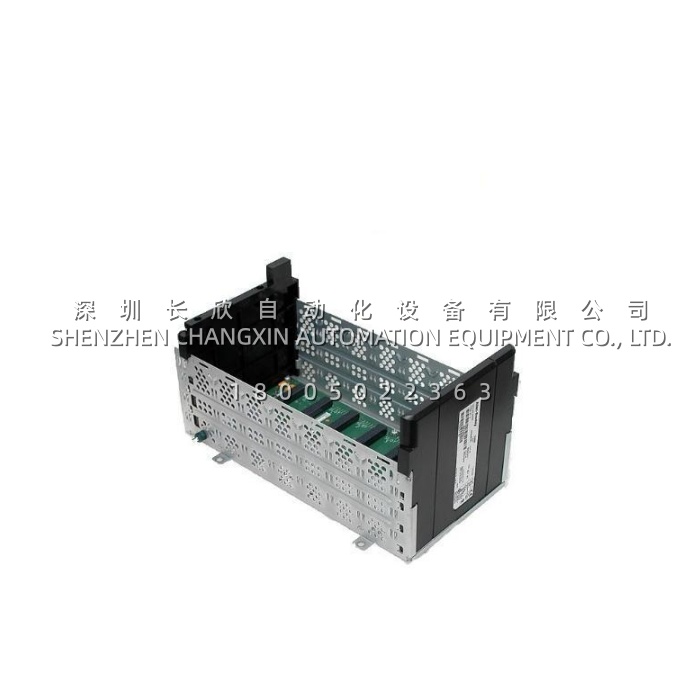
A system integrator building a skid-mounted water treatment control panel needs a controller, an Ethernet communication module, and four I/O cards for valve control, pump status, and analog sensor inputs. The seven-slot 1756-A7/B accommodates this exact configuration with one slot remaining for a future communication card, avoiding the cost and cabinet space of a ten-slot chassis. Because the chassis uses convection cooling with no fans , it installs in a sealed NEMA enclosure without introducing a forced-air path that would draw in moisture or dust—a common failure mode in washdown-adjacent environments.
Parameter
| Parameter | Value/Description |
|---|---|
| Product Model | 1756-A7/B (Series B) |
| Manufacturer | Allen-Bradley / Rockwell Automation |
| Product Category | ControlLogix Standard Chassis |
| Slot Count | 7 |
| Backplane Current (5.1 VDC) | 15 A chassis total / 6 A per slot maximum |
| Backplane Current (3.3 VDC) | 4 A chassis total / 4 A per slot maximum |
| Backplane Current (24 VDC) | 2.8 A chassis total / 2.8 A per slot maximum |
| Backplane Current (1.2 VDC) | 1.5 A chassis total |
| Cooling | Convection (no fans) |
| Operating Temperature | 0°C to +60°C (Series B) |
| Enclosure Rating | None (open-style; must be installed in a protective enclosure) |
| Minimum Enclosure Size | 50.8 × 60.9 × 20.3 cm (20 × 24 × 8 in.) |
| Mounting | Sub-panel, horizontal only |
| Functional Ground Wire | 8 AWG copper, rated 90°C or higher |
| Protective Ground Wire | 14 AWG copper, rated 90°C or higher |
Technical Principles and Innovative Values
Innovation Point 1: Backplane Capacity Matched to Mid-Size Systems. The 1756-A7/B delivers 15 A at 5.1 VDC across the chassis, with a 6 A per-slot ceiling . This is sufficient for a 1756-L8x processor, an Ethernet module, and several high-draw analog or motion modules without approaching the power supply limit. The per-slot limit is the constraint to watch: a single module drawing more than 6 A at 5.1 VDC requires redistribution or a larger chassis, regardless of the chassis total.
Innovation Point 2: Fanless Convection Cooling. Unlike larger chassis in some automation families that rely on forced air, the 1756-A7/B dissipates heat through natural convection . This eliminates a mechanical wear item, removes a path for airborne contaminants to enter the enclosure, and keeps acoustic noise at zero—a practical advantage in control rooms or cleanroom-adjacent panels.
Innovation Point 3: Redundancy-Ready Form Factor. Rockwell’s redundant ControlLogix documentation specifies that the two chassis in a redundant pair must be the same size, with 1756-A7 cited as a valid example . The seven-slot frame is therefore suitable for mid-size redundancy architectures where the I/O load does not justify a 13- or 17-slot pair, keeping the redundant cabinet footprint proportionate to the process criticality.
Application Cases and Industry Value
A Midwestern food and beverage plant replaced a failing PLC-5 system with a ControlLogix platform on a packaging line. The panel had limited spare back-panel space after the original installation. The integrator selected the 1756-A7/B because it fit the available sub-panel area while accommodating a 1756-L83E controller, a 1756-EN2T Ethernet module, two 1756-IB16I input cards, and two 1756-OB16I output cards—six slots occupied with one free for a future analog module. The minimum enclosure requirement of 50.8 × 60.9 cm was met by the existing Hoffman cabinet, avoiding a cabinet replacement . The line returned to production with the original enclosure, and the integrator reported that the convection cooling kept internal temperatures within 5°C of ambient even during summer production peaks.
In a Canadian oil sands application, an integrator configured a redundant ControlLogix pair for a critical compressor control loop. The 1756-A7/B chassis pair housed one 1756-L71 controller per chassis, with partner modules in identical slots per Rockwell’s redundancy requirements. The seven-slot size was chosen deliberately: it provided sufficient capacity for the redundant controller, a redundancy module, and the necessary communication cards, while leaving no empty slots that would invite ad-hoc expansion and complicate the validated redundant configuration.