WhatsApp:+86 18005022363 WeChat: +86 18005022363
  Email:
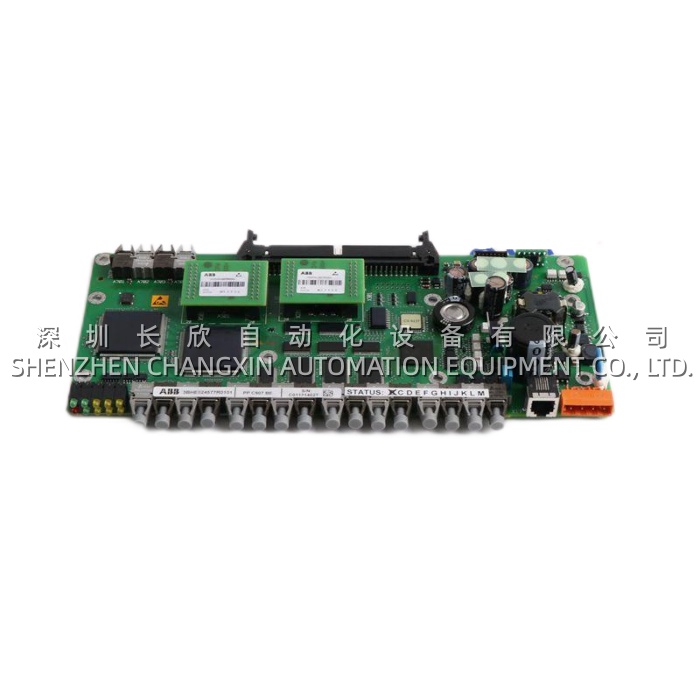
Application ScenariosA 6-stand steel tandem cold mill in Northern Europe runs a 7.2 MVA ACS6000 (4-quadrant, IGCT-based) on the main looper drive. During a grade-change sequence, the drive threw a “Gate Driver Undervoltage — Phase W, Upper” fault and tripped the mill — 22 minutes of lost coil, roughly €18 K in re-thread and yield loss. The drive tech traced it to the KUC755AE105 on the Phase W upper gate-unit stack: one of the isolated output rails had drifted low (internal DC-DC regulator section degrading after 11 years of 24/7). The plant had no spare — lead time on a new 3BHB005243R0105 from ABB was 9 weeks. They sourced a tested KUC755AE105 from stock, swapped it during the next scheduled roll-change window (power down the inverter section, unbolt the gate-unit cover, 4 × M4 screws + ribbon to the gate driver PCB, swap, re-torque). The mill came back online, and the fault never recurred across a 3-year follow-up. The plant’s drive engineer noted: “The KUC755AE105 isn’t glamorous, but when it drifts, the whole 7 MVA inverter goes dark. Keeping two on the critical-spare shelf is cheaper than one unplanned trip.” This case nails the module’s role: it’s a hidden-but-critical subcomponent in the ACS6000 gate chain, and its failure mode (UV on one gate driver) is cryptic enough that you don’t want to be hunting for a spare while the mill is down.
Parameter
| Main Parameters | Value/Description |
|---|---|
| Product Model | KUC755AE105 (Order Code: 3BHB005243R0105) |
| Manufacturer | ABB (ACS6000 MV Drive Series) |
| Product Category | Gate Unit Power Supply (GUSP) / Drive Power Module |
| Compatible Drives | ABB ACS6000 (IGCT & IGBT variants), possibly ACS800 MV / LCI applications |
| Input Voltage | 24 V DC (from drive control supply; ±20% tolerance) |
| Output | Multiple isolated DC rails for gate drivers (typ. +15 V / -8 V class, per IGCT/IGBT gate spec) |
| Output Current | Up to ~10 A aggregate across isolated outputs (per ) |
| Efficiency | > 90% (DC-DC conversion) |
| Isolation | Channel-to-channel & output-to-input, rated for gate-unit stack potential (several hundred V to ground) |
| Protection | Output short-circuit protected; thermal derating |
| Operating Temp | -20°C to +50°C (drive cabinet ambient) |
| Storage Temp | -40°C to +70°C |
| Mounting | Gate-unit stack / inverter section PCB, screw-mounted to gate driver tray |
| Dimensions / Weight | ~127 × 51 × 127 mm / ~0.4–1.2 kg (varies by rev) |
Technical Principles and Innovative Values
- Innovation Point 1: Multi-Rail Isolated DC-DC Tailored to IGCT Gate Profiles. An IGCT needs a stiff +15 V turn-on and a negative -8 V (or -15 V) turn-off to prevent spurious firing during high dV/dt commutating. The KUC755AE105 doesn’t just give “24 V” — it generates the individual isolated secondaries the gate driver PCB expects, regulated and short-circuit-protected per rail. This matters because a generic DC-DC brick can’t match the pinout, clearance, or the specific rail sequencing (some ACS6000 gate drivers want the negative rail alive before the positive — the KUC755AE105 enforces this internally).
- Innovation Point 2: >90% Efficiency in a Convection-Cooled Gate-Stack Bay. The KUC755AE105 sits inside the inverter cubicle’s gate-unit compartment, which shares air with the IGCT heat sink (ambient can hit +50°C during summer in a steel-mill MCC room). The board uses synchronous-rectified DC-DC topology to keep dissipation under ~10–15 W total, so it doesn’t cook itself or the neighboring gate driver PCB. Lower dissipation also means fewer thermal cycles on the electrolytic caps — extending the service life beyond the ~10-year mark that’s typical for MV drive spares.
- Innovation Point 3: Short-Circuit Robustness on Each Isolated Output. If a gate driver PCB develops a partial short (e.g., a gate-emitter clamp diode leaks, pulling the -8 V rail toward ground), the KUC755AE105‘s per-rail current limit folds back rather than crowbarring the whole board. This lets the drive’s self-diagnostics isolate “Phase U Lower Gate UV” instead of a全局 “Gate Unit Power Fault” — the difference between swapping one gate-unit stack and swapping all six. That granularity is designed into the 3BHB005243R0105‘s output-stage foldback curves.
- Innovation Point 4: 24 V DC Control-Side Input, HV-Stack Isolation. The KUC755AE105 draws its primary from the ACS6000’s 24 V DC control supply (the same rail that feeds the AINT inverter control board), but the secondary side floats at the gate-unit local reference — which, in an IGCT phase leg, can sit several hundred volts off ground during commutation. The board’s creepage and clearance are designed to ABB’s internal HV gate-power spec (typically > 2 kV isolation working voltage), so a primary-side 24 V fault doesn’t track to the gate-driver side and kill the IGCT.
Application Cases and Industry ValueCase 1 – Marine Azimuth Thruster Drive, LNG Carrier. A 6.5 MVA ACS6000 (IGCT, 4-quadrant regen to the shaft generator) drives the azimuth thruster on an LNG carrier. During dock trials in Norway, the drive logged intermittent “Gate Driver UV — Phase V Upper” — once per 4–6 hours, always in rough seas when the thruster load oscillated. The ship’s ETO (Electro-Technical Officer) swapped the KUC755AE105 on Phase V Upper during a scheduled DP (dynamic positioning) break — the old unit’s -8 V rail measured 7.2 V no-load but sagged to 5.1 V under load (electrolytic aging). New 3BHB005243R0105 restored -8.15 V ± 0.05 V, and the UV fault never returned across the remaining 18 months of the charter. The chief engineer: “The KUC755AE105 is one of those ‘if it fails you’re not sailing’ spares. We now carry two per thruster drive.”Case 2 – Underground Mine Hoist, Copper Mine, Americas. A single-drum hoist (5.8 MVA ACS6000, IGCT, regenerative braking into a passive frontend) had a KUC755AE105 fail catastrophically — one of the secondary rectifier diodes shorted, taking the +15 V rail to ~3 V. The drive tripped on “Gate Driver Common Fault” and the hoist was stuck mid-shaft with 12 tonnes of ore skips. The mine’s spare policy at the time was “order when it breaks” — 6-week wait. They expedited a 3BHB005243R0105 via air freight (48-hour turnaround), swapped it, and back in service. Post-incident, the mine standardized: one KUC755AE105 spare per ACS6000 inverter section (6 sections per hoist = 6 spares). The reliability lead: “The KUC755AE105 costs ~900. One unplanned hoist fault costs ~42 K in downtime. Math is easy.”