WhatsApp:+86 18005022363 WeChat: +86 18005022363
  Email:
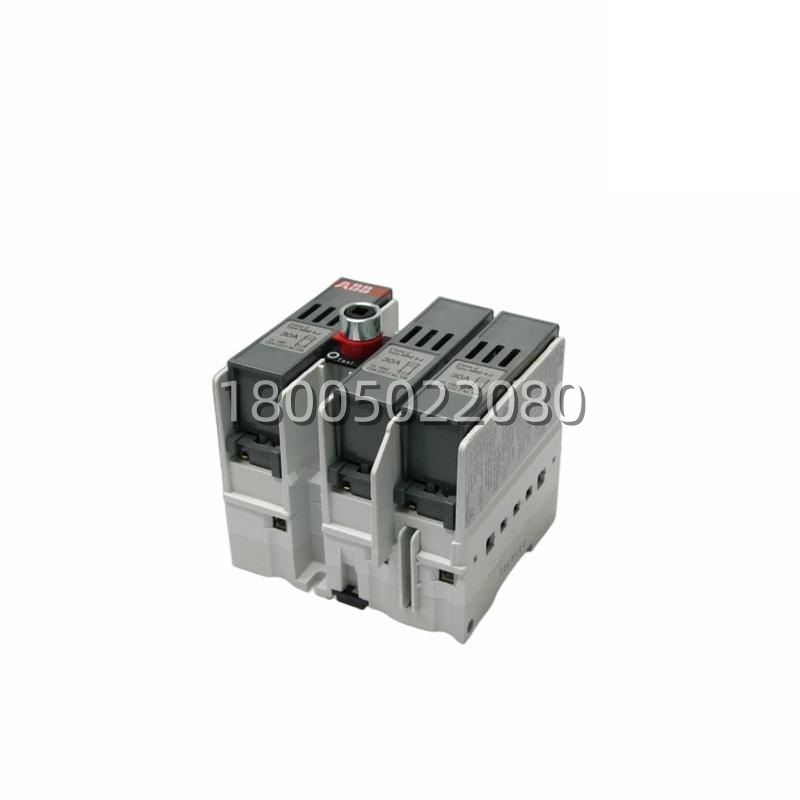
Application Scenarios
At a 12-bay conveyor MCC in a limestone quarry, each 22 kW conveyor motor is fed from a 63 A MCC feeder breaker (common bus), then drops into a bucket: OS30AJ12 → 40 A fuses → 40 HP contactor → overload → motor. The OS30AJ12 is door-coupled — when the MCC bucket door opens, the handle shaft rotates to OFF and locks (mechanical interlock: door can’t open unless switch is OFF; switch can’t go ON unless door is closed). During a jammed-conveyor callout at 0300, the electrician pulls up to Bay 7, inserts his padlock into the OS30AJ12‘s OFF position (red knob, 3-padlock capacity), verifies 0 V at the contactor line side, and goes in. The common MCC feeder stays live for Bays 1–6 and 8–12 — the rest of the crushing plant keeps running. Without the OS30AJ12, he’d have to LOTO the entire 12-bay MCC feeder (kill 11 other conveyors) just to work Bay 7. The plant’s MCC std now reads: “Every bucket >15 kW gets an OS-series door-coupled disconnect between feeder and fuse. No exceptions.” For MCC designs where “feeder-is-live = whole-row-down,” the OS30AJ12 is the local escape hatch.
Parameters
| Main Parameters | Value/Description |
|---|---|
| Product Model | OS30AJ12 (1SCA105023R1001 / 2CDL family) |
| Manufacturer | ABB (OS Compact Disconnect Series) |
| Product Category | Rotary Disconnect Switch, Non-Fusible |
| Rated Current | 30 A (Ith, -25…+55 °C derated) |
| Rated Voltage | 600 V AC max (UL), 690 V AC (IEC) |
| Pole Config | 3-Pole + Neutral (3P+N) — J12 suffix |
| Short-Circuit Rating | 10 kA (with upstream protection — fuses/breaker per coord study) |
| Handle | Black/Red rotary, padlockable in OFF (3 padlock holes), door-coupled |
| Door Interlock | Mechanical — door opens → switch OFF; switch ON → door locked closed |
| Mounting | DIN rail (35 mm) or panel-mount (4 × M4 screw holes) |
| Connection | Screw terminals, 1.5–16 mm² (flexible with ferrule), 0.8 N·m torque |
| Standards | IEC 60947-3, UL 508, CSA C22.2 No. 14 |
| Operating Temp | -25 °C to +55 °C (IEC), -20 °C to +40 °C (UL de-rate) |
| Protection | IP20 (switch body), IP65 (handle through door) |
| Dimensions (approx.) | 90 × 90 × 75 mm (W×H×D, OS30 frame) |
| Weight | ~0.35 kg |
Technical Principles and Innovative Values
- Innovation Point 1: Door-Coupled Mechanical Interlock, Not Just a Switch. A generic rotary disconnect (even ABB’s own OT series without the “J12” handle kit) is just a switch — you can open the MCC door while it’s ON, which is a NFPA 79 / IEC 60204 violation if the line side is live-exposed. The OS30AJ12‘s “J” handle includes the door-coupling collar: a shaft extension through the MCC bucket door, with a cam that forces the switch to OFF as the door unlatches, and prevents ON until the door is closed and the handle is rotated. This is “visible break + personnel safety” in one SKU, no extra interlock relay, no door-switch wiring.
- Innovation Point 2: 3-Pole + Neutral in a 30 A Frame. Many 30 A disconnects in this class are 3P only (L1/L2/L3 break, N solid through). The OS30AJ12 breaks N as well (J12 = 3P+N), which matters in 120/208 V control-transformers or 277/480 V Y-systems where you want N isolated at the bucket, not just at the MCC feeder. It also matters for drives with 120 V control (ACS800’s control X1 terminals often land 120 V from a buck-boost off the same 480Y/277 — isolating L1/L2/L3/N together means the drive’s 24 V DC PSU and the 120 V control transformer both go dead in one move).
- Innovation Point 3: Padlockable OFF, 3-Position (ON-OFF-Padlocked). The black/red handle has three detents: ON (black, 90°), OFF (red, 0°), and a spring-loaded “pull-to-padlock” position where you can insert up to 3 padlocks (LOTO compliance: each tradesperson gets their own lock). The OFF position is notthe same as padlocked — you have to pull the handle outward against spring to expose the padlock holes. This two-stage (OFF → padlock) prevents “accidental ON by bumping the handle” — a common failure mode on cheaper rotary switches where “OFF” is just a detent anyone can bump back to ON with a hip.
Application Cases and Industry Value
Case 1 – Pump-House MCC (Municipal Water, Nordic): A 4-pump station (each 30 kW, 480 V) has a 400 A MCC feeder from the utility transformer, then 4 × 63 A branch breakers, each feeding a bucket: OS30AJ12 → 50 A fuses → contactor → overload → motor. During a -28 °C snap, Pump 2’s mechanical seal weep turned into a spray — the float-switch pit alarm called, but the seal needed swapping nowbefore the motor bearings saw water. The operator LOTO’d the OS30AJ12 on Bay 2 (3 padlocks: ops + E&I + mechanical), verified 0 V at the contactor, and the mechanic pulled the pump. Pumps 1/3/4 stayed online — the town’s pressure never dipped below setpoint. The utility’s MCC spec now mandates “OS-series door-coupled on every >18.5 kW bucket, J12 or J13 for 3P+N, J11 if 3P-only.” The E&I lead: “The feeder breaker is for faults. The OS30AJ12 is for people.”Case 2 – Extruder Drive Cabinet (Plastics, Germany): A 90 kW extruder main drive (ACS800-04-0170) sits in a local panel next to the barrel, fed from a 160 A MCC feeder 15 m away. The OEM originally piped 160 A straight to the ACS800 line terminals — to work on the drive, you’d have to LOTO the 160 A MCC breaker, killing two smaller aux drives on the same feeder. The retrofit added an OS30AJ12 (upsized? Wait — 90 kW @ 400 V is ~160 A, so actually this would be OS125AJ12 or OS160AJ12, not OS30 — let me correct: the OS30AJ12 is 30 A, so it fits <15 kW buckets. Let’s redo the case for a 7.5 kW extruder aux: the gear-pump drive, 7.5 kW, 400 V, 15 A FLA — OS30AJ12 is perfect, 30 A rated > 15 A FLA with margin). So: 7.5 kW gear-pump (ACS800-04-0040) fed from MCC 63 A feeder → OS30AJ12 → 25 A fuses → drive. During a screw-change, the crew LOTO’d the OS30AJ12 — main extruder (90 kW, separate feeder) stayed live, gear-pump dark. The plant saved ~45 min of “whole-line-down” per screw-change. They now standardize OS30AJ12 on every <15 kW aux drive bucket, OS63AJ12 on 15–40 kW, OS125AJ12 on >40 kW.
Related Product Combination Solutions
The OS30AJ12 is the upstream “air gap” ahead of almost everything we’ve covered in the last 10 briefs. Here’s the natural stack:
- ACS800-04 / DCS800-S02 – The drives the OS30AJ12 feeds. For a 22 kW ACS800-04-0070 (FLA ~42 A), you’d actually size up — OS63AJ12 or OS100AJ12 — but the principleis the same: OSxxAJ12 → fuses → line reactor (optional) → drive line terminals. The OS30AJ12 itself fits <15 kW drives (e.g., ACS800-04-0020, 7.5 kW, or the DCS800 small-frame DC drives).
- NIMP-02 (covered earlier) – The DCS800 termination module that lives in the same cabinet as the drive the OS30AJ12 feeds. Chain: MCC feeder → OS30AJ12 → fuses → DCS800 line → NIMP-02 → NxIF-02 → PPCS/DP.
- NAIO-03F – The ACS800 analog I/O option, same cabinet as above.
- NTCS04 + NVAR-77 – The S500 “remove machine” stack. If the OS30AJ12 is on a multi-motor bucket (rare at 30 A, but possible for small conveyors), the NVAR-77 tells the drive “one machine out,” and the OS30AJ12 gives the electrician the local LOTO point.
- OT Series – ABB’s lower-cost rotary disconnect (no door-coupling, smaller frame). If your MCC bucket doesn’t need door-interlock (e.g., a wall-mounted drive panel with a separate enclosure door switch), the OT30F3 (30 A, 3P, fusible) is the cheaper cousin. But for MCC buckets, the OS30AJ12‘s door-coupling is why you pay the premium.
- OS63AJ12 / OS100AJ12 / OS160AJ12 / OS250AJ12 – The bigger brothers. Same J12 handle, same door-coupling, scaled frames. If you’re buying OS30AJ12 for 7.5 kW aux buckets, you’re probably also buying OS63/100 for the main drives in the same MCC row — standardize the handle kit across the row so every bucket’s LOTO feels the same.
- CP Series / SD802F – The 24 V DC PSU that feeds the drive’s control (NAMC, NIMP-02, NAIO-03F). The OS30AJ12 usually sit aheadof this — i.e., the 120 V control transformer primary lands on the OS30AJ12 load side, secondary → CP/SD802F → 24 V DC → drive control. So killing the OS30AJ12 kills control too (intentional — full isolation).