WhatsApp:+86 18005022363 WeChat: +86 18005022363
  Email:

Technical Specifications
| Parameter Name | Parameter Value |
|---|---|
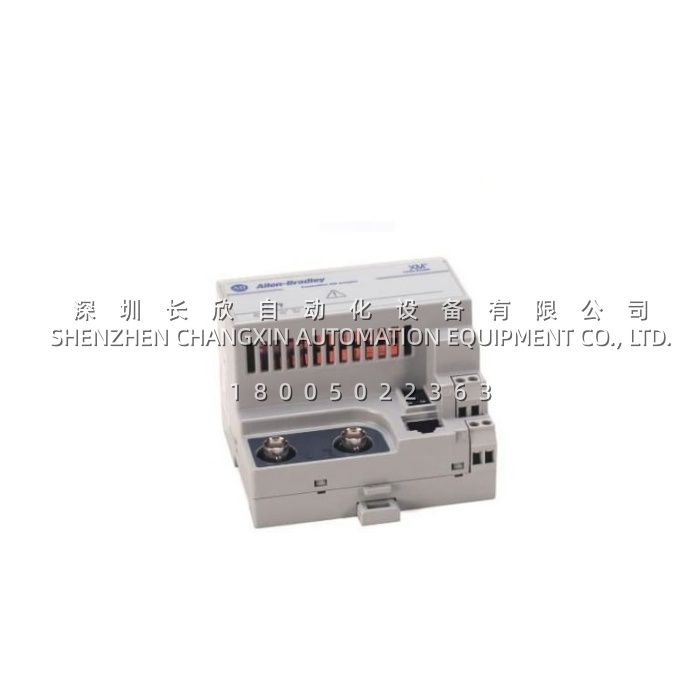
| Product Model | 1440-RMA00-04RC (XM-440) |
| Manufacturer | Allen-Bradley / Rockwell Automation |
| Series | Bulletin 1440 XM Series — Condition Monitoring and Machinery Protection |
| Product Type | Master Relay Module (relay output / voting logic module) |
| Required Terminal Base | XM-942 Master Relay Terminal Base, Cat. No. 1440-TB-C (keyswitch position 2) |
| On-board Relays | 4 relays, DPDT, 2 Form C contacts each |
| Relay Contact Rating | 250 V AC, 50/60 Hz, 3 A resistive; 150 V DC, 1.6 A |
| Expansion Capability | Up to 2 XM-441 Expansion Relay modules, raising total to 12 relays |
| Voting Logic | Independently configurable “A out of B” voting per relay, B up to 16 alarms/relays, A from 1 to B |
| Time Delay | Adjustable 0 to 25.5 seconds, in 100 ms increments |
| Failsafe Configuration | Normally energized (failsafe) or normally de-energized (non-failsafe), selectable |
| Latching | Latching or non-latching operation supported |
| Trigger Event Function | Broadcasts a trigger event signal to linked XM measurement modules to capture triggered trend data |
| Communication Protocol | DeviceNet (standard for all functions) |
| DeviceNet Baud Rates | 125 kbps, 250 kbps, 500 kbps |
| Serial Configuration | RS-232 via mini-connector or terminal base, fixed 19,200 baud |
| Network Addressing | Ships set to MAC ID 63 with autobaud; software configurable |
| Reset Methods | Local switch, remote switch via terminal base, or digital reset via serial or DeviceNet command |
| Supply Voltage | 24 V DC, Class 2 / SELV / PELV listed source |
| Current Consumption | 200 mA maximum |
| Power Dissipation | 3.4 W (11.6 BTU/hr) |
| LED Indication | Module status red/green, network status red/green, individual red LED for relays 1 to 4 |
| Operating Temperature | −20 °C to +65 °C (−4 °F to +149 °F) |
| Storage Temperature | −40 °C to +85 °C (−40 °F to +185 °F) |
| Relative Humidity | 95 % non-condensing |
| PCB Protection | Conformally coated printed circuit boards |
| Dimensions (H × W × D) | 97 mm × 94 mm × 94 mm (3.8 in × 3.7 in × 3.7 in) |
| Terminal Screw Torque | 0.6 N·m (7 lb-in) |
| Certifications | UL ordinary and Class I Division 2, CSA, ATEX, CE, C-Tick / Australian RCM, Korean KC |
| Country of Origin | United States |
| Lifecycle Status | Discontinued by Rockwell Automation on 31 December 2016; no planned replacement |
Main Features and Advantages
Voting logic instead of simple alarm mapping: The most valuable capability of the Allen-Bradley 1440-RMA00-04RC is that each of its four relays can be independently configured with “A out of B” voting logic, where B represents up to sixteen alarms or relay states drawn from across the XM network and A can be any number from one to B. This allows a plant to require, for example, two-out-of-three bearing vibration channels to be in alert before a trip relay operates — dramatically reducing spurious shutdowns while still delivering fast, deterministic protection when a genuine fault develops.Time delays that filter process transients: Each relay carries an adjustable delay from 0 to 25.5 seconds in 100 ms steps. On machinery where startup passes through a resonance region or where process upsets briefly push a measurement past its alert threshold, this adjustment is what distinguishes a protective trip from a nuisance trip.Failsafe behaviour chosen per application: Relays can be configured as normally energized or normally de-energized, and as latching or non-latching, so the 1440-RMA00-04RC can be matched to the safety philosophy of the installation — a de-energize-to-trip scheme will drop out on loss of power, while an energized-on-alarm scheme suits annunciation duty. Reset can be performed locally, from a remote switch wired to the terminal base, or by digital command over serial or DeviceNet, giving operators flexibility without forcing a cabinet visit.Triggered data capture across the network: When one or more relays activate, the Allen-Bradley 1440-RMA00-04RC can broadcast a trigger event to a defined group of XM measurement modules, instructing them to store triggered trend data. This is a genuinely useful diagnostic feature: the vibration and position waveforms surrounding a trip are preserved automatically, so root-cause analysis can begin with real data rather than with speculation.Expansion without additional network nodes: Up to two XM-441 Expansion Relay modules can be driven directly from the terminal base side connector, extending a single node from four to as many as twelve relays. Because the expansion modules inherit the master’s logic and functional controls, the added capacity costs no additional DeviceNet address and no additional PLC overhead.Serviceability in the field: The two-part design, combined with explicit support for removal and insertion under power, means a suspect 1440-RMA00-04RC can be swapped while the base remains wired — provided the hazardous-area precautions in the installation manual are respected.
Application Field
In rotating machinery protection, the Allen-Bradley 1440-RMA00-04RC consolidates the alarm and danger states produced by distributed XM measurement modules — vibration, axial position, speed and temperature — into unified physical trip circuits. On a large steam or gas turbine train, that means one module can supervise contacts feeding the emergency shutdown solenoid, the annunciator panel and the DCS alarm system, with each output carrying its own voting rule and delay rather than a single common trip.In compressor and pump services, 1440-RMA00-04RC is used to drive suction and discharge valve interlocks, lube-oil pressure permissive circuits and local audio-visual alarms, with the adjustable time delay preventing shutdown during normal startup transients. This is where the two-out-of-three style voting pays for itself: a single faulty accelerometer no longer removes a machine from service.In power generation, petrochemical, mining and pulp and paper plants, Allen-Bradley 1440-RMA00-04RC supports the classic centralized hardware-trip matrix architecture: a group of locally mounted XM modules each measure one machine, and the master relay module provides the plant-wide interlock layer wired directly into shutdown relays, breaker trip coils and burner management permissives, without routing every decision through a central PLC.The DeviceNet interface also makes it straightforward to bring the relay states and the underlying alarm data up to a ControlLogix controller, a FactoryTalk View operator interface or a third-party DCS, so that a hardware trip and its software record occur from the same event.Finally, because Rockwell discontinued the module at the end of 2016, a substantial share of current demand is life-cycle maintenance. Plants with installed XM-440 hardware procure 1440-RMA00-04RC as a critical spare to protect a working protection system against an unplanned component failure, and to buy time to plan a migration to a current architecture on their own schedule.
Related Products
1440-TB-C (XM-942 Master Relay Terminal Base) — The DIN-rail base unit that the 1440-RMA00-04RC plugs into. It carries all field wiring terminations, accepts the side connector for power, DeviceNet and expansion, and must have its keyswitch set to position 2 for the XM-440. The XM-440 is compatible only with this base.1440-REX00-04RD (XM-441 Expansion Relay Module) — The companion expansion module that adds four more DPDT relays, mounted on a 1440-TB-D terminal base immediately to the right of the master. Up to two can be used, taking the total relay count to twelve.1440-VST02-01RA (XM-120 Dynamic Measurement Module) — A two-channel dynamic measurement module for vibration, pressure and strain, with a tachometer input; one of the measurement modules whose alarm states are typically voted by 1440-RMA00-04RC.1440-SDM02-01RA (XM-124 Dynamic Measurement Module) — The successor dynamic measurement module in the XM-120 family, used for bearing condition assessment and general vibration monitoring on the same DeviceNet network.1440-SPD02-01RB (XM-220 Dual Speed Module) — A two-channel tachometer module measuring speed, rotor acceleration and peak speed, with zero-speed, locked-rotor and reverse-rotation detection; commonly paired with a master relay module for overspeed tripping.1440-TPS02-01RB (XM-320 Position Module) — A dual-channel position monitor accepting LVDT and proximity probe inputs for axial thrust position and valve stem position, providing the position alarms that the XM-440 consolidates into trip contacts.1440-TB-A / 1440-TB-B / 1440-TB-D (Terminal Bases) — The screw-clamp terminal bases used by the various XM measurement and expansion modules; note that the 1440-RMA00-04RC requires the 1440-TB-C specifically and must not be installed on other bases.1440-5AFUSEKIT — The fuse kit accessory for XM installations, used to provide the fused SELV or PELV supply required by the module’s power specification.