WhatsApp:+86 18005022363 WeChat: +86 18005022363
  Email:
Application Scenarios
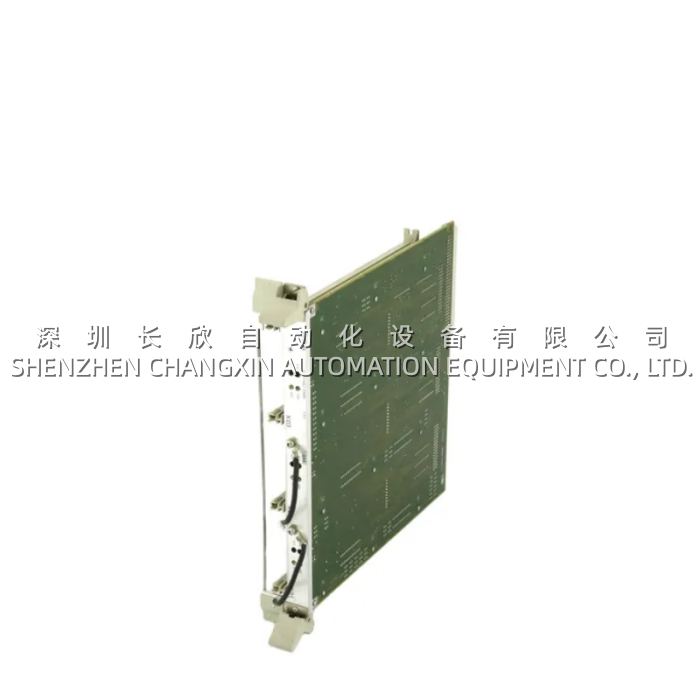
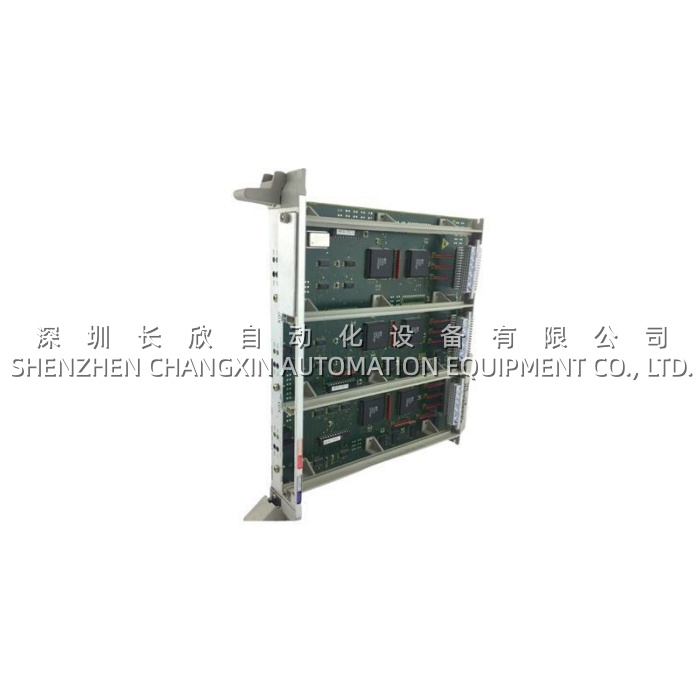
In an integrated steel mill’s hot-strip finishing train, the SIMADYN D control system manages over 30 individually driven rolls — from the looper tables through the laminar cooling section to the downcoiler. Each drive converter communicates with the central SIMADYN D processor via a dedicated protocol: PROFIBUS DP for the main drive converters, USS for the auxiliary pump inverters, and DUST for legacy roller-table controllers. To consolidate this heterogeneous communication landscape without consuming additional subrack slots, the mill’s automation architecture deployed the 6DD1662-0AB0 CS7 carrier module in the central SIMADYN D rack. One 6DD1662-0AB0 hosted an SS52 submodule running PROFIBUS DP on receptacle X01, an SS5 submodule handling USS on X02, and an SS4 submodule managing DUST on X03 — three independent serial communication channels in a single slot. When the original carrier began exhibiting intermittent L-bus errors after 19 years of continuous operation in the drive’s electronics room, the maintenance team needed an exact replacement to avoid re-architecting the communication hierarchy. Because the 6DD1662-0AB0 is a pure carrier — the communication submodules and their D7-SYS configuration remain untouched — the technician simply extracted the failing carrier via its handle, inserted a verified replacement, and re-seated the three submodule cards. The system was back online in under 15 minutes with zero reconfiguration. The two diagnostic LEDs per compartment (H10/H11, H20/H21, H30/H31) provided instant visual confirmation that each submodule was correctly initialized. This case illustrates why strategic spares stocking of the 6DD1662-0AB0 is non-negotiable for any plant running multi-protocol SIMADYN D systems: the carrier’s failure disables all three communication channels simultaneously, and with the module deleted without replacement by Siemens, the global installed base competes for a finite pool of verified original stock.
Parameter
| Main Parameters | Value/Description |
|---|---|
| Product Model | 6DD1662-0AB0 |
| Manufacturer | Siemens AG |
| Product Category | SIMADYN D Communication Carrier Module |
| Product Family | CS7 (6DD1662) |
| Module Function | Carrier for up to 3 communication submodules |
| Supported Submodules | SS4, SS5, SS52 |
| Receptacles | 3 (X01, X02, X03) |
| Dual-Port RAM | 16 KB per communication submodule (channel) |
| Supported Protocols | DUST, USS, PROFIBUS DP (via inserted submodule) |
| Backplane Interface | L-bus (L-Bus connection for serial protocols) |
| L-bus Interrupt | Possible (single module configuration; not used with SS4/SS5/SS52) |
| Diagnostic LEDs | 2 per compartment (H10/H11, H20/H21, H30/H31) |
| Test Sockets | 1 pair per receptacle (X10/X11, X20/X21, X30/X31) — reset/test purposes |
| Operating Temperature | 0 °C to +60 °C |
| Protection Class | IP20 (indoor cabinet installation) |
| Net Weight | 0.554 kg |
| Country of Origin | Germany |
| Mounting | Standard SIMADYN D rack slot |
| Lifecycle Status | PM500 — Discontinued since Oct 1, 2017, deleted without replacement |
| Commodity Code | 85389091 |
| ECCN | N / AL : N |
Technical Principles and Innovative Values
- Innovation Point 1: Triple-Submodule Density in a Single Rack Slot. The 6DD1662-0AB0 redefines communication expansion efficiency in SIMADYN D racks by hosting up to three independent communication submodules (SS4, SS5, or SS52) in one slot. This 3:1 slot consolidation means a single 6DD1662-0AB0 can simultaneously run PROFIBUS DP, USS, and DUST protocols — a capability that would otherwise consume three separate rack slots with individual carrier modules. In a SIMADYN D subrack with limited slot availability, this density advantage is often the deciding factor between a feasible communication architecture and an impossible one.
- Innovation Point 2: Dedicated 16 KB Dual-Port RAM per Channel. Each submodule inserted into the 6DD1662-0AB0 receives its own isolated 16 KB dual-port RAM buffer. This memory acts as a shared data exchange zone between the communication submodule and the SIMADYN D CPU via the L-bus — the CPU can read/write at any time while the submodule independently updates its contents. This parallel architecture eliminates data collisions, reduces latency, and offloads bit-level serial processing from the main CPU, ensuring deterministic communication performance even under heavy data traffic.
- Innovation Point 3: L-Bus Integration for Zero-Latency Data Exchange. The 6DD1662-0AB0 connects to the SIMADYN D processor via the L-bus — Siemens’ high-speed local bus architecture. This direct backplane integration ensures that serial communication data reaches the control core without traversing slower system buses or requiring protocol gateway modules. The L-bus interrupt capability (available in single-module configuration) further enables event-driven communication synchronization, allowing the CPU to respond to submodule events with microsecond-level latency.
- Innovation Point 4: Per-Compartment Diagnostic LED Architecture. The 6DD1662-0AB0 features two diagnostic LEDs per submodule compartment (H10/H11 for X01, H20/H21 for X02, H30/H31 for X03). This granular visual diagnostics capability allows maintenance technicians to instantly identify which specific submodule — or the carrier itself — is experiencing faults without software tools or network analysis. Combined with the test sockets (X10/X11, X20/X21, X30/X31) for reset and test purposes, the 6DD1662-0AB0 transforms fault isolation from a time-consuming diagnostic session into a 30-second visual check.
- Innovation Point 5: Protocol-Agnostic Carrier Philosophy. Unlike fixed-function communication processors, the 6DD1662-0AB0 is protocol-agnostic — its communication capability is determined entirely by the submodule inserted. This design future-proofs the carrier: as Siemens introduced new SS-series submodules over the years (SS4 → SS5 → SS52), the same 6DD1662-0AB0 carrier remained compatible, protecting the customer’s initial hardware investment across decades of SIMADYN D evolution. A carrier installed in 1995 could still host a modern SS52 PROFIBUS submodule in 2017.