WhatsApp:+86 18005022363 WeChat: +86 18005022363
  Email:
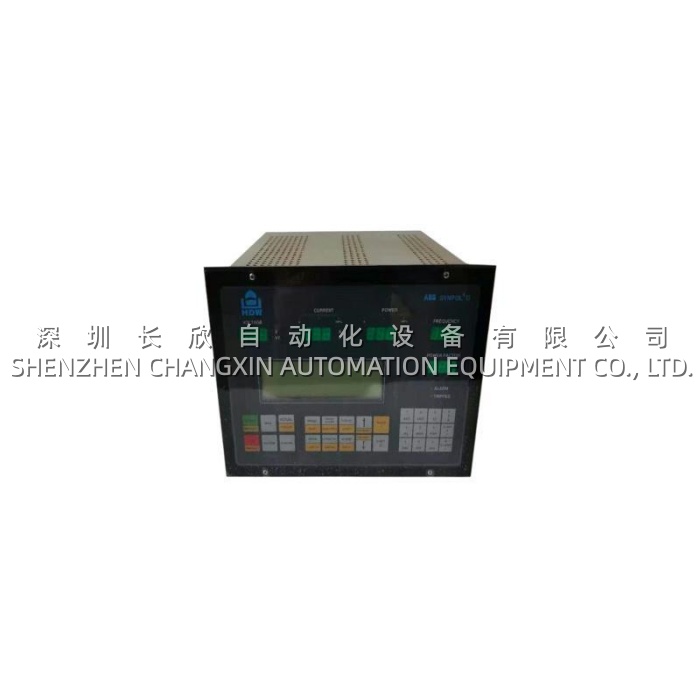
Application ScenariosA 55 MW diesel-electric propulsion package on a North Sea PSV runs ABB SYNPOL D drives on the main thrusters and two 2.5 MW generator sets. The SYNPOL D cubicles sit in the E-deck machinery space, 40 m from the bridge CCR — every time the chief engineer wanted to tweak the pitch-controller gain during bollard-pull trials, the ETO had to call the bridge to “watch the CCR screen” and read back PV/SP over the sound-powered phone. The retrofit added a CMA120 (3DDE300400) in each SYNPOL D cubicle door: 144×82 mm cutout, rubber seal, 4× clamp screws. The CMA120‘s MOD 300 serial port lands on the Basic Controller’s COM link, and the film keys give MAN / AUTO / CAS, ↑↓ numeric, ENTER, ESC, and ACK — enough to trim SP, force DO for thrust-actuator test, and clear the “thyristor-fan-fail” alarm without opening the door (salt-air + open cabinet = bad idea). The ETO noted post-install: “We still do the deep tuning from the CCR, but for sea-trial gain bumps, the CMA120 saves us two trips per trial up and down the ladder. The film keys are stiff in cold weather but they work with gloved hands — a touchscreen wouldn’t.” This case captures the CMA120‘s sweet spot: it’s the pre-touchscreen workhorse for machinery-space doors where gloves, spray, and vibration kill capacitive screens, and where you just need PV/SP/ACK, not a full 800xA faceplate.Parameter
| Main Parameters | Value/Description |
|---|---|
| Product Model | CMA120 (Order Code: 3DDE300400) |
| Manufacturer | ABB (MOD 300 / Advant OCS / SYNPOL D family) |
| Product Category | Basic Controller Panel (door-mount local HMI) |
| Compatible Systems | MOD 300 Basic Controller, Advant OCS (via serial), SYNPOL D, small standalone PLC contexts |
| Display / Keypad | Character/graphic LCD + sealed film membrane (↑↓, ENTER, ESC, MODE Man/Auto/Cas, ACK) |
| Digital Input | 8 ch, 24 V DC sink (photocoupler isolated) |
| Analog Input | 4 ch, 4–20 mA or 0–10 V DC (software-select, 12-bit) |
| Relay Output | 2 ch, NO/NC, 5 A @ 250 V AC / 5 A @ 30 V DC (resistive) |
| Communication | MOD 300 serial (to Basic Controller) + RS-485 (Modbus RTU, 9600–19200 bps, optional Profibus DP on some revs) |
| Supply Voltage | 24 V DC (18–30 V DC tolerance), typical 5–8 W |
| Protection | Front: IP65 / NEMA 4X; Rear/terminal side: IP20 |
| Mounting | Cabinet door cutout, 4× screw + rubber seal (standard ~144×82 mm, some revs 190×145 mm) |
| Operating Temp | 0°C to +55°C (front exposed); -20°C to +60°C some batches |
| Weight / Depth | ~0.3 kg; rear box depth ~40–60 mm (check cutout clearance before order) |
Technical Principles and Innovative Values
- Innovation Point 1: Cabinet-Door Form Factor with IP65 Front / IP20 Rear Split. The CMA120 is not a DIN module — it’s a door insert. The front bezel (LCD + film keys) sits outside the cabinet door, sealed by a molded rubber gasket compressed against the cutout lip; the rear box (terminals + PCB) hangs inside the cabinet. This split gives IP65 outside (hosedown, salt spray, cement dust) while the terminal side stays IP20 because it’s behind the door. For SYNPOL D cubicles on deck or MOD 300 racks in a pulp washer bay, this form factor means “local HMI without a local HMI enclosure” — you use the existing cubicle door as the enclosure.
- Innovation Point 2: Dual Personality — MOD 300 Serial + RS-485 Modbus RTU. The CMA120 speaks two languages: the MOD 300 proprietary serial link to a Basic Controller (one cable, 24 V DC power + data paired, no separate PSU needed — the Basic Controller feeds it), and a standard RS-485 A/B/GND for Modbus RTU to a third-party PLC or a small standalone context. This dual-path design means the CMA120 can serve as (a) a genuine MOD 300 local panel, or (b) a generic RS-485 “dumb terminal” with 8DI/4AI/2DO hanging off it for a pump-skid stand-alone. One spare part covers both roles.
- Innovation Point 3: Film-Key Ergonomics for Gloved Hands. Unlike a touchscreen (which hates rain, gloved hands, and diesel soot), the CMA120‘s membrane has raised tactile domes under the film — ↑↓ numeric, MODE (Man/Auto/Cas toggle), ACK for alarm clear, ENTER/ESC. The key travel is long enough to feel through a latex glove, and the film is chemical-resistant (diesel, hydraulic oil, bleach wash). ABB designed this for machinery-space ETOs, not office operators.
- Innovation Point 4: What It Doesn’t Try to Be. The CMA120 is intentionally minimal: no Ethernet, no 800xA Web, no trend curves, no color graphics. It shows PV / SP / MODE / ALARM TEXT — that’s it. This constraint is the reason it’s still alive 30 years later: no OS to patch, no browser to crash, no SD card to corrupt. For a SYNPOL D door or a MOD 300 pump-bay panel, “it turns on and shows the SP” is 90% of the requirement.
Application Cases and Industry ValueCase 1 — Municipal Booster Pump Station, 6 × 450 kW. The station runs MOD 300 Basic Controllers on the 6 pumps (lead/lag/alternate logic). Original design had no local panel — every SP trim or alarm-ACK meant walking to the CCR 300 m away or opening the MCC door (which the area supervisor discouraged because the VFD bay is 4160 V). The retrofit cut a CMA120 (3DDE300400) into each pump-bay MCC door: MOD 300 serial to the Basic Controller, 24 V DC tapped from the MCC’s 24 V distribution. The film keys let the operator ACK the “suction-well-low” alarm and bump the lead-pump SP from 3.2 bar to 3.6 bar during peak without opening the door. The station chief: “The CMA120 cost €340 each. One less ‘walk to CCR for a 0.2 bar bump’ per shift = 12 minutes saved × 3 shifts × 365 = 22 hours/year of operator time. Math is stupidly easy.”Case 2 — Cement Plant Raw-Mill Duct Damper, Southeast Asia. The raw-mill exhaust fan’s inlet damper is MOD 300-controlled (AO → damper actuator, AI ← position feedback). The CCR is 200 m away across the preheater tower, and during mill-start sequences the panel operator often needed to “jog” the damper 2% open to stabilize draft — but the 4–20 mA loop had a 1.5 s delay over the old MB300 link, and the CCR faceplate’s “fine adjust” was coarse. The plant added a CMA120 on the damper-local cubicle door (right next to the actuator cal jack). The CMA120 landed on the Basic Controller’s COM port, showed AO raw value and AI position on the LCD, and the ↑↓ keys let the tech trim ±0.5% in real time during start. “The CMA120 didn’t replace the CCR — it just gave us ‘hands on the damper’ during the 90-second start window. Before that we were guessing from the CCR.”Related Product Combination SolutionsThe CMA120 (3DDE300400) sits in the MOD 300 / Advant / SYNPOL D ecosystem; here are the natural siblings:
- MOD 300 Basic Controller (BC) CPU – The host that the CMA120‘s MOD 300 serial port talks to; if you’re buying CMA120 spares, you’re maintaining a BC rack somewhere.
- AC450 / AC410 (Advant Controller) – The Advant-family big brother; the CMA120 can also hang off an Advant node via serial in smaller installations (not the primary HMI — that’s MasterView — but a local door panel).
- SYNPOL D Drive Controller – ABB’s thruster/pitch drive line (marine); the CMA120 is a common door-panel match for SYNPOL D cubicles.
- 3BHT410082R0001 (Advant Bus Extender) – Covered in the prior query; if your CMA120 is on an Advant node and the door is >500 m from the controller, you’ll need the bus extender between.
- YPK107E (3ASD489301A410) – Also covered prior; the 16-relay DO card that might sit in the same MOD 300/Advant rack behind the CMA120 door.
- S100 I/O (Advant/MOD 300 rack I/O) – The local I/O the CMA120‘s 8DI/4AI might shadow or supplement; in larger installs the CMA120 is just the HMI, and S100 DI/AI live in the rack.