WhatsApp:+86 18005022363 WeChat: +86 18005022363
  Email:
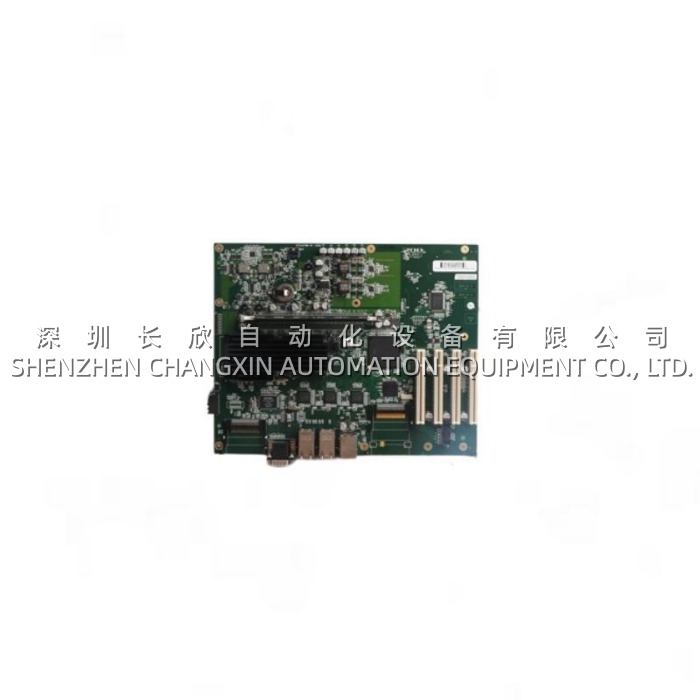
Technical Specifications
| Parameter Name | Parameter Value |
|---|---|
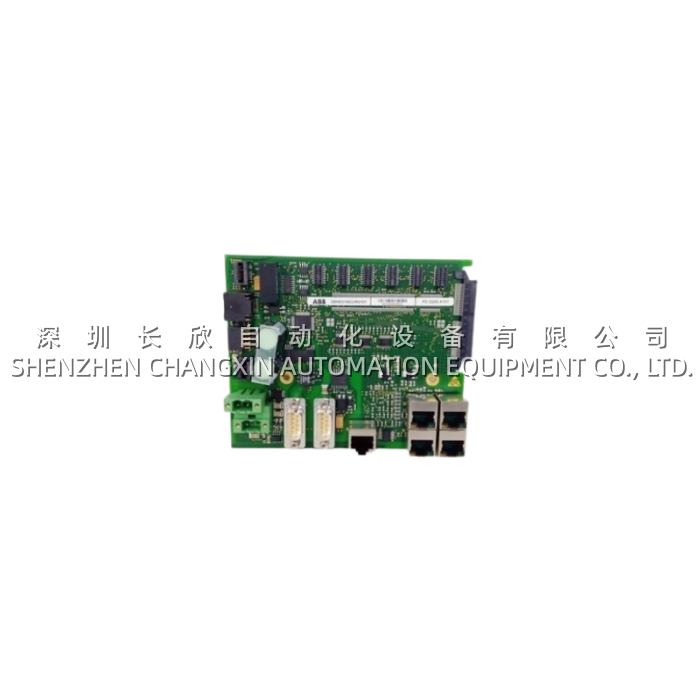
| Product Model | 3BHE015619R0001 (Alternate: XVD825A01) |
| Manufacturer | ABB (Drives / Semiconductors Division) |
| Product Type | DC-Link Voltage Divider / Sensing PCB |
| Platform | ABB ACS6000 / ACS5000 MV Drive (3-Level NPC) |
| Input (Sense) | DC-link positive & negative busbars, working voltage up to ~10 kV DC (drive-tier dependent: 3.3 kV / 4.16 kV / 6.6 kV class) |
| Divider Ratio | High-ohmic resistor network, scaled to AMC AI range (typ. 0–10 V or ±10 V output, verify per drive BOM) |
| Output | Isolated low-voltage analog to AMC controller (via on-board isolation amp or hybrid) |
| Accuracy | ±1% full-scale typical (DC-link voltage regulation critical for flux-vector) |
| Isolation Voltage | > 10 kV working, > 15 kV transient (between HV divider and LV output/controller side) |
| Mounting | DIN-clip or standoff in ACS6000/5000 power cubicle, near DC-link busbar |
| Connectivity | HV sense: 2× to DC+ / DC− busbar (screw terminal); LV out: multi-pin header/ribbon to AMC or intermediate interface |
| Operating Temperature | 0 °C to +55 °C (cabinet ambient; PCB components rated higher) |
| Storage Temperature | –40 °C to +85 °C |
| Humidity | 5%–95% RH, non-condensing |
| Protection | Conformal-coated PCB, creepage-optimised layout, HV resistor standoff |
| Dimensions (approx.) | ~120 × 80 × 25 mm (PCB only, resistors add height) |
| Weight | ~0.3–0.5 kg |
Main Features and Advantages
High-voltage divider designed for MV drive duty. The 3BHE015619R0001 uses a cascade of high-ohmic metal-film or thick-film resistors (total resistance in the MΩ range) to scale a ~9 kV DC-link down to ~10 V for the AMC. The resistor network is selected for low temperature coefficient (so the DC-link reading doesn’t drift 2% between winter and summer in an ID-fan cubicle) and for surge withstand — a regenerative braking event on a downhill conveyor or a hoist deceleration can push the DC-link 15–20% above nominal for seconds, and the divider must not arc or drift. The XVD825A01 layout provides >10 mm creepage per kV (per IEC 60664) on the HV side, with the divider resistors standing off the PCB to avoid surface tracking.Galvanic isolation between HV and LV sides. The 3BHE015619R0001 incorporates an isolation amplifier or opto-isolated transmit section so that the AMC’s 5 V / 24 V analog input side is completely floating from the DC-link. This matters because the DC-link is referenced to the drive’s main-earth scheme, which may differ from the AMC’s control-earth (especially on retrofits where the drive cubicle earth and the DCS room earth have different potentials). The isolation also protects the AMC from a divider-resistor failure — if one resistor in the chain arcs, the isolation barrier contains the event to the HV side; the AMC side sees an open-circuit (reads 0 V or rail) and trips “DC-Link Meas Failure,” not “AMC destroyed.”Enables three critical drive functions. First, pre-charge supervision: when an ACS6000 powers up, the DC-link charges through pre-charge resistors and a soft-start contactor; the 3BHE015619R0001 feeds the rising DC-link voltage to the AMC, which releases the main contactor only when DC-link reaches ~90% of nominal (e.g., ~8.4 kV on a 9.3 kV link). Without the XVD, the AMC blind-guesses and either closes the main contactor too early (inrush trips the upstream breaker) or too late (unnecessary wear on pre-charge resistors). Second, flux-vector regulation: in sensorless vector mode, the AMC estimates stator flux partly from DC-link voltage; an inaccurate DC-link reading shows up as torque ripple at low speed. Third, overvoltage protection: during regenerative braking (hoist lowering, fan windmilling), the DC-link climbs; the XVD825A01 lets the AMC ramp back the torque or activate the brake chopper before the IGCTs see destructive overvoltage.Compact, conformal-coated, cubicle-native. The 3BHE015619R0001 is a small PCB — roughly palm-sized — that tucks onto a DIN clip inside the power cubicle, away from the main airflow but within sense-lead length of the DC-link busbars. Conformal coating (typically polyurethane or silicone) protects against the oily / humid air that fills MV drive rooms in pulp mills, desalination plants, and marine engine rooms. The “A01” revision (vs. earlier A00 or later Bxx) typically reflects component-value tweaks for a specific drive voltage tier or AMC AI range — matching the revision to your existing cubicle matters (see BOM caution below).
Application Field
The 3BHE015619R0001 lives exclusively inside ACS6000 and ACS5000 cubicles, so its “application field” is really “anywhere those drives run.” A 660 MW coal unit’s FD and ID fans on ACS5000 (air-cooled, 4160 V): each drive has one XVD825A01 monitoring the DC-link. During a monsoon brownout, the grid side sags, the fan motor regenerates into the DC-link, and the voltage climbs toward the overvoltage trip. The 3BHE015619R0001 feeds the real-time DC-link value to the AMC, which backs off the torque request to the IGCTs and engages the brake chopper (if fitted) — trip avoided. If the XVD itself drifts +3% (one divider resistor ageing), the AMC thinks DC-link is 9.6 kV when it’s actually 9.3 kV, and it may trip “DC Overvol” prematurely during every monsoon windmill event — spurious trips that the electrical team chases for weeks before someone thinks to calibrate the XVD.In mining, a 5 MW hoist on ACS6000 (water-cooled, 3.3 kV or 6.6 kV): the 3BHE015619R0001 is doing pre-charge supervision every start (the hoist starts 20× per shift on a busy cycle). A failing XVD that reads 5% low will cause the AMC to hold the main contactor open too long — the pre-charge resistors cook (they’re rated for ~30 seconds continuous, not 3 minutes), and the hoist misses a skip exchange. On a double-drum winder doing 2000 cycles/day, that’s ore throughput lost. The maintenance team’s standard: if the drive logs “Pre-charge Timeout” twice in a week on the same cubicle, swap the 3BHE015619R0001 before blaming the pre-charge resistors.Marine Azipod (ABB, ACS6000 heart): the XVD825A01 monitors the DC-link of the pod’s inverter section. Classification society surveys (DNV, Lloyd’s) periodically verify that the DC-link measurement chain is intact — the XVD is part of that chain. A drifting XVD can cause a “DC-Link Meas Discrepancy” between the pod’s AMC and the bridge-side DC-backup monitor, which becomes a survey finding. Keeping a cold-spare 3BHE015619R0001 onboard (in the E&I store, moisture-barrier packed) is standard practice on LNG carriers and cruise vessels.Retrofit / life-extension: plants with ACS6000 commissioned 2005–2010 are now seeing the first XVD825A01 failures — not the divider resistors (those are stable for decades if not arced), but the isolation amp hybrid or the LV-side op-amp drifting. A plant may proactively replace all XVD boards in a 4-drive bay during a turnaround — 4 × 3BHE015619R0001 — because the labour to open the cubicle once and swap all four is less than opening four times over two years. Specialist-surplus with a calibration check (divider ratio verified against a HV-calibrator) is the usual source, since ABB’s new lead on 3BHE codes in this tier can be 12+ weeks.