WhatsApp:+86 18005022363 WeChat: +86 18005022363
  Email:
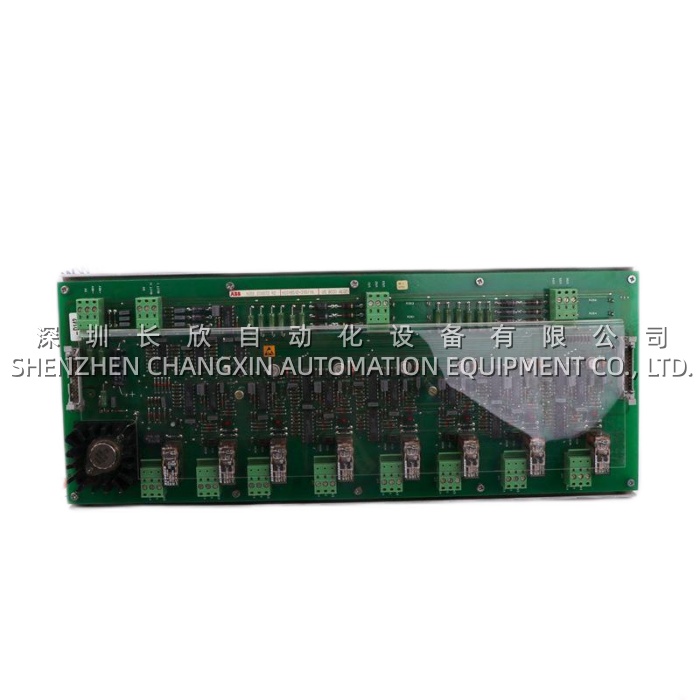
Application ScenariosA 420 MW hydroelectric plant in the Alps runs two UNITROL 6000 static exciters on its main generators. Every summer thunderstorm season, the plant’s DCS (800xA) would log sporadic “PROFIBUS slave dropout — Exciter A, Interface Card” alarms — three to five drops per storm, each forcing the unit onto manual excitation for the 90 seconds it took the card to re-sync. Root-cause analysis pointed to the old interface board’s 500 V channel isolation being borderline for the cabinet’s grounding layout (the exciter cubicle shares a building ground with the station service 400 V distro, and lightning-induced ground rise was coupling into the PROFIBUS shield). The retrofit swapped in a UFC760BE143 (3BHE004573R0143): the UFC760BE143 carries 1000 V AC continuous isolation between all field-signal circuits and internal logic, plus a full G3 conformal coating that shrugs off the valley’s high-humidity/sulfated-air environment. More importantly, the UFC760BE143‘s dual independent PROFIBUS DP ports let the techs loop the 800xA onto Port A and a portable FBUS diagnostics tablet onto Port B simultaneously — something the old single-port card couldn’t do. Post-install, through two thunderstorm seasons, zero PROFIBUS dropouts logged. The plant’s E&I lead noted: “The UFC760BE143 is the only interface board in the ABB catalog that gives you Masterbus300 + dual PROFIBUS + 1000 V isolation in one AC800PEC slot. Once you’ve had a storm-night exciter trip, you don’t spec anything else.”
Parameter
| Main Parameters | Value/Description |
|---|---|
| Product Model | UFC760BE143 (Order Code: 3BHE004573R0143) |
| Manufacturer | ABB (AC800PEC / UNITROL 6000 Family) |
| Product Category | Signal Interface PC Board (Excitation / Power Electronics) |
| Compatible Hosts | UNITROL 5000/6000 excitation cabinets; ACS6000 MV drive racks; PPC907BE CPU subrack |
| Digital Inputs | 16 galvanically isolated 24 V DC sinking/sourcing (breaker, interlock, fan status, etc.) |
| Analog Outputs | 8 configurable isolated test/trim AO (4–20 mA or 0–10 V) for field trim / calibration |
| Primary Control Bus | Masterbus300 fiber-optic, sub-1 ms deterministic loop to PPC907BE CPU |
| Fieldbus Uplinks | Dual independent PROFIBUS DP-V1; isolated RS-485 Modbus RTU slave |
| Supply Voltage | 24 V DC ±10% (AC800PEC subrack backplane) |
| Power Draw | ~5.5 W typical / 8 W max |
| Galvanic Isolation | 1000 V AC continuous (field signals ↔ logic ground) |
| Environmental Protection | Full G3 conformal coating (coastal/humid/chemical atmosphere rated) |
| Hot-Swap | AC800PEC certified; excitation regulation maintains stable output during swap |
| Diagnostics | Per-channel open/short detect; fiber-link loss alarm; PROFIBUS slave-dropout LED; backplane UV watchdog |
| Mechanical | Single-width subrack PCB, W 22.5 × H 108 × D 114.5 mm; ~0.54 kg |
| Operating Temp | -10°C to +55°C (full rated accuracy) |
Technical Principles and Innovative Values
- Innovation Point 1: Masterbus300 Fiber to PPC907BE CPU. The UFC760BE143 isn’t a standalone controller — it’s the field-front-end for the AC800PEC rack. All 16 DI and 8 AO land on the UFC760BE143, get conditioned, then serialize onto the Masterbus300 fiber ring (≤ 1 ms cycle) to the PPC907BE CPU that runs the AVR PID and firing-angle logic. This separation — field I/O on UFC760BE143, control law on PPC907BE — means a noisy breaker auxiliary contact can’t inject ground bounce into the CPU’s analog measurement section. The fiber link also kills the ground-loop path that plagues copper-backplane designs in multi-cubicle exciters.
- Innovation Point 2: Dual Independent PROFIBUS DP-V1 Ports. Unlike the older single-PROFIBUS interface boards (which forced a TAP or repeaters if you wanted diagnostics access), the UFC760BE143 carries two fully independent DP slaves, each with its own address space. Port A goes to the plant DCS (800xA, Symphony, etc.) for real-time excitation data (generator V, I_f, firing angle, limiter status); Port B can hang a portable FBUS tablet, a second DCS ring, or a history logger. This dual-port architecture is why the UFC760BE143 is the go-to for retrofits where the original single-port card became a cabling bottleneck.
- Innovation Point 3: 1000 V AC Isolation + G3 Conformal in a 22.5 mm Subrack Slot. The UFC760BE143 is built for the exciter cabinet environment — not a climate-controlled DCS room. The G3 coating (per ISA-71.04) resists sulfur vapor from nearby 400 V switchgear and salt air in coastal plants, while the 1000 V AC isolation rating (versus 500 V on the earlier interface generation) gives headroom for ground-rise events during faults or lightning. In a hydro plant where the exciter cubicle sits two floors below the generator breaker (and the station ground mat sees 80 V rise during a line-to-ground fault), that extra 500 V margin matters.
- Innovation Point 4: Hot-Swap Without Dropping Excitation. The UFC760BE143 is AC800PEC-certified hot-swappable: the subrack backplane holds the last-I/O state via the PPC907BE’s redundancy, and the UFC760BE143 re-syncs Masterbus300 within ~2 seconds of insertion. The AVR loop (running on PPC907BE) never drops — critical because “pull the interface card = excitation trip” is not acceptable on a synchronized generator. ABB recommends redundant PPC907BE + redundant UFC760BE143 for any unit where manual excitation during swap isn’t acceptable (i.e., most grid-connected machines).
Application Cases and Industry ValueCase 1 – Coal-Fired 600 MW Unit, Eastern Europe. The unit’s UNITROL 6000 ran an older single-PROFIBUS interface that also handled the 8 analog trim outputs for the manual/auto transfer test. During a turbine CV (control valve) calibration, the DCS engineer needed simultaneous visibility to excitation data on 800xA and a standalone trend recorder for the compliance report — the single-port card couldn’t serve both. The outage swapped to a UFC760BE143 (3BHE004573R0143): Port A = 800xA (original node addr), Port B = trend recorder. The G3 coating also helped — the plant’s switchgear yard is 80 m from the exciter building, and sulfide from the coal pile occasionally drifts into the cabinet bay; the previous board’s uncoated version had shown green creep corrosion on the DI header after 4 years. 18-month follow: zero corrosion callback, and the dual-PROFIBUS saved a second outage when the 800xA node went offline for a switch upgrade — the trend recorder stayed live on Port B and caught a V/Hz limiter event that the ops team otherwise would have missed.Case 2 – Geothermal Cogeneration Plant, Southeast Asia. The two 55 MW units run ACS6000 MV drives on the extraction steam turbo-feeders, with UFC760BE143 as the interface between the ACS6000’s AC800PEC rack and the plant’s Symphony DCS. The original interface board (an earlier UFC760BE revision without G3) failed twice in 14 months — the plant’s geothermal vent gas carries trace H₂S, and the non-coated DI header pins sulfided shut, causing “breaker-closed” status to stick false. The UFC760BE143‘s G3 coating + 1000 V isolation solved it; 26 months in, the DI header still reads clean. The panel tech: “The UFC760BE143 costs maybe 15% more than the non-G3 version. When your H₂S eats a header in 18 months, that 15% looks cheap.”