WhatsApp:+86 18005022363 WeChat: +86 18005022363
 Email:

Technical Specifications
| Parameter Name | Parameter Value |
|---|---|
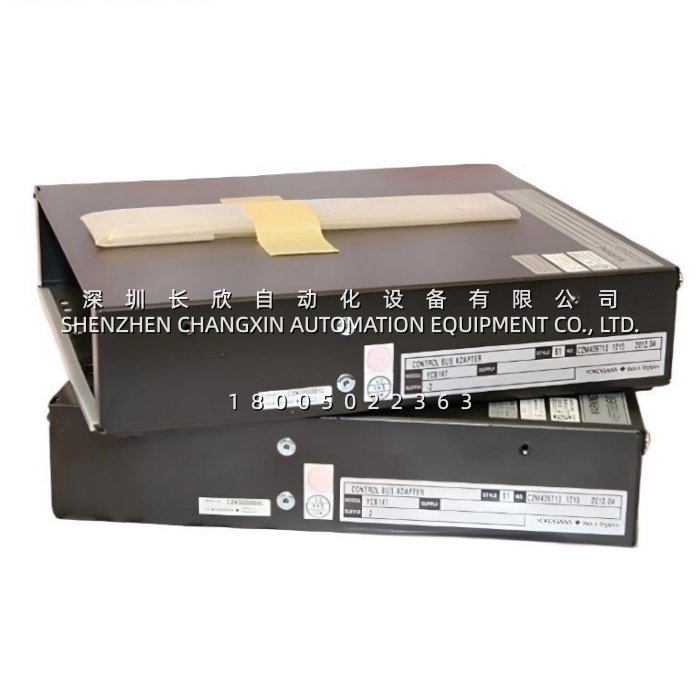
| Product Model | YCB147-2 |
| Manufacturer | Yokogawa Electric Corporation, Japan |
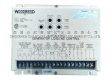
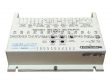
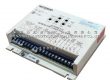
| Product Type | Control Bus Cable Conversion Adapter |
| System Platform | CENTUM CS 1000 / CENTUM CS 3000 / CENTUM VP |
| Host Bus Family | V net control bus |
| Cable Standards Bridged | 10BASE-5 (N-type thick coax) ↔ 10BASE-2 (BNC thin coax) |
| Connector Configuration | 2-connector variant (non-explosion-protection type) |
| Characteristic Impedance | 50 Ω coaxial environment |
| Operating Mode | Passive conversion — no external power supply required |
| Termination Support | Works with YCB118 / YCB148 V net terminators |
| Compatible Cables | YCB111 (10BASE-5, up to 500 m) / YCB141 (10BASE-2, up to 185 m) |
| Mounting Option | Panel mount, or /BR General-purpose Rack Mountable Type |
| Operating Temperature | 0 to +55 °C (cabinet environment) |
| Storage Temperature | −20 to +70 °C |
| Ambient Humidity | 5 to 95 % RH, non-condensing |
| Ingress Protection | IP20 — for installation inside control cabinets |
| Housing | Industrial metal enclosure with EMI/RFI shielding |
| Country of Origin | Japan |
Main Features and Advantages
Genuine passive reliability: The Yokogawa YCB147-2 contains no active electronics — no power terminals, no firmware image, no configuration database, no diagnostic cycle. A passive adapter cannot suffer a supply-rail failure, cannot lose its settings during a cabinet outage, and cannot be reconfigured incorrectly by an operator. This absence of failure modes is exactly why Yokogawa specified a passive conversion element for the V net physical layer: the adapter simply presents the right connector geometry and the right impedance, and the bus behaves identically on both sides of it.
Impedance matching that protects the V net: The V net runs a 10 Mbps token-ring protocol with Manchester encoding over Yokogawa-specified coaxial cable, and its electrical rules are stricter than commodity Ethernet even though the 10BASE-5 and 10BASE-2 designations are borrowed from Ethernet terminology. The YCB147-2 maintains the 50-ohm coaxial environment across the transition, and when deployed together with the YCB118 (for 10BASE-5) or YCB148 (for 10BASE-2) terminator, it prevents the standing-wave reflections that otherwise manifest as intermittent communication timeouts, frozen operator screens, and synchronization alarms on the FCS.
Seamless mixed-cable topology: Many mature CENTUM installations have grown organically — a thick-coax 10BASE-5 trunk may run long distances between buildings while thin-coax 10BASE-2 segments serve the local cabinet cluster, because 10BASE-5 supports runs up to 500 m while 10BASE-2 covers up to 185 m. The Yokogawa YCB147-2 is the factory-sanctioned component that lets these two cable standards coexist on the same V net trunk, allowing the plant to optimise cost and reach without violating the electrical envelope of the bus.
Clean mechanical integration: The adapter’s compact industrial housing is designed for cabinet installation, and the optional YCB147-2 /BR General-purpose Rack Mountable Type variant provides a tidy 19-inch rack mounting solution that keeps the conversion point accessible for inspection while protecting it from mechanical strain. Double-shielded coaxial construction and a metal enclosure support the EMI/RFI environment of a live DCS cabinet.
Lifecycle continuity: The YCB147-2 is engineered specifically for the CENTUM CS and CENTUM VP ecosystem, so it integrates without adapters-of-adapters, custom splices, or improvised BNC-to-N baluns. For plants that must extend the life of a proven Yokogawa DCS rather than re-engineer the bus, the YCB147-2 is the component that matches the original specification exactly.