WhatsApp:+86 18005022363 WeChat: +86 18005022363
 Email:

Application Scenarios
A chemical blending skid uses four 4–20 mA level transmitters and two ±10 VDC pressure sensors from different vendors, each with its own grounding scheme. A standard multiplexed analog module would force all six signals to share a common reference, introducing ground-loop errors that drift with pump load. The 1756-IF6I isolates each channel from the backplane and from every other channel at 250 V continuous , so the 4–20 mA loops and the voltage sensors coexist without interaction. When one transmitter’s field wiring develops a ground fault, the fault is confined to that channel; the remaining five continue reporting accurate values, and maintenance can isolate the problem without shutting down the blend sequence.
Parameter
| Parameter | Value/Description |
|---|---|
| Product Model | 1756-IF6I |
| Manufacturer | Allen-Bradley / Rockwell Automation |
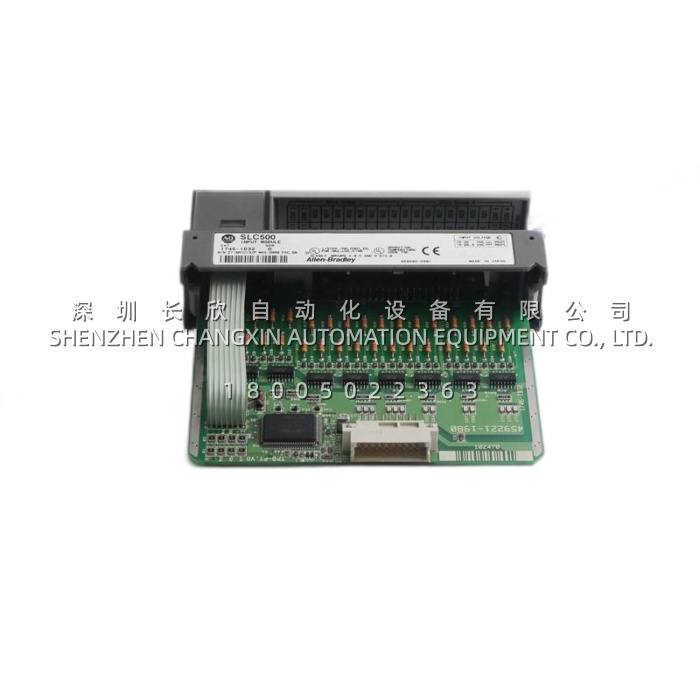
| Product Category | ControlLogix Isolated Analog Input Module |
| Inputs | 6, individually isolated |
| Input Ranges | ±10 VDC, 0–10.5 VDC, 0–5.25 VDC, 0–21 mA |
| Resolution | 16-bit (343 µV/bit at ±10 V; 0.34 µA/bit at 0–21 mA) |
| Calibrated Accuracy | Better than 0.1% of range @ 25°C |
| Isolation | 250 V continuous, channel-to-channel and channel-to-backplane |
| Conversion Method | Sigma-Delta |
| Channel Bandwidth | 15 Hz |
| Common Mode Rejection | 120 dB @ 60 Hz; 100 dB @ 50 Hz |
| Backplane Current | 250 mA @ 5.1 VDC; 100 mA @ 24 VDC |
| Data Formats | Integer (2’s complement) or IEEE 32-bit floating point |
| Operating Temperature | 0°C to +60°C |
Technical Principles and Innovative Values
Innovation Point 1: True Per-Point Isolation, Not Just Field-to-Backplane. Most analog modules isolate the field side from the backplane as a group. The 1756-IF6I goes further: each of its six inputs is isolated from the other five as well as from the backplane . This matters when a panel mixes transmitters powered from separate supplies or when a single sensor’s ground reference sits at a different potential than its neighbors. The isolation barrier prevents circulating currents from corrupting low-level measurements.
Innovation Point 2: Configurable Voltage and Current on Every Channel. Each channel of the 1756-IF6I can be independently set to ±10 V, 0–5 V, 0–10 V, or 0–20 mA through the Logix Designer configuration . A single module can therefore serve a mixed sensor population without external signal conditioners. The module’s actual usable range extends slightly beyond the nominal settings—0–5.25 V and 0–21 mA—which allows detection of over-range conditions without clipping .
Innovation Point 3: Float Mode Unlocks the Full Feature Set. The 1756-IF6I operates in either integer or floating-point data format. Integer mode supports multiple ranges, notch filtering, and real-time sampling, but floating-point mode adds digital filtering, process alarms, rate alarms, and engineering-unit scaling . The rate alarm, in particular, can flag a transmitter that is drifting faster than a defined threshold—a capability that integer mode simply does not offer.
Application Cases and Industry Value
A pharmaceutical manufacturer in the U.S. Northeast used 1756-IF6I modules to monitor differential pressure across sterile filters in a vaccine production suite. The transmitters were 4–20 mA devices from two different vendors, installed on skids with separate power supplies. The module’s per-channel isolation prevented a ground potential difference between the skids from appearing as a false pressure offset. When one transmitter’s cable shield accidentally contacted a grounded conduit, the fault produced an out-of-range reading only on that channel; the other five filters continued monitoring without interruption. The maintenance team traced the fault to the cable within minutes, and the batch was completed without a deviation report.
In a European steel mill, an integrator used the 1756-IF6I to acquire load cell signals on a rolling mill tension stand. The load cells were wired in a full-bridge configuration with excitation from an external supply, while adjacent channels monitored ±10 VDC position feedback from the mill’s hydraulic cylinders. The module’s 120 dB common-mode rejection at 60 Hz suppressed the mill’s heavy electrical noise environment, and the per-channel isolation kept the load cell circuit independent from the position sensors. The integrator noted that the float mode’s digital filter was set to 10 Hz for the load cells, smoothing the tension readings enough for the controller’s closed-loop response without introducing unacceptable lag.