WhatsApp:+86 18005022363 WeChat: +86 18005022363
  Email:
Product Overview
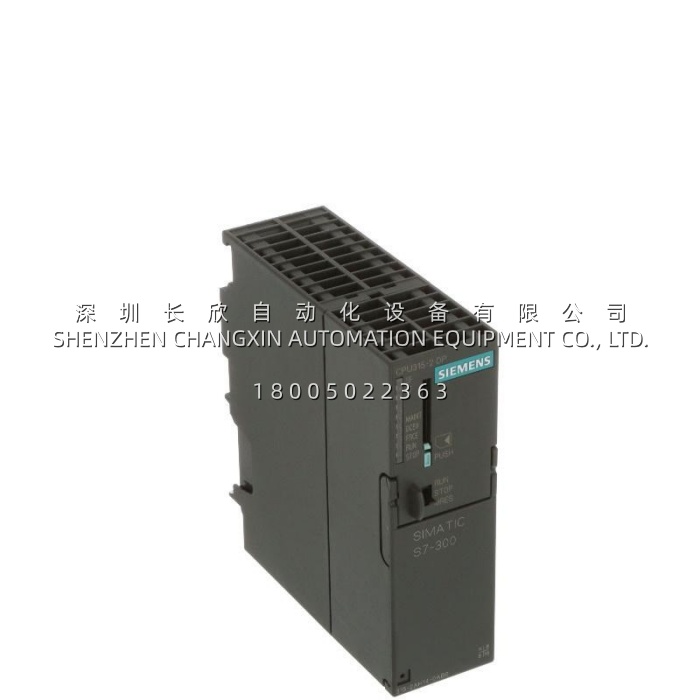
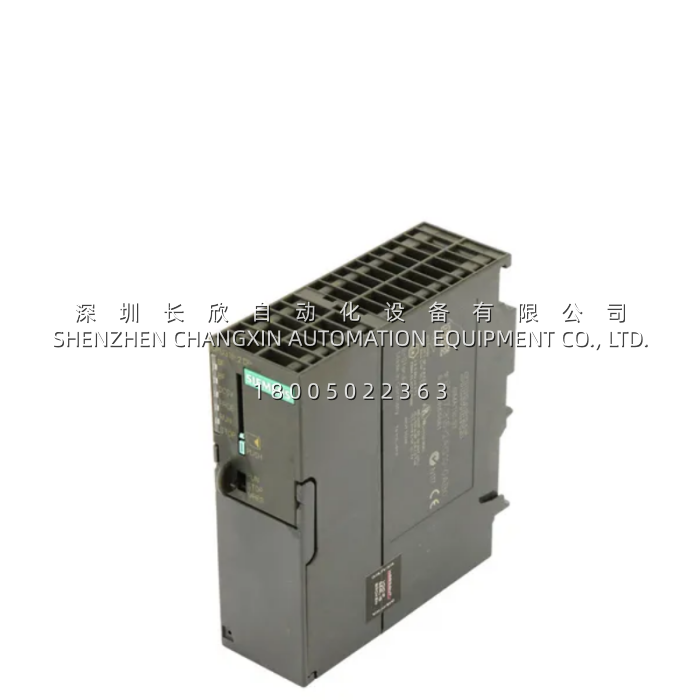
The 6ES7 315-2AH14-0AB0 is a Siemens SIMATIC S7-300 CPU 315-2DP central processing unit, positioned in the S7-300 midrange as the dual-interface workhorse for distributed control architectures that need both MPI (programming/HMI/PLC interlink) and a Profibus DP master/slave port on the same processor. Where the entry-level S7-300 CPUs trade interface count for cost, the 6ES7 315-2AH14-0AB0 carries two RS485 ports—Port 1 as MPI (up to 187.5 kbit/s, 12-station multipoint), Port 2 as Profibus DP (9.6 kbit/s…12 Mbit/s, DP-V0/DP-V1, isochronous mode supported, up to 124 DP slaves per master)—making it the default choice for panels that must talk to a rack-mounted HMI on MPI while simultaneously governing a DP string of drives, remote I/O heads, and intelligent field devices. The module integrates its own 24 V DC supply pickup from the S7-300 backplane (19.2–28.8 V range, 850 mA rated, 4.5 W loss) and requires a Micro Memory Card (MMC) to be inserted before power-up; program and retentive data live on the MMC, so the 6ES7 315-2AH14-0AB0 runs battery-free—a deliberate S7-300 design pivot away from the battery-backed RAM of the S7-300’s earlier CPU 31x generations.Performance-wise the 6ES7 315-2AH14-0AB0 sits well above the CPU 312/313 tier: 256 KB integrated work memory (program + data, doubled versus the legacy 6ES7315-2AG10-0AB0 it replaced), 0.05 µs per bit operation, 0.09 µs word, 0.12 µs fixed-point, 0.45 µs floating-point. That puts it into the “mid-size machine + light process” sweet spot—conveyor merges, packaging indexing, water-treatment chemical dosing, building-HVAC plant rooms, small-to-medium automotive skids—where a CPU 314 is too thin on memory and a CPU 317 is overspec. Siemens placed the 6ES7 315-2AH14-0AB0 on PLM PM400 (product phase-out announced effective 1 Oct 2023), meaning it is no longer the forward-new-design choice (S7-1500 or CPU 315-2EH14 with PN take that role), but it remains the correct sparing and retrofit part for the tens of thousands of S7-300 racks still running globally.
Technical Specifications
| Parameter | Value |
|---|---|
| Product Model | 6ES7 315-2AH14-0AB0 |
| Manufacturer | Siemens |
| Product Type | CPU 315-2DP, SIMATIC S7-300 Central Processing Unit |
| Work Memory (integrated) | 256 KB (program + data), non-expandable |
| Retentive Memory | 128 KB (maintained via MMC, battery-free) |
| Load Memory | Micro Memory Card (MMC) required, max. 8 MB |
| Supply Voltage | 24 V DC (19.2–28.8 V DC range) |
| Current Consumption | 850 mA (rated), 150 mA no-load, 3.5 A inrush |
| Power Loss (typ.) | 4.5 W |
| Processing Times | Bit 0.05 µs / Word 0.09 µs / Fixed 0.12 µs / Float 0.45 µs |
| Communication Ports | 1 × MPI (RS485, ≤187.5 kbit/s) + 1 × Profibus DP (RS485, ≤12 Mbit/s, Master/Slave, DP-V1, isochronous) |
| Max. DP Slaves | 124 per DP master interface |
| I/O Capacity (max.) | 16 384 DI + 16 384 DO / 1 024 AI + 1 024 AO (incl. distributed) |
| Expansion Racks | Max. 4 racks (IM 360/361), 32 modules total |
| Block Count (DB/FB/FC) | 1 024 each, 64 KB max. per block |
| Operating Temperature | 0 … +60 °C |
| Dimensions (W × H × D) | 40 × 125 × 130 mm |
| Weight (approx.) | 0.29 kg |
| Mounting | S7-300 DIN rail, Slot 1 |
| Protection | IP20, Class I |
| Programming | STEP 7 V5.5 + SP1 (or V5.2 + SP1 + HSP 218) |
Main Features and Advantages
The 6ES7 315-2AH14-0AB0 earns its keep by solving the “one CPU, two networks” problem without stepping up to a 317 or 319. The dual-port layout—MPI on Port 1, Profibus DP on Port 2—lets the same processor serve a local HMI/PG on MPI while acting as DP master for a string of drives, ET 200 distributed I/O, and third-party DP slaves (GSD import supported). For machine builders that standardize on MPI for the panel door and DP for the field, the 6ES7 315-2AH14-0AB0 eliminates the need for an external CP 342 card, saving a rack slot, 24 V budget, and STEP 7 configuration overhead. DP-V1 and isochronous mode support on Port 2 also open the door to DPV1 alarm OBs (OB55/56/57) and synchronized I/O sampling—useful on press lines, web-handling, and motion-coupled process loops where jitter at the DP scan matters.Processing headroom is the second lever. The 6ES7 315-2AH14-0AB0 runs 0.05 µs per bit instruction and carries 256 KB of work RAM—exactly double the 128 KB of the legacy 6ES7315-2AG10-0AB0 it succeeded. For plants migrating an aging AG10-based rack forward without jumping to S7-1500, dropping in a 6ES7 315-2AH14-0AB0 gives a free performance lift: larger DB/FB pools, more headroom on STL/SCL compute blocks, and margin for logic growth over the remaining panel life. The 1 024-block ceiling (DB, FB, FC each) with 64 KB per block is generous for a midrange CPU—most S7-300 applications hit I/O or rack-slot limits long before they hit block count.Battery elimination is the third quiet win. Because program and retentive data live on the MMC (plug-in, maintenance-free, 10-year minimum data hold per Siemens spec), the 6ES7 315-2AH14-0AB0 does not need a backup battery, unlike the older S7-300 CPU generations and unlike S7-400 which still carries a battery. No battery means no “BATF” LED, no scheduled battery swap during outage, no acid-leak risk in hot/humid cabinets. The MMC itself is the wearing item—but at 10-year data-retention and the fact that most plants swap the CPU (or the whole rack) before the MMC ages out, this is a net maintenance reduction. One procedural catch: the MMC must be inserted before the 6ES7 315-2AH14-0AB0 is powered on; powering up without MMC forces the CPU to STOP with SF lit, and you’ll need to insert the card and re-power or use a PG to recover.Lifecycle positioning closes the feature set. Siemens moved the 6ES7 315-2AH14-0AB0 to PLM PM400 (phase-out announced 1 Oct 2023), so it is no longer the forward-new-design SKU—S7-1500 or the PN-equipped CPU 315-2EH14 take that role. But for the installed base—automotive body shops, water treatment plants, building management panels, food & beverage lines—the 6ES7 315-2AH14-0AB0 is exactly the sparing part to stock, because ripping a running S7-300 into S7-1500 is a requalification event most plants defer until the next major upgrade. Having tested 6ES7 315-2AH14-0AB0 units on the shelf avoids a forced expedite when a CPU SF/MT (memory test) fault lands on a weekend.
Application Field
The 6ES7 315-2AH14-0AB0 sits in S7-300 racks across the classic midrange automation footprints—machine-level control that is too complex for a 313 but does not justify a 317 or an S7-1500 migration. Automotive is the single largest vertical: body-shop welding clamps, paint-shop conveyor merges, powertrain test-cell stands, and end-of-line check fixtures routinely run a 6ES7 315-2AH14-0AB0 as the cell controller, with MPI to the door-mounted TP177/TP277 HMI, DP master to a string of ET 200S/ET 200M remote I/O heads on the cell periphery, and DP slave enabled when the cell reports upward to a line-level S7-400 or S7-1500. Bit-time of 0.05 µs and 256 KB work RAM comfortably carry the interlock + positioning + fault-logic load of a 2–4 station cell.Water and wastewater is the second heavy user: chemical dosing skids, lift-station RTU panels, small WWTP aeration basins, and RO train controls commonly standardize on S7-300 for its mix of analog density (AI/AO for pH/ORP/flow/pressure) and DP connectivity to drive VFDs and magmeters. The 6ES7 315-2AH14-0AB0 fits here because the MPI port talks to a local OP177 or KTP panel in the shelter while the DP port chains 8–20 ET 200M nodes spread across the process area. Battery-free operation also helps in shelter environments where summer heat would otherwise shorten a backup battery’s life.Building automation and HVAC plant rooms, food & beverage batch skids, packaging lines (cartoner, wrapper, palletizer cells), and material-handling zones (sorter induct, merge, divert) round out the footprint. Anywhere a panel needs ~1 000–2 000 digital points or ~200–800 analog points, 4 expansion racks, and a DP master string, the 6ES7 315-2AH14-0AB0 is the default S7-300 CPU. Obsolescence management is now the fastest-growing application: as Siemens phases the MLFB to PM400, EPCs and plant MRO teams proactively secure 6ES7 315-2AH14-0AB0 units (new-old-stock or tested surplus) to cover the remaining 5–10 years of S7-300 life without a forced retrofit. For AG10-to-AH14 migration specifically, the 6ES7 315-2AH14-0AB0 drops into the same Slot 1, same backplane, same 40 mm width—only the MMC, hardware configuration (STEP 7 V5.5+ required, recompile and download), and the work-memory headroom change.