WhatsApp:+86 18005022363 WeChat: +86 18005022363
  Email:
Application
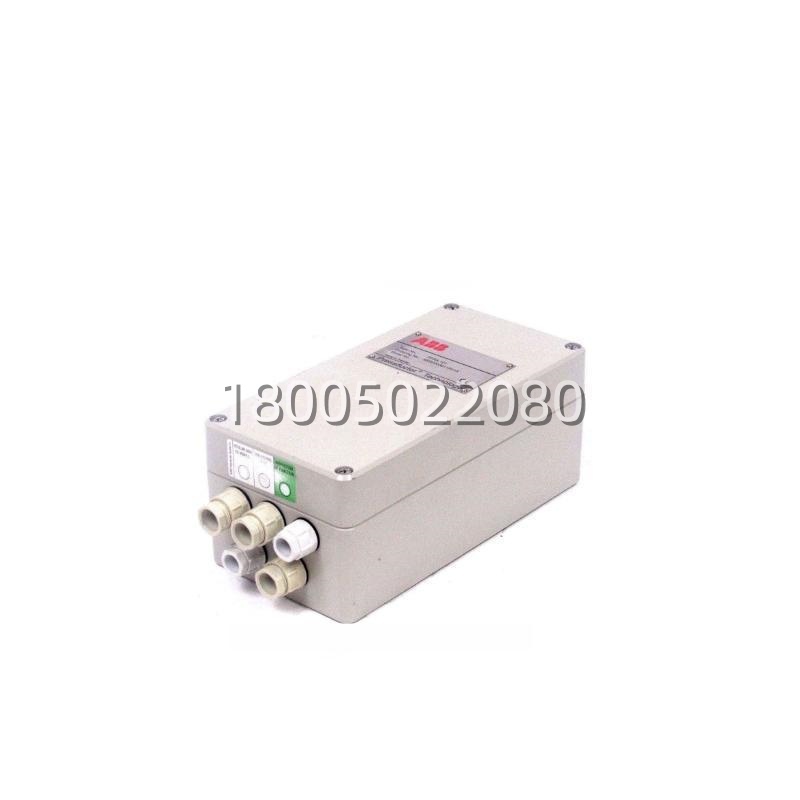
ScenariosA US Southeast kraft-liner machine running a 4-roll calender (top/bottom king rolls + 2 swimming rolls) originally landed the four Pressductor PMFW pillow sensors (one under each king-roll bearing) on a 1998-vintage PFRA101 batch (the original 115 V AC units — the mill’s MCC is 120 V AC domestic, so the E&I spec’d R115 across the board). After 24 years, one ABB PFRA101 (3BSE003911R115) in the bottom-king-B position started “drifting warm” — the 4–20 mA output would sag 1.2% over a 6-hour run as the calender oil temp climbed from 45 °C to 62 °C, and the nip-load DCS loop (AB 1756 + PlantPAx) would trim the swimming-roll actuator to compensate, over-working the hydraulic servo and adding < 0.5% caliper variance across the reel. The plant had one spare PFRA101 R115 on the shelf (matched firmware/batch to the three live units — critical: the PMFW’s Pressductor constant (k-factor) is stored in the PFRA101‘s dip-switch / parameter set, and a mismatched batch can mean wrong k-factor decode → force reads 20% off). Swap took 18 minutes during a scheduled reel-change: LOTO the 115 V AC to the calender-local panel, unplug the PMFW 4-conductor (excitation + signal screened pair), undo the DIN latch, rack new PFRA101, re-land, power up, auto-zero with the roll loaded (the PFRA101 has a front-panel “Auto-Zero” pushbutton that nulls tare with roll weight on — no DCS recal needed). Post-swap, nip-load drift < 0.15% over 8 hours, caliper variance dropped to spec. The E&I lead noted the PFRA101‘s front LEDs (PWR, SIGNAL, ERROR, BUS if fieldbus-fitted) made “which king bearing is drifting?” a 30-second glance at the local panel — no PlantPAx drill-down needed.
Parameter
| Main Parameters | Value/Description |
|---|---|
| Product Model | ABB PFRA101 (3BSE003911R115) |
| Manufacturer | ABB |
| Product Category | Pressductor Force Amplifier (Single-Channel, PFRA family) |
| Target Sensor | ABB Pressductor PMFW (pillow), PMCW (compression), PQFW (quadrant) — paper/continuous |
| Supply Voltage | 115 V AC ±10%, 50/60 Hz (R115 suffix = 115 V AC prepared) |
| Sensor Excitation | Typically 5 V DC or 10 V DC (Pressductor dependent; PMFW = 10 V DC nominal) |
| Input Signal | 0.几 mV (Pressductor output, ~1–3 mV/V at full load) |
| Output (Analog) | 4–20 mA active/passive (loop-powered or active, batch-dependent), ±10 V optional on some batches |
| Output (Digital/Fieldbus) | Optional Profibus DP (on fieldbus-fitted batches); base PFRA101 = analog-only |
| Accuracy | ≤ 0.1% FS (typical, after auto-zero, 20–60 °C) |
| Linearization | Built-in Pressductor V–F non-linear curve correction (k-factor stored in DIP/switch set) |
| Auto-Zero | Front-panel pushbutton + remote DI (zero with roll tare weight on) |
| Mounting | 35 mm DIN rail (inside local calender/stand panel) |
| Operating Temperature | 0 °C to +60 °C (some batches -20 °C to +60 °C) |
| Dimensions (L×W×H) | Approx. 120 × 110 × 75 mm (standard ABB PFRA DIN housing) |
| Weight | Approx. 0.4–0.5 kg |
Technical Principles and Innovative Values
- Innovation Point 1: Pressductor V–F Non-Linear Correction in Hardware. A Pressductor PMFW/PMCW sensor isn’t linear — the output mV/V vs. force (V–F) follows a mild 2nd-order curve (the magnetic-flux-path saturation effect). The PFRA101 stores the sensor’s k-factor (set via DIP switches or parameter download) and applies piecewise linearization internally, so the 4–20 mA output is linear force (kN or tons) without the DCS doing the math. This offloads the PLC and means the PFRA101 can feed any4–20 mA analog input (AB 1756-IF16, S7-400 SM331, AC 450 AI801) — no special function block needed in the DCS.
- Innovation Point 2: Auto-Zero with Roll-Loaded Tare. Most force amps require “zero with roll off” (mechanical lift, zero, roll down, re-zero for tare). The PFRA101 has a smarter approach: you can auto-zero with the roll loadedif you know the tare weight (bearing housing + roll shell + screw load). There’s a front-panel “AZ” pushbutton and a remote DI (“AZ request” from DCS). On a calender, the operator can zero all four king bearings during a reel-change (rolls still loaded at 50 kN nip) by telling the DCS “send AZ pulse” — the PFRA101 subtracts the tare and outputs 4 mA = 50 kN (the pre-load), 20 mA = 50 + full-scale. This avoids a mechanical roll-lift just for tare — a 20-minute saving per grade-change.
- Innovation Point 3: 115 V AC / 230 V AC R-Suffix Split = Global Drop-In. The PFRA101 internals are identical except the SMPS/transformer and the fuse rating — R115 = 115 V AC (US/Japan 120 V domestic MCC), R230 = 230 V AC (EU/AP 230 V). This means a US plant’s spare bin (R115) won’tpower a EU sister-mill’s 230 V panel — and vice versa. The R-suffix is silk-screened on the side label; the 3BSE003911 base order code is shared, only the R-suffix changes. Always confirm your panel voltage before ordering — a R115 on a 230 V AC panel will pop the internal fuse (slow-blow 2 A typical) on first power-up; a R230 on 115 V AC will undervolt the SMPS and the PFRA101 will PWR-LED-flicker but not boot.
Application Cases and Industry ValueA North American tinplate tandem cold mill (5-stand, 1200 m/min) ran ABB PFRA101 R115 units on the bridle-winder node (not the stands — the stands used MFR401 metals amplifiers; the bridle-winder’s 4 tension rolls each had a PMFW pillow, and the E&I spec’d PFRA101 because the winder DCS was AB 1756 and they wanted simple 4–20 mA into the 1756-IF16, not a Profibus telegram per roll). The pain point was “wind-off tension jitter” during coil-transfer: the 4–20 mA from the PFRA101 on Bridle-D was stepping in 0.3% increments (the PFRA101’s ADC is 12-bit underlying, so 4–20 mA / 4096 = ~0.0039 mA/LSB ≈ 0.024% FS — but the actuallimit was the 1756-IF16’s 16-bit resolution + the PMFW’s own noise floor). The fix wasn’t the PFRA101 — it was adding a 10 Hz RC low-pass on the PFRA101‘s analog output (the PFRA101 has a DIP-selectable output damping: 0 / 0.5 / 1 / 2 / 4 / 8 s; it was on 0 s, i.e., undamped). Flipping DIP to 2 s damping killed the jitter, wind-off tension variance dropped from ±4% to ±1.5%, and coil-transfer rejects (telephone-booking from tension overshoot) dropped 60%. The E&I lead noted the PFRA101‘s DIP bank (accessed through the front flip-cover) made the damping change a 2-minute door-open — no CBF, no DriveWindow, no DCS download.