WhatsApp:+86 18005022363 WeChat: +86 18005022363
  Email:
Technical Specifications
| Parameter Name | Parameter Value |
|---|---|
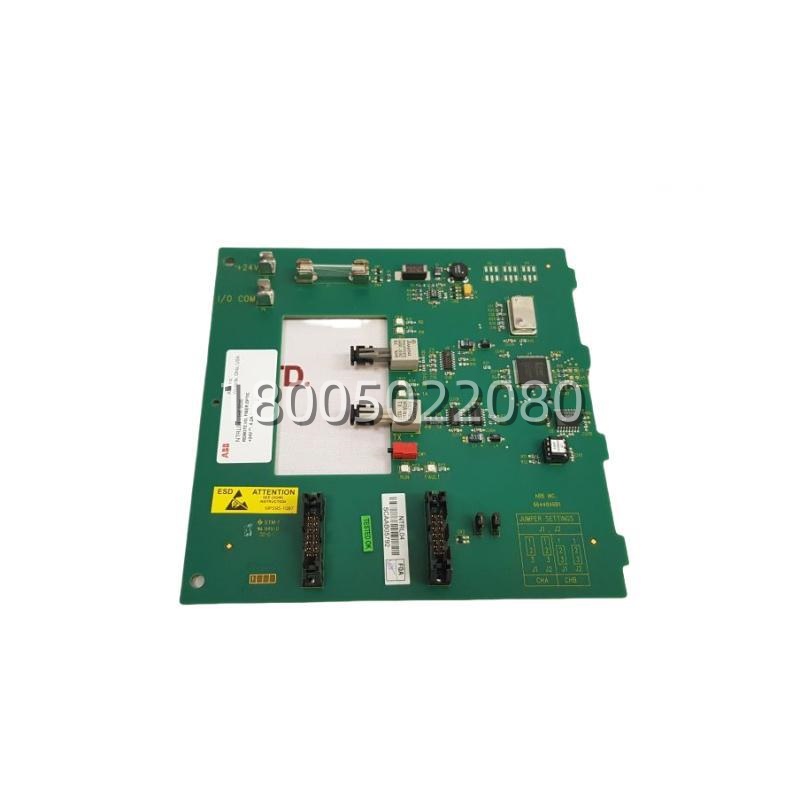
| Product Model | NTRL04 |
| Manufacturer | ABB |
| Product Type | Termination Unit (TU) for HARM HNET Fiber Optic Repeater |
| Platform | ABB Harmony OCS / Advant OCS (HNET network) |
| Paired Electronic Module | HARM HNET Repeater (NRP-family, e.g. NRP04 / NRPxx, sold separately) |
| Network Type | HNET (Harmony NETwork), 10 Mbps, fiber-optic, redundant ring/mesh |
| Fiber Connector | ST-BF (multimode 62.5/125 µm, HNET standard; repeater module may support SM conversion) |
| Number of Fiber Ports | Typically 2–4 (In/Out per ring direction; exact per NRP variant mated) |
| Indicators | Per-port LEDs: Link, Activity, Error; Module Power LED |
| Interface to Repeater Module | Short ribbon cable (baseplate-mount) or long ribbon (door-mount TU) |
| Supply Voltage | 24 V DC (from Harmony rack backplane, via repeater module) |
| Mounting | Harmony baseplate / DIN rail (TS35); door-mount via TU bracket |
| Operating Temperature | 0 … +60 °C (control-room cabinet envelope) |
| Storage Temperature | -40 … +70 °C |
| Humidity | 5 … 95 % RH, non-condensing |
| Dimensions (W × H × D) | ~36–72 mm W (Harmony TU standard) × 120 mm H × ~115 mm D |
| Weight | ~0.15–0.25 kg |
Main Features and Advantages
HNET segment extension and media conversion via the repeater + TU pair. The architectural role of the NTRL04 is to serve as the hand-off point between the plant’s HNET fiber plant and the NRP repeater module that regenerates the 10 Mbps HNET signal. A native HNET segment on 62.5/125 µm multimode ST fiber is limited to ~2 km before attenuation and dispersion erode the bit-error rate; the NTRL04 + NRP repeater regenerates the optical signal (clock recovery, reshaping, retransmitting), allowing daisy-chained segments that can reach 10+ km total when single-mode fiber is used in the inter-repeater spans. In plant layouts where the HNET backbone must cross battery limits — e.g., a refinery’s main control building (Harmony HAC controllers) to a remote tank-farm I/O building 5 km away, or an offshore platform’s process module (HPC4) to a subsea control pod interface 3 km down a jumper — the NTRL04 lands the platform-side ST multimode tails, the NRP repeater converts/regenerates to single-mode for the long haul, and a second NTRL04 + NRP at the far end converts back to multimode for the remote I/O drop. The NTRL04 itself doesn’t “know” multimode vs. single-mode — that’s the NRP module’s optical transceiver choice — but the TU’s ST connector footprint is standardized so the plant’s fiber crew lands the same ST-BF pigtails regardless.Redundant HNET ring/mesh resilience. HNET is architected as redundant dual-counter-rotating rings (Ring A / Ring B) or mesh, and the NTRL04 + NRP repeater sits transparently in the ring — the repeater regenerates both rings independently, so a fiber cut between Repeater A and Repeater B only breaks one ring, the other ring maintains comms, and the Harmony DCS logs a “ring degradation” alarm (not a node loss). The per-port LEDs on the NTRL04 (Link, Activity, Error per port) let a walk-by maintenance tech see which ring leg is dark: if Port 1 (Ring A east) LED is off and Port 2 (Ring A west) is green, the cable between this repeater and the next eastbound node is cut — the tech grabs the fiber splice kit, finds the break, repairs, LED returns green, no DCS restart. This diagnostic visibility at the TU — without opening a laptop or logging into Composer — is the Harmony TU philosophy carried over from the Bailey INFI 90 days, and the NTRL04 inherits it.Hot-swappable TU with Harmony rack discipline. Like the S200 TUs (NTAI06, etc.) and the Harmony I/O TUs, the NTRL04 is designed to be hot-swappable from the field side — the ribbon to the NRP repeater module carries 24 V and signal, but the TU can be unplugged while the NRP module stays online (best practice: inhibit the ring segment in the DCS first to avoid a spurious ring-break alarm, but electrically the NRP survives a TU pull). In a cabinet where all TUs are door-mounted (typical Harmony/Advant panel build: TUs on door, electronic modules on DIN rail inside, ribbons穿过 the hinge area), the NTRL04 can be swapped with the door at 90° — the panel-shop tech doesn’t need to open the cabinet interior, just work the door. For offshore E-rooms where cabinet interior access is tight (pipework, cable trays crowding the cabinet sides), this door-mount discipline is valuable. The NTRL04 mounting is DIN-rail (TS35) compatible if the plant chose rail-mount TUs instead of door-mount — the TU itself is the same, the ribbon length differs (0.8 m for rail-mount same-row, 2.0 m for door-mount).LED diagnostics mirror the NRP repeater state. The NTRL04 carries per-port LEDs (Link = optical power detected, Activity = packet traversing, Error = BER threshold crossed or loss-of-lock) and a Module Power LED (24 V present from NRP/repeater). These are driven from the NRP module over the TU–module ribbon — the NTRL04 doesn’t autonomously detect link, it reflects what the NRP sees. This means the NTRL04 LED grammar is consistent with the Harmony DCS faceplate: if the DCS shows “HNET Ring A degraded, Repeater #3 port 1 link down,” the NTRL04 at Repeater #3 will show Port 1 Link LED off — the tech correlates DCS alarm → cabinet walk → TU LED → fiber splice. No parameterization on the NTRL04 itself — all HNET config (node ID, ring membership, redundancy role) is in the Harmony engineering database and downloaded to the NRP / controller nodes.Infrastructure-level spare with long service life. The NTRL04 is almost entirely passive — ST connectors (ceramic ferrule, ruggedized ST-BF for industrial use), LED drivers (low-power SMT), ribbon header (keyed, ESD-protected). There are no electrolytics, no processor, no firmware — the only wear mechanisms are mechanical: ST ferrule micro-cracks from repeated mate/demate (fiber crews re-patching during expansions), ribbon header fretting from cabinet vibration (offshore platforms, compressor stations), and LED dimming (decades-scale). This makes the NTRL04 a “buy 1 per 10–15 HNET repeater nodes” spare — it fails rarely, but when a repeater node needs TU swap (ST damage from mishandled fiber drop, ribbon loose from vibration), having the NTRL04 on the shelf beats waiting 2 weeks for a new one, especially since Harmony is mature and ABB’s lead times on legacy TUs have stretched.
Application Field
The NTRL04 deploys wherever a Harmony OCS / Advant OCS HNET backbone needs a fiber-optic repeater — which is to say, anywhere the HNET run exceeds ~2 km multimode limit, or where the topology needs media conversion (multimode ↔ single-mode) for long-haul plant-to-plant or platform-to-platform links. The canonical domain is oil & gas — offshore topsides (HPC4/HAC controllers in the MCC/E-room) to subsea control pods (HNET over single-mode to the umbilical termination, repeater at the topsides end and at the subsea I/O end), and onshore wellpad clusters (central battery-limit Harmony rack, satellite wellpad I/O huts 3–8 km away over HNET single-mode, NTRL04 + NRP at each end). Refining and petrochemical complexes use HNET between the main CCR (central control room, Harmony HACs) and satellite unit control buildings (e.g., sulfur recovery, coker, tank farm) that are 1–5 km apart — the NTRL04 + NRP repeater sits in each building’s Harmony rack, ST multimode tails to the local I/O, single-mode inter-building spans through the plant’s fiber backbone (often shared with telecom, but HNET gets its own fiber pair per ring for determinism).Power generation is another dense domain — a combined-cycle plant may have the Harmony DCS (HAC/HPC4) in the control building, the GT (gas turbine) local I/O in the GT enclosure 200 m away (multimode, no repeater needed), the ST (steam turbine) local I/O 150 m away, but the BOP (balance-of-plant — CW pumphouse, HRSG, fuel-gas skids, switchyard) can be 1–3 km from the control building, especially on greenfield sites where the BOP is at the plot perimeter. HNET to BOP I/O uses NTRL04 + NRP at the control-building end and at the BOP I/O building end, single-mode between. Nuclear BOP (auxiliary building to rad-waste, to intake) also fits this pattern, though some nuclear sites have migrated to AC 800M + S800.Pulp & paper mills — large site (~1 km from woodyard to bleach plant to paper machine to baling line), Harmony DCS covering the whole site with HNET rings daisy-chained through repeater nodes at each section’s MCC room — the NTRL04 + NRP in each MCC room’s Harmony rack extends the HNET from the previous section. Marine and offshore platforms (drillships, FPSO, shuttle tankers) with Harmony DCS on the process side and HNET to the power-management I/O on the engine-room side, and to the cargo-control I/O on the process side — the NTRL04 lands the ST tails in each cabinet.Retrofit and migration context: plants migrating from Advant OCS (AC450/AC460 controllers + S200 I/O + HNET) to AC 800M (PM8xx/PM9xx + S800 I/O + Plant Network Ethernet) often keep the HNET backbone alive during a phased cutover — the Harmony controllers stay as I/O concentrators / gateway nodes (HPG Harmony-PC Gateway) talking HNET to the legacy I/O and Ethernet to the AC 800M, and the NTRL04 + NRP repeaters continue serving the HNET segments during the multi-year migration. This makes the NTRL04 a strategic spare even in plants that have already begun DCS modernization — the HNET network may run another 5–10 years before the last legacy I/O is retired.