WhatsApp:+86 18005022363 WeChat: +86 18005022363
  Email:
Product Overview
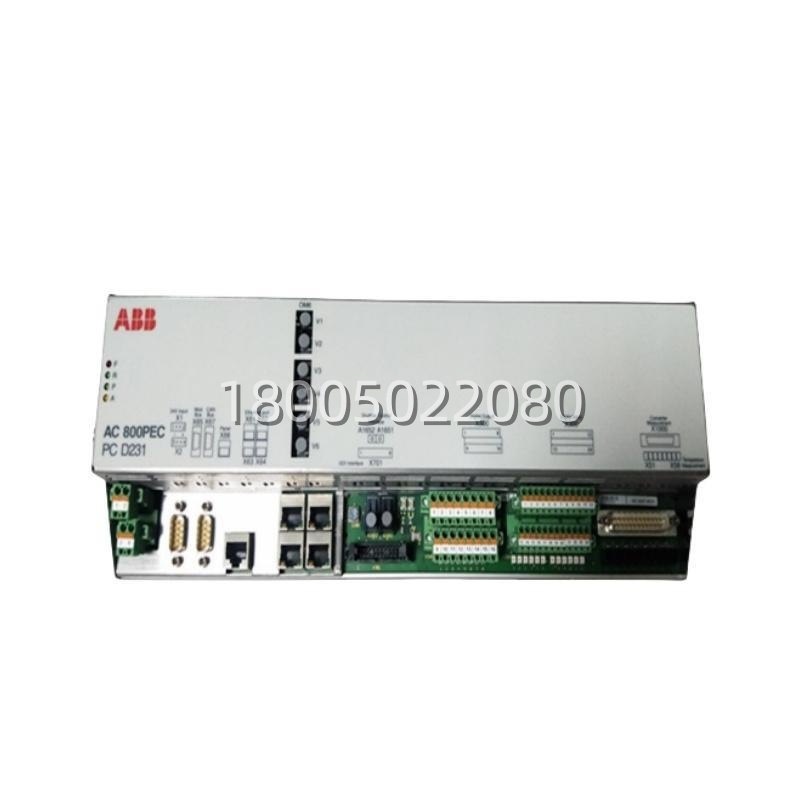
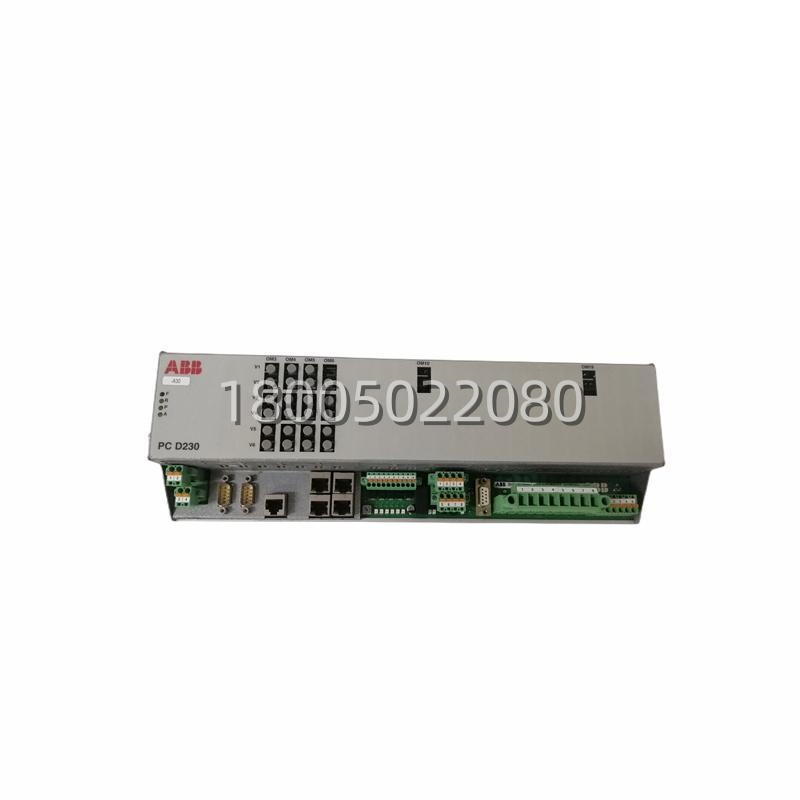
The PCD230A (order number 3BHE022291R0101) is ABB’s digital Input/Output module designed for the AC 800PEC (Programmable Automation Controller for Power Electronics) platform — ABB’s high-performance control system purpose-built for power-electronic converters: HVDC (both classic line-commutated and HVDC Light VSC), SVC (Static Var Compensator — TCR/TSC), STATCOM, large MV drives (ACS6000 series for pumps, fans, compressors, marine propulsion), and wind-turbine converter systems (PCS6000 offshore/onshore). While the AC 800PEC CPU (typically a PM8xx-class processor module) runs the fast current-loop, modulation, and protection algorithms (execution times down to 25 µs per task), the PCD230A provides the localized digital I/O layer that interfaces the PEC controller to the converter’s auxiliary plant: valve-cooling pump contactors, bypass-switch solenoids, DC-filter fan starters, breaker-close/trip interlocks, alarm horns, status lamps, and the converter’s own auxiliary-sequence DI (e.g., “water-flow OK,” “valve-hall door closed,” “DC-bus pre-charge complete”).The “PCD” prefix in ABB’s Grid division denotes “Process Control Device” within the PEC I/O family — sibling modules include PCD231 (possibly different DI/DO count or voltage), PCT230 (pulse-counter / encoder input for motor-speed feedback), PQA250 (power-quality / analog acquisition), etc. The PCD230A specifically delivers 16 digital inputs (24 V DC, sink/source configurable, filtered, with debounce) and 16 digital outputs (24 V DC, 0.5 A per channel, short-circuit and over-temperature protected, grouped into galvanically isolated banks). The module seats directly on the AC 800PEC local I/O backplane (a compact Eurocard-style subrack that sits alongside the CPU module in the PEC cabinet), draws its logic supply from the backplane (5 V / 3.3 V internal, with the 24 V field side either from an onboard DC/DC or from a shared PEC 24 V rail depending on rack build), and communicates with the CPU over the PEC internal bus (optical or parallel-local, depending on PEC generation). Configuration of the PCD230A I/O mapping is done inside ABB’s Control Builder M (the PEC engineering tool) — each DI/DO channel is assigned a signal name, debounce time, and fail-safe state, and the CPU’s application code (IEC 61131-3 + ABB PEC function blocks for HVDC/SVC modulation) reads/writes them directly.The “A” suffix on PCD230A denotes a revision — the BOM and connector keying are stable across PCD230 revisions, and the 3BHE022291R0101 article is the current/late-production spare. Because AC 800PEC remains ABB’s active platform for new HVDC and SVC projects (even as ABB Grid transitions some newer designs toward the Ability™ Vi eS Grid Automation suite), the installed base of PCD230A modules is growing, not just sustaining — every new HVDC Light link (e.g., North Sea offshore wind export, urban infeed in APAC) and every new SVC/STATCOM (renewable-interconnection, industrial arc-furnace compensation) ships with at least one PEC rack carrying a PCD230A or its siblings. For plants with legacy PEC racks (early 2000s HVDC Classic retrofits, SVCs from the 1995–2010 window that were upgraded to PEC CPUs), the PCD230A (3BHE022291R0101) is the correct spare — the module is backward-compatible to earlier PEC backplane revisions, though the PEC CPU firmware should be ≥ the version that introduced the PCD230A’s diagnostic extensions (minor — ABB documents compatibility from PEC firmware vX.x upward; for most post-2010 retrofits, it’s plug-and-play).
Technical Specifications
| Parameter Name | Parameter Value |
|---|---|
| Product Model | PCD230A |
| Manufacturer | ABB (Grid Division — High Power Electronics) |
| Order / Article Number | 3BHE022291R0101 |
| Product Type | Digital I/O Module (Local I/O for AC 800PEC) |
| Platform | ABB AC 800PEC (Power-Electronic Controller) |
| Digital Inputs | 16 channels, 24 V DC, sink/source configurable, filtered (debounce 1–32 ms programmable) |
| Digital Outputs | 16 channels, 24 V DC, 0.5 A per channel, short-circuit protected, over-temperature protected |
| Output Groups | 2–4 galvanically isolated groups (depending on rack 24 V distribution) |
| Backplane Interface | AC 800PEC local I/O bus (electrical / optical hybrid, per PEC generation) |
| Configuration | Via Control Builder M (signal mapping, debounce, fail-safe) |
| Status Indication | Per-channel LEDs (DI = input active, DO = output active), module-status LED |
| Supply Voltage (field side) | 24 V DC (from PEC rack 24 V rail or external PSU) |
| Supply Voltage (logic side) | 5 V / 3.3 V from PEC backplane |
| Response Time | ≤1 ms (DI to CPU) / ≤1 ms (CPU to DO), subject to PEC task cycle (min 25 µs for fast tasks, DI/DO typically on 1 ms base) |
| Isolation | Channel-to-backplane, group-to-group (reinforced per IEC 61010) |
| Operating Temperature | -20 … +60 °C (PEC cabinet envelope) |
| Mounting | AC 800PEC local I/O backplane (Eurocard slot) |
| Protection Rating | IP20 (module-level, inside cabinet) |
| Certifications | CE, applicable Grid-division type-tests (HVDC/SVC cabinet qualification) |
Main Features and Advantages
16 DI + 16 DO in a single PEC I/O slot. The PCD230A packs 32 channels (16 in, 16 out) into one AC 800PEC local I/O slot — the PEC I/O backplane is紧凑, and the CPU rack typically has 4–8 I/O slots alongside the PM-class CPU and the optional communication modules, so channel density matters. In a typical HVDC valve-control cabinet, the DI count goes to “valve-cooling pump run-status,” “water-leak detector,” “valve-hall door-switch,” “DC-filter fan run,” “bypass-switch auxiliary limit,” “pre-charge contactor auxiliary” — 8–12 DIs; the DO count goes to “cooling-pump start contactor coil,” “alarm horn,” “bypass-valve solenoid pilot,” “DC-filter fan start” — 6–10 DOs. One PCD230A covers most of that, leaving the other I/O slots for analog (PQA250) or pulse-counter (PCT230) modules. In an SVC TCR cubicle, the PCD230A handles “TCR step-switch auxiliary,” ” TSC bank breaker auxiliary,” “reactor-fan run-status,” “thyristor-cooling OK” — again, one module covers the bulk.24 V DC industrial-standard field interface with protection. Both DI and DO on the PCD230A run 24 V DC — the plant-standard control voltage globally — so the field wiring lands on the PEC rack’s 24 V terminal block (or on a marshalling TB that feeds the PEC 24 V rail) without interposing relays for standard PLC-load devices (solenoids ≤0.5 A, indicator lamps, alarm buzzers). The DO channels are short-circuit protected (if a tech miswires a 24 V DO to a 120 V AC solenoid coil during a turnaround — rare but happens — the PCD230A DO bank current-limits rather than blowing the output FET, and the module’s status LED for that group flags a fault). The DI channels are filtered with programmable debounce (1–32 ms in Control Builder M), letting the PEC application reject contact-bounce from mechanical auxiliary contacts (pump starter aux, breaker aux) without writing debounce logic in the 25 µs task. This is valuable in HVDC/SVC where the PEC CPU is already taxed running the modulation and protection — offloading debounce to the PCD230A hardware keeps the CPU cycles for the fast loops.Per-channel LEDs for local diagnostics. Each of the 16 DI and 16 DO channels on the PCD230A fascia carries an LED — DI LED on = 24 V present on that input (field device closed contact); DO LED on = module actively driving that output (CPU commanded ON). A walk-by maintenance tech on an HVDC valve-hall walkway can see “DI-3 off” on the PCD230A through the PEC cabinet’s viewing window, correlate to “valve-cooling pump run-status lost,” and go straight to the pump MCC — no laptop, no Control Builder, no PEC faceplate login. The module-status LED (usually a bi-color at the corner of the PCD230A) shows “green = healthy on-backplane, firmware enumerated” vs “red = backplane comm lost or module internal fault” — useful for triage when the PEC CPU logs “I/O module not responding.”Seamless AC 800PEC backplane integration, no user-DIPs. The PCD230A seats on the PEC local I/O backplane and is auto-enumerated by the PEC CPU at power-up — no node address, no DIP switches, no GSD/EDS. The I/O mapping lives in the Control Builder M project: under the “I/O” tree, the PCD230A appears as “PCD230A_1:Slot_3” (for example), and each channel is assigned a symbolic name (“DI_Cool_Pump_Run,” “DO_Bypass_Sol”) and a fail-safe state (0 or 1 on CPU watchdog trip). This means a replacement PCD230A (3BHE022291R0101) is truly plug-and-play: power down the PEC rack (or follow hot-swap if the PEC generation supports I/O hot-swap — later PEC racks do, early ones may require rack power cycle), pull the old module, seat the new, power up, CPU re-enumerates, I/O mapping reloads from the CPU’s application download, and the converter’s auxiliary sequences resume. No re-parameterization, no MC card (the configuration lives on the CPU’s CFast/SD, not on the PCD230A).Ruggedized for HVDC/SVC cabinet environments. The PCD230A is built to Grid-division standards, not general-industrial — the difference shows in EMC, thermal, and vibration specs. An HVDC valve-hall cabinet sits next to the valve-shelf cooling-water system (humidity 60–80 % RH, constant), and the PEC rack inside the valve-control cubicle (separate from the valve hall, but adjacent) sees 40–50 °C ambient during summer peaks because the valve-hall’s own heat rejection loads the E-room. The PCD230A is specified to 60 °C ambient and carries conformal-coating-adjacent protections (the Grid division’s 3BHE boards typically get a coat pass — confirm on the 3BHE022291R0101 label if the batch is “C” or not, but PCD230A rev A is generally coated). Vibration: a PEC rack in a STATCOM container on a wind-farm BOP pad sees structural vibration from the collector-road traffic and from the STATCOM’s own cooling fans — the PCD230A screws to the backplane standoffs, and the backplane connector is keyed/retained, so fretting is minimal. This is why a PCD230A typically runs 15–20 years in a valve-control cabinet before any electrolytic or LED dimming shows — the duty is low-cycle (aux contacts switch a few times per day, not thousands per second like a high-speed DI on a packaging line), so wear is thermal/aging, not mechanical.