WhatsApp:+86 18005022363 WeChat: +86 18005022363
 Email:

Description
Application Scenarios
A packaging OEM was standardising a new case-erector skid for export. The panel was tight, the customer’s plant could be on 120V 60Hz in Mexico or 230V 50Hz in Poland, and the 24V load was predictable: a 1769-L33ER, eight 1769-IQ16 and 1769-OB16 modules, a handful of banner sensors and a 1783-BMS switch. The integrator had been oversizing the PSU “just in case” and eating 60mm of DIN rail on every build.The fix was a 1606-XLE80E. The 100–240V auto-range input killed the jumper and the region-specific bill of materials; the 24–28V adjustment let the installer recover the 0.6V drop to the far end of the sensor rail without bumping to a 28V or 48V system; and the 32mm width freed up exactly the space needed for a second breaker. Commissioning took one extra step — trim the pot to 24.1V under full load, cold, per the factory default. Six months and forty machines later, the failure count was zero and the panel assembler had stopped ordering the 120W unit “for safety margin.”That is the product’s whole pitch: not the biggest numbers in the room, but the cheapest 80W you will never have to think about twice.
Parameter
| Parameter | Value / Description |
|---|---|
| Product Model | 1606-XLE80E (Bulletin 1606-XLE Essential family; also stocked as 1606XLE80E) |
| Manufacturer | Allen-Bradley, Rockwell Automation |
| Product Category | Switched-mode power supply (PSU), single-phase input, DIN-rail / wall-mount |
| Lifecycle Status | Active, preferred in category. (Rockwell also marks the family “Active mature” against newer lines — worth a glance if you are designing a new panel today) |
| Input Voltage, AC | 100–240V AC, 50/60 Hz, wide-range auto-sensing. Operational band published as 90–132V AC / 180–264V AC (the 90V low-end is where hold-up and boost behaviour need checking — see the notes) |
| Input Voltage, DC | 110–300V DC — useful when the cabinet is fed from a DC battery or solar/telecom bus and you still want a 24V control rail |
| Rated Input Current | 1.24A @ 100V AC; 0.68A @ 230V AC (120V column in the Rockwell table: 1.50A — reconcile against your actual tap voltage) |
| Inrush Current | 23A @ 120V AC, 45A @ 230V AC, limited by an NTC inrush limiter. Size the upstream breaker and the input fuse for the let-through, not the running current |
| Input Protection | External fuse required, minimum B-10A or C-6A (per the Rockwell installation data). The PSU has no internal replaceable fuse — skip this and the first fault trips the whole panel |
| Output Voltage | 24V DC nominal, adjustable 24–28V via the front potentiometer. Factory setting 24.1V ±0.2% at full load, cold unit |
| Guaranteed / Max Output | 30V maximum at the clockwise end of the pot travel — there is headroom, but it is not a 30V-rated rail |
| Output Current | 3.3A @ 24V; 2.7–2.9A @ 28V (the datasheet’s Fig. 9-1 gives 2.7A at 28V; the power derate is real, so do not set 28V and budget 3.3A) |
| Output Power | 80W continuous |
| Line Regulation | ≤ 50mV (90–264V AC in) — the rail barely moves when the plant voltage sags |
| Load Regulation | ≤ 100mV, static, 0A → 3.3A → 0A |
| Ripple & Noise | ≤ 50mVpp, 20Hz–20MHz, 50Ω measurement bandwidth. Quiet enough that a 1769 analog input will not blame the PSU for its noise |
| Output Capacitance | ≈ 1450µF internal. This is also the reservoir that buys you the peak-current and hold-up performance |
| Short-Circuit Behaviour | 4A minimum, 8A maximum into a 250mΩ load. Hiccup-style protection returns the unit to normal when the fault clears — no fuse to replace, no manual reset |
| Dynamic Power Boost | 120% boost (≈96W) for several seconds when ambient is below 45°C. Charges capacitive loads, wakes inrush-heavy solenoid banks and lets a downstream breaker trip on its own curve instead of the PSU folding first |
| Peak Current (capacitor discharge) | ≈ 6.6A for 50ms (24V → 12.5V dip), ≈ 16.5A for 2ms, ≈ 16.5A for 5ms (24V → 7V). Use these only as startup transients — they are not a continuous rating |
| Hold-Up Time | > 60ms at 120V AC — long enough to ride out the dead half-cycle of a contactor drop or a UPS transfer |
| Efficiency | 86.4% @ 100V, 88.0% @ 120V, 89.8% typical @ 230V, 24V/3.3A |
| Power Loss | 5.4W @ no load (100V), 9.1W typical @ 230V full load, 12.5W @ 100V full load. Less heat in the cabinet than the brick it replaces |
| Power Factor | 0.56 typical (Essential family, no PFC stage — budget the input current honestly on the breaker) |
| Derating | 1.8W/°C above 60°C (convection-cooled, no fan). At 70°C ambient the usable output is roughly 62W, not 80W — the most commonly missed line in the spec |
| Status Indication | Single DC OK LED on the front panel. Green = rail healthy; off or flickering = check input, load and the 60ms hold-up band before you blame the PLC |
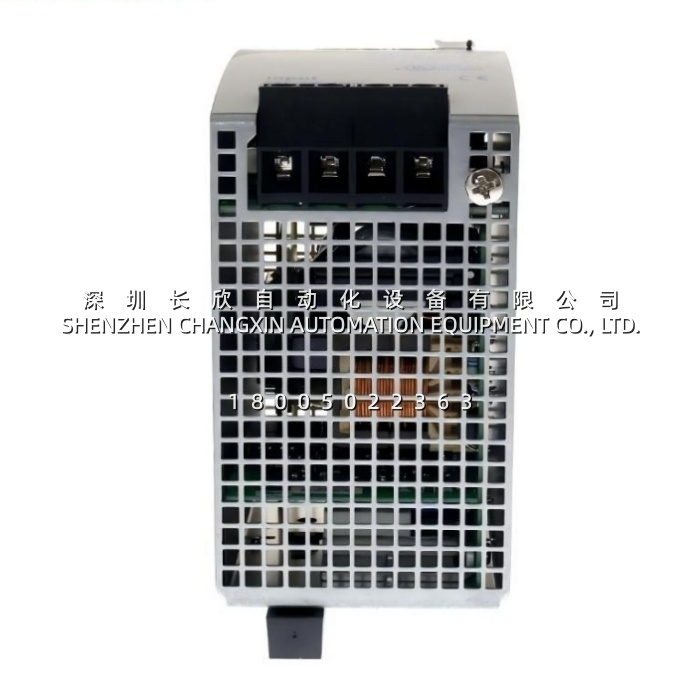
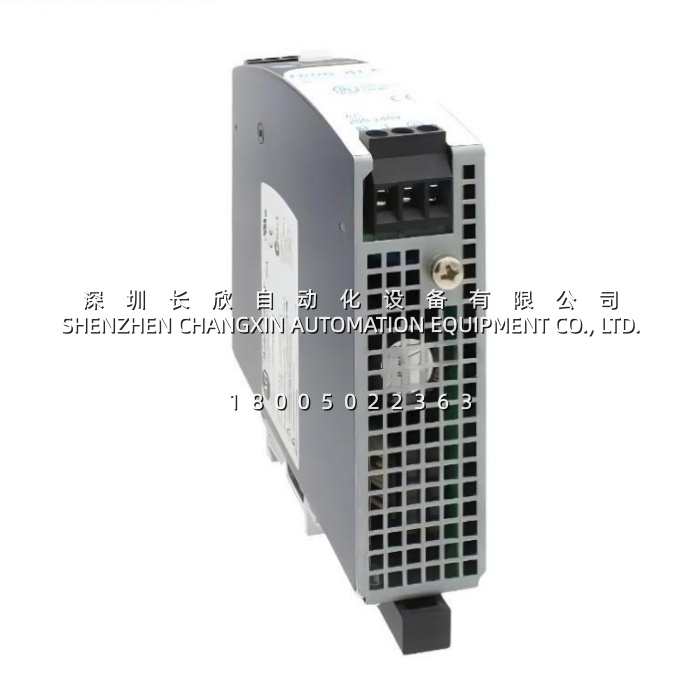
| Mechanical | 32mm wide × 124mm high × 102mm deep (1.26 × 4.88 × 4.02 in). DIN rail and wall-mountable; not direct/chassis-mountable |
| Terminals | Screw connection; torque 0.2–0.25 N·m (2.2 kgf·cm). Spring-washer and ferrules welcome, over-torque strips the clamp |
| Protection / EMC | IP20, open-style (cabinet-mount only). Immunity per IEC 61000-4-2/3/4/5/6/8/11; ESD 8kV air / 6kV contact; radiated 10V/m; EFT 2kV; surge 2kV line-to-earth; conducted 10V |
| Environment | –25 °C to +70 °C operating, –25 °C to +85 °C storage, 5–95% RH non-condensing |
| Shock / Vibration | 30g / 6ms and 20g / 11ms shock; 2g vibration, 10–500Hz |
| Reliability | MTBF 2,243,000 hours @ 40°C (SN29500); minimum service life 77,000 hours @ 40°C, 24V/3.3A — that is roughly 8.8 years flat-out, and the datasheet notes >160,000h at half load |
| Weight | 430g (0.95 lb) |
| Certifications | cULus Listed (NEC Class 2 output), CE, RCM; Country of origin is multi-source (CN among others) — confirm the label on the unit you receive |
| Agency Special Feature | NEC Class 2 output. That designation is what lets you run the 24V side with Class-2 wiring methods and limited-current protection; do not defeat it by paralleling outputs or stacking boost mode |