WhatsApp:+86 18005022363 WeChat: +86 18005022363
 Email:

Description
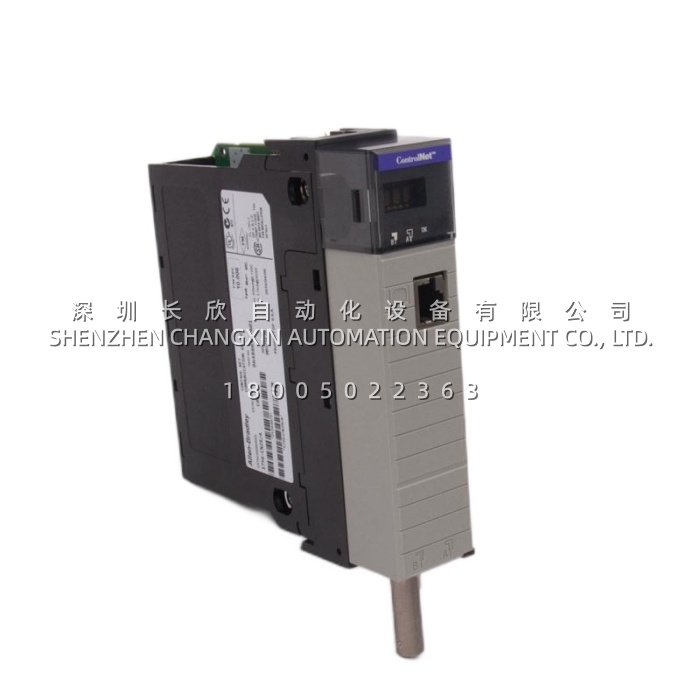
Technical Specifications
| Parameter | Value |
|---|---|
| Product Model | 1756-CN2R |
| Manufacturer | Rockwell Automation / Allen-Bradley |
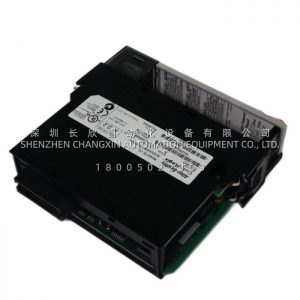
| Product Type | ControlLogix ControlNet Redundant Media Bridge Module |
| Network Protocol | ControlNet (CIP / CTDMA) |
| Data Rate | 5 Mbps (fixed) |
| ControlNet Ports | 2 × BNC (Channel A and Channel B) |
| USB Port | 1 × USB 1.1 Series B, 12 Mbps (local config/diagnostics) |
| Logix Communication Connections | 128 (131 total; 3 reserved for redundant control) |
| Maximum Nodes per Segment | 99 |
| Media / Cable | 1786-RG6 quad-shield RG6 coaxial |
| Backplane Current Draw | 1.3 A @ 5.1V DC; 3 mA @ 24V DC |
| Power Dissipation | 6.6 W (22.9 BTU/hr) |
| Isolation Voltage | 30V DC continuous; tested at 500V AC for 60 s |
| Slot Width | 1 (any ControlLogix chassis slot) |
| Chassis Compatibility | 1756-A4, 1756-A7, 1756-A10, 1756-A13, 1756-A17 |
| Compatible Power Supplies | 1756-PA72, PA75, PB72, PB75, PC75, PH75; redundant PA75R, PB75R, PSCA2 |
| Redundancy Support | Enhanced Redundancy (1756-RM); redundant media |
| Configuration Software | RSNetWorx for ControlNet v6; Studio 5000 / RSLogix 5000 |
| Supported Features | I/O bridge, produced/consumed tags, MSG instructions, adapter mode, remote I/O |
| Indicators | Module status, network status, Channel A, Channel B |
| Weight | 0.293 kg (0.64 lb) |
| Operating Temperature | 0°C to 60°C (32°F to 140°F) |
| Storage Temperature | −40°C to 85°C |
| Relative Humidity | 5% to 95%, non-condensing |
| Shock / Vibration | 30 G operating; 2 G @ 10–500 Hz |
| Enclosure Rating | Open style (none) |
| Certifications | UL, CSA, CE, ATEX, IECEx, C-Tick, FM, GOST, KC, RCM, ABS, DNV, GL, LR, TÜV |
| Warranty | 1 year |
Main Features and Advantages
True redundant media, not just a second port: The two BNC ports of the Allen-Bradley 1756-CN2R are not an either/or choice—they are a live redundant pair carrying the same traffic simultaneously. A broken trunk, a loose BNC connector, or a missing 75-ohm terminator on one channel is reported as a Channel A or Channel B media fault while the process continues uninterrupted on the other. The module’s status LEDs make the failure visible at the rack, and RSNetWorx pinpoints the offending node or cable segment.Capacity that removes the bottleneck: With 128 available Logix connections, the Allen-Bradley 1756-CN2R offers roughly twice the connection headroom of the legacy 1756-CNBR and CNB family. This matters in real plants: every remote I/O rack, every MSG instruction, and every third-party CIP device consumes a connection, and the older 40–48 connection envelope is easily exceeded once a system grows beyond its original design. The higher capacity of the Allen-Bradley 1756-CN2R is why upgrading an existing CNB/CNBR installation is often the cure for persistent CIP connection-timeout faults.Deterministic control-layer performance: ControlNet’s scheduled-data mechanism gives I/O updates and controller-to-controller interlocking priority over program uploads, downloads, and messaging. The Allen-Bradley 1756-CN2R therefore delivers repeatable scan behavior even while an HMI is being serviced or a program is being transferred—a characteristic that makes it suitable for high-speed interlocking and motion-coordination tasks where jitter cannot be tolerated.One module fits both roles: A single Allen-Bradley 1756-CN2R can operate as a standard single-media bridge if only Channel A is connected, which simplifies spares holding: the plant keeps one part number that covers both redundant and non-redundant applications. It also supports adapter functionality for remote ControlLogix I/O, so the same module can serve as the communication engine for a remote rack.Physical-layer flexibility: ControlNet supports RG-6 coaxial and 200/230 micron hard-clad silica fiber, and the Allen-Bradley 1756-CN2R can use coax and fiber repeaters to extend distance and provide electrical isolation. The 1786-RG6 quad-shield cable is the standard medium, and no routing tables are required—the network is self-configuring once the node addresses and the maximum unscheduled node address are set.