WhatsApp:+86 18005022363 WeChat: +86 18005022363
 Email:

Description
Application Scenarios
In a coastal integrated steel mill, the caster and hot-strip mill sections sit more than 1.5 km away from the main CENTUM VP control room, separated by high-power rolling-stand drives, VFD cabinets, and heavy crane busbars that saturate the air with conducted and radiated electromagnetic noise. Conventional copper-cabled ESB bus node units (ANB10□) had repeatedly suffered from ground-potential faults and communication dropouts during rolling operations, forcing operators to perform costly shielded-cable rerouting with marginal improvement. By re-deploying the remote I/O backbone on ANB11D-225 optical node units paired with ANT401 repeater master modules, the mill’s instrumentation team eliminated the ground loop issue entirely, achieved error-free transmission across the noisy zone, and gained the flexibility to locate FIO cabinets directly beside the field equipment — shortening sensor cabling runs and cutting installation cable cost dramaticallycnplcdcs.com+1.
Parameter
| Main Parameters | Value / Description |
|---|---|
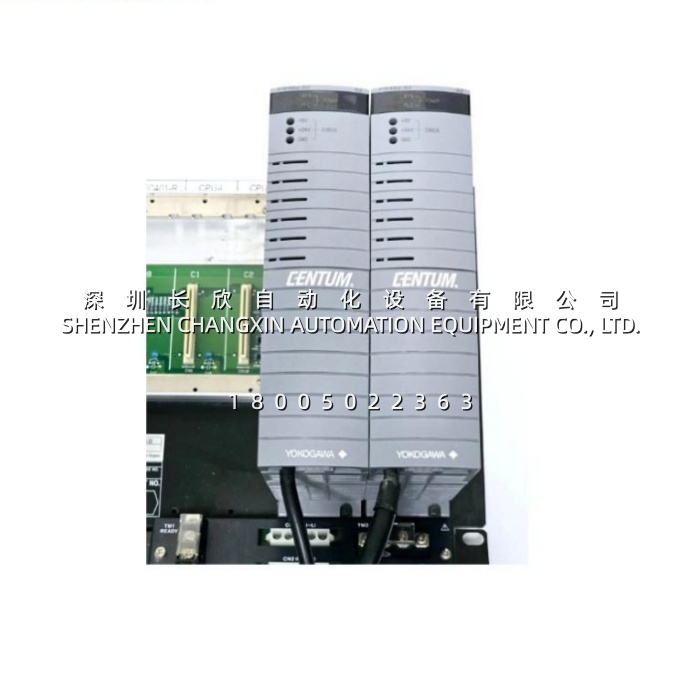
| Product Model | YOKOGAWA ANB11D-225 |
| Manufacturer | Yokogawa Electric Corporation |
| Product Category | Dual-Redundant Optical ESB Bus Node Unit (for N-IO / FIO) |
| Host System | CENTUM VP / CENTUM CS 3000 DCS, AFV30□ / AFV40□ / A2FV50□ FCU |
| Suffix Code Breakdown | -2: dual-redundant PSU + 5 km optical repeater; -2: 220–240 V AC input; -5: basic type |
| Optical ESB Transmission | 5 km with ANT401/ANT502; up to 50 km with ANT411/ANT512 |
| Transmission Medium | Single-mode optical fiber (EMI-immune, ground-potential isolated) |
| I/O Slots | 8 slots (2 reserved for ESB interface modules) |
| Power Supply | 220–240 V AC (range 180–264 V AC), 50/60 Hz |
| Power Consumption | 230 VA / 120 W |
| Dimensions (W × H × D) | 482.6 × 132.5 × 310 mm (19-inch rack-mountable) |
| Weight | Approx. 10 kg (loaded with 8 I/O modules) |
| Operating Temperature | 0 – 50 °C (basic); −20 – 70 °C (with /G3 option) |
| Relative Humidity | 5 – 95% RH (non-condensing) |
| Redundancy | Dual-redundant PSU + dual-redundant ESB bus paths |
| Optional Interfaces | /BU2A (ESB connector), /BU2B (ESB connector with terminator), /HU2A (HKU cabinet monitor) |
| Safety & EMC Certifications | CSA, CE, FM non-incendive; ATEX/IECEx (explosion-protected option); CE, C-Tick, KC EMC |
Technical Principles and Innovative Values
- Innovation Point 1 — Complete Electrical Isolation via Optical Transmission. The ANB11D-225 converts every ESB bus signal to optical pulses, physically eliminating common-mode voltage, ground-potential differences, and conducted EMI between the FCU cabinet and remote I/O cabinets. This is a structural advantage over copper ESB (ANB10□), where shield quality directly constrains link stability in VFD-dense environmentscnplcdcs.com.
- Innovation Point 2 — Dual-Redundant Power & Dual-Redundant Bus in One Chassis. With two independent power modules and dual ESB bus paths, a failure of either supply rail or either fiber leg does not interrupt I/O processing. Switching is bumpless at the FCU, a critical property for continuous-process plants that cannot tolerate a data gap during module swapinnoplcsync.com+1.
- Innovation Point 3 — Distance Class Selection at Order Time. By pairing the ANB11D-225 with ANT401 (5 km class) or ANT411 (50 km class) repeater master modules at the FCU side, the same node unit supports both intra-building and inter-building / across-site deployments without changing the node hardware, simplifying spares holdingyokogawa.com+1.
- Innovation Point 4 — Integrated HKU Cabinet Condition Monitoring. With the optional /HU2A interface, the node unit reports internal cabinet temperature and fan status to the FCU over the optical ESB bus itself, so operators watch the remote cabinet health from the same console that monitors the I/O — no separate RTU or dial-up diagnostics requiredyokogawa.com+1.
- Innovation Point 5 — Sustained Performance in Harsh Thermal Environments. The /G3 low-temperature option extends the operating envelope of the ANB11D-225 to −20 – 70 °C, enabling deployment in unheated offshore enclosures, arctic pipelines, and desert field stations where standard electronics derate or failcnplcdcs.com+1.