WhatsApp:+86 18005022363 WeChat: +86 18005022363
  Email:
Description
Application Scenarios:
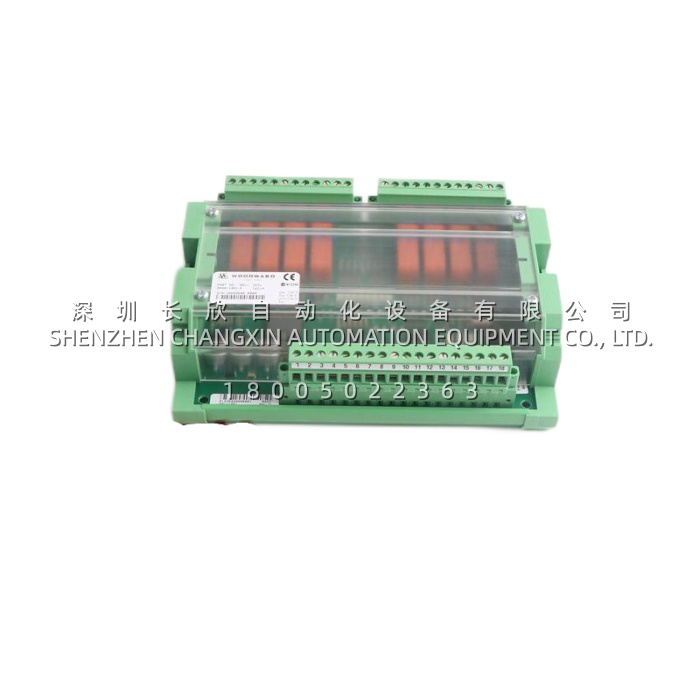
A machine builder assembles a remote I/O node for a packaging line: a fieldbus coupler, eight digital input cards reading photo-eyes and proximity switches, four digital output cards driving solenoid valves and contactors, and a couple of analog cards for a temperature loop. The cabinet’s 24 VDC switch-mode supply sits at the bottom of the panel. The naive approach is to feed 24 V into the coupler and let it run down the assembly — which works until the output cards start pulling real current, the voltage at the far end sags, and the solenoid valves begin dropping out intermittently in a way that looks exactly like a fieldbus fault.The 750-602 solves this at the design stage. Placed after the coupler, it injects 24 V fresh from the PSU at that point in the assembly, feeding up to 10 A downstream. Add a second 750-602 midway and the node is split into two independently fed potential groups — which in practice means the solenoid and contactor group can be switched off for a safety stop or an emergency-off circuit while the input cards, the analog cards and the fieldbus coupler stay alive and reporting. That is the real value here: not raw current capacity, but the ability to segment a single fieldbus node into isolated power domains without adding a second coupler. In a machine where a safety function must kill actuator power while the controller keeps watching the process, that is a design requirement, and the 750-602 is the cheapest way to meet it.The second recurring scenario is brownfield expansion. A node was commissioned years ago with three I/O cards and has since grown to fifteen. Nobody recalculated the field current budget. The symptom is heat at the first power jumper contact and mysterious resets under load. Dropping an additional 750-602 into the middle of the assembly — no rewiring, no reconfiguration, no addressing — redistributes the load and removes the fault, which is a ten-minute fix compared with re-engineering the field supply.
Parameter:
| Main Parameters | Value / Description |
|---|---|
| Product Model | 750-602 |
| Manufacturer | WAGO Kontakttechnik GmbH & Co. KG (Germany) |
| Product Category | Passive supply / potential feed module — field-side 24 VDC distribution |
| Platform | WAGO I/O System 750 and 753 |
| Signal Type | Voltage — 24 VDC |
| Supply Voltage (System) | 5 VDC, via data contacts — comes from the coupler, not from this module |
| Supply Voltage (Field) | 24 VDC, −25 % to +30 % (≈ 18.0…31.2 VDC), via power jumper contacts |
| Current Carrying Capacity | 10 A DC via power jumper contacts — the total budget for everything downstream |
| Outgoing Power Jumper Contacts | 3 |
| Connection Technology | 6 × CAGE CLAMP® spring terminals |
| Conductor Range | 0.08 … 2.5 mm² / AWG 28 … 14, solid or fine-stranded |
| Strip Length | 8 … 9 mm / 0.31 … 0.35 in |
| Indicators | LED (C) green — operating voltage status at the power jumper contacts |
| Dimensions (W × H × D) | 12 mm × 100 mm × 69.8 mm; 62.6 mm depth from upper edge of DIN rail |
| Weight | 43.3 g |
| Housing Material | Polycarbonate; polyamide 6.6, light gray; fire load 1.169 MJ |
| Mounting | DIN-35 rail, snap-on; horizontal (standing/lying) |
| Ambient Temperature | 0 … +55 °C operating; −40 … +85 °C storage |
| Protection / Pollution Degree | IP20; pollution degree 2 per IEC 61131-2 |
| Operating Altitude | 0 … 2000 m |
| Vibration / Shock | 4 g per IEC 60068-2-6; 15 g per IEC 60068-2-27 |
| EMC | Immunity EN 61000-6-2 and emission EN 61000-6-4, marine applications |
| Certifications | CE; UL 508 (E175199); ATEX / IECEx / CCCEx / INMETRO / KTL / UKEx (II 3 G Ex ec IIC T4 Gc); UL 121201 hazardous locations (E198726); EAC; KC |
| Marine Approvals | ABS, BSH, BV, DNV, KR, LR, PRS, RINA |
| Customs Tariff / GTIN | 85389091890 / 4045454393731 |
Technical Principles and Innovative Values:
Innovation Point 1: Passive distribution, with all the reliability that implies. The 750-602 contains no semiconductors, no switching stage and no regulation circuitry — it is six CAGE CLAMP terminals, three jumper contacts, a status LED and a housing. There is no firmware, no configuration, no address, and no process image entry. The practical consequence is that there is almost nothing to fail, and nothing to configure when one is added or replaced. In a distributed I/O node where every other module needs commissioning attention, the supply module is the one component you can genuinely treat as fit-and-forget.Innovation Point 2: Potential-group segmentation as a first-class design tool. WAGO’s documentation notes that supply modules may be used to change the supply voltage to certain I/O modules within a single fieldbus node. In practice this is how machine builders create isolated power domains: outputs on a switched group that a safety relay can kill, inputs and analog on an unswitched group that must stay alive. Two 750-602 modules give you two independently controlled groups on one coupler, at the cost of 24 mm of rail — vastly cheaper and simpler than a second fieldbus node with its own coupler and address.Innovation Point 3: A 10 A ceiling that forces honest current budgeting. The 10 A rating on the 750-602 is stated as a limit on the total current drawn by all connected modules, and WAGO is explicit that exceeding it requires adding an intermediate supply module. That constraint is a design feature rather than a limitation: it pushes the current budget into the design phase, where it costs nothing, instead of into commissioning, where it costs days. The rule of thumb that follows is simple — total the field-side current of every module to the right of a 750-602, and if it approaches 10 A, insert another one.Innovation Point 4: 12 mm of rail for 10 A of distribution. At 12 mm wide, the 750-602 occupies the same rail slice as a typical I/O module while carrying the current for a dozen of them. In a densely packed control cabinet where DIN rail length is genuinely contested space, that ratio is what makes the segmentation economy work — you can afford to add feed points because each one costs almost nothing in panel real estate.Innovation Point 5: Approvals breadth that removes the requalification conversation. The 750-602 carries ATEX, IECEx, CCCEx, INMETRO, KTL and UKEx for hazardous areas (II 3 G Ex ec IIC T4 Gc), UL 508 for ordinary locations, UL 121201 for Class I Division 2, and eight marine society approvals including DNV, ABS, BV, LR and RINA. For an OEM shipping the same machine design into a Zone 2 chemical plant, a North American Class I Div 2 installation and a shipboard application, one part number covers all three — which eliminates the variant engineering, the separate bills of materials and the separate certification paperwork that would otherwise attach to each market.
-300x300.jpg)