WhatsApp:+86 18005022363 WeChat: +86 18005022363
  Email:
Description
Technical Specifications
| Parameter | Value |
|---|---|
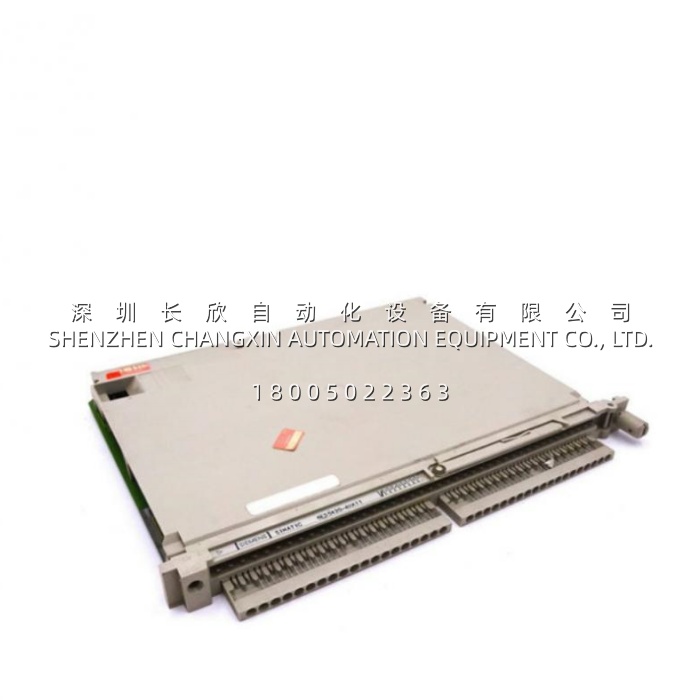
| Product Model | 6ES5420-4UA11 |
| Manufacturer | Siemens (SIEMENS) |
| Product Type | Digital Input Module (SIMATIC S5-420 Series) |
| Number of Inputs | 32 (non-floating / potential-bonded) |
| Input Voltage | DC 24 V (nominal, per S5 sensor-bus convention) |
| Input Type | Sink/source compatible per S5 24 V DC DI convention (PNP sensor typical) |
| Channel Isolation | Non-floating (channels share common reference to rack M) |
| Mechanical Version | Compact Version U (shorter depth vs. standard/K) |
| Compatible Rack | S5-115U central rack (primary); S5-135U with configuration note |
| Front Connector | S5 standard front-connector interface (20-pin or 46-pin depending on 32-point wiring breakdown — verify against original panel drawing) |
| Operating Temperature | 0 °C to +60 °C |
| Storage Temperature | -40 °C to +70 °C |
| Protection Class | IP20 (control-cabinet) |
| Power Dissipation | Typ. ~3–5 W (all 32 channels active, LED load included) |
| Weight | approx. 0.42 kg |
| Commodity / HS Code | 85389091 |
Main Features and Advantages
32 × 24 V DC density in a single S5 slot. The S5 central rack (S5-115U chassis) is a limited resource — a standard 9-slot rack might carry a PS, a CPU, possibly a CP (communications processor), and then DI/DO/AI/AO modules fighting for the remaining positions. The 6ES5420-4UA11 packing 32 inputs into one slot is the reason many S5-115U panels manage to close out their I/O count without going to expansion racks or ET 100U distributed I/O, which would mean IM (interface module) cost and another rack footprint. For a panel originally drawn with four 420 DIs (128 points) and three 421 DOs (96 points), the 6ES5420-4UA11 is the exact 32-point DI building block.Compact Version U mechanical — clearance-friendly. S5 modules came in three mechanical depths: “standard” (full depth, e.g. many AI/AO and CP modules), “K” (compact, shorter), and “U” (compact, slightly different dimensional envelope, often used on 420/421/460 high-density DI/DO to keep the rack shallow). The 6ES5420-4UA11 in Version U is deliberately shorter than a full-depth S5 module, which matters when the cabinet backplane is close to a wall, or when a deep neighbour module (say a S5-465 analogue or S5-470 CP) sits adjacent and the wiring duct behind needs room. Panel retrofits that discover “the original 420 K doesn’t quite clear the new cabinet gutter” often swap to the 6ES5420-4UA11 U version for the few millimetres of saved depth — a trivial-looking dimension that resolves a real mechanical clash.Non-floating topology for cost and simplicity. The 6ES5420-4UA11 bonds all 32 inputs to the rack/M reference. For sites where the 24 V DC sensor supply is derived from the S5 PS 24 V auxiliary (6ES5951-7ND11 etc.) or otherwise shares the S5 0 V rail, this is the correct topology — no per-group isolation needed, fewer terminals, lower module cost versus a 430 floating equivalent. The trade-off: you cannot mix sensor loops that sit at different ground potentials (e.g. a 24 V DC sensor powered from a drive-DC bus that floats relative to S5 M). That’s a real constraint, but in perhaps 80% of S5-115U panels the sensor bus is S5-referenced, so the 6ES5420-4UA11 is the right default, not a compromise.LED-per-channel diagnostics. Like most S5 DI modules, the 6ES5420-4UA11 surfaces each input state on a front-panel LED (typically a row of 32 green LEDs behind the cover, grouped visually). On a Monday-morning fault call — “conveyor won’t auto-restart, E-Stop chain OK, looking for the limit that didn’t make it” — the maintenance tech pulls the panel door, sees LED 17 dark when the physical limit is made, and knows instantly: either the limit switch N/C contact, the 24 V feed to that sensor, or the field wiring to terminal 17 on the 6ES5420-4UA11 front connector. Without per-channel LEDs you’re hunting with a multimeter; with them you’re done in thirty seconds.Step 5 symbol/address mapping unchanged from the 1980s. The 6ES5420-4UA11 enumerates in Step 5’s I/O table exactly as the original S5-115U hardware manual specifies: 32 inputs map to the rack slot’s byte/bit addresses (PIB/PIW space depending on slot and rack IM configuration). No GSD, no TIA Portal migration headache, no firmware mismatch — if the rack expects a 420-4 in that slot, the 6ES5420-4UA11 drops in and the existing Step 5 project sees it identically to the original. For brownfield continuity this is the entire value proposition.NOS and refurb with rack-test. Because the 6ES5420-4UA11 is S5-obsolete, every unit moving through a specialist channel should be rack-tested: seat in a S5-115U test rig, toggle all 32 inputs from a patterned driver, verify LED response and backplane bus handshake, check the front-connector pin retention (S5 30-year-old plastic headers sometimes crack), and only then ship. The 6ES5420-4UA11 silicon rarely fails; the weak points are the header and the LED lens yellowing, neither of which affects function — but a pre-ship check catches a cracked header before it becomes a panel-install Friday-night frustration.