WhatsApp:+86 18005022363 WeChat: +86 18005022363
  Email:
Description
Technical Specifications
| Parameter | Value |
|---|---|
| Product Model | 6ES5375-1LA15 |
| Manufacturer | Siemens |
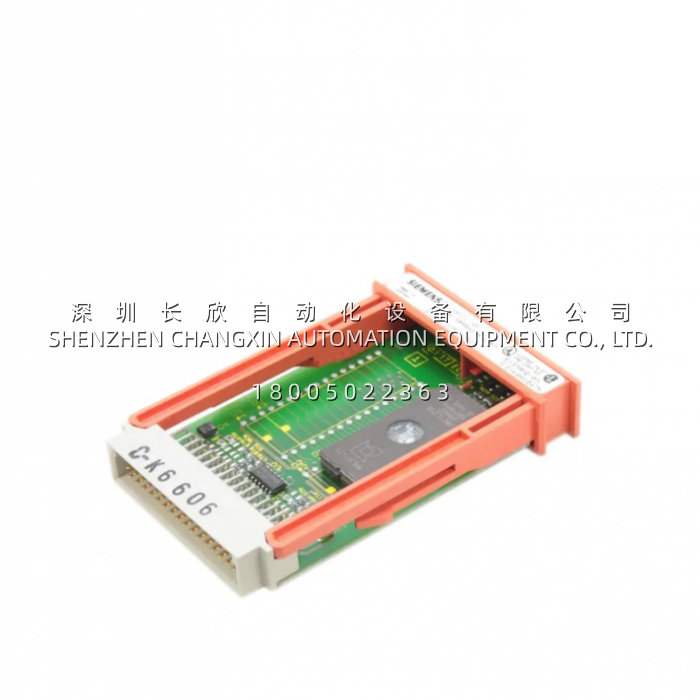
| Product Type | CMOS EPROM Memory Submodule |
| Series | SIMATIC S5-375 |
| Memory Capacity | 8 KB (8K × 8 bit, 2764 chipset) |
| Memory Technology | CMOS EPROM, UV-erasable window |
| Compatible PLC | SIMATIC S5-95U / 100U / 115U / 135U / 155U |
| Programming Method | External PG or PC parallel programmer (not in-PLC) |
| Programming Voltage (VPP) | 21–25 V (programmer-dependent) |
| Interface | 28-pin DIN sub-module connector |
| Data Retention | ≥ 10 years (typical, no UV exposure) |
| Operating Temperature | –25 °C to +60 °C |
| Dimensions (approx.) | 75 × 110 × 30 mm |
| Weight (approx.) | 100 g |
Main Features and Advantages
Authentic Siemens S5-375 platform fit. The 6ES5375-1LA15 is the factory-defined 8 KB EPROM submodule for the S5-375 carrier, with a 28-pin DIN footprint that drops directly into the memory slot of S5-95U through S5-155U CPUs without adapter changes. For legacy plants still running S5, using the correct 1LA15 instead of a higher-density sibling avoids mismatched load mapping and prevents the subtle step-count or DB-frame issues that can surface when an incorrect density module is forced in.CMOS EPROM reliability for long-term retention. Unlike volatile RAM (6ES5375-0LDxx) that depends on a live backup battery, the 6ES5375-1LA15 stores OB, PB, FB and SB code blocks plus pre-formatted DB frames in UV-erasable EPROM silicon. Once programmed externally via STEP 5 and a PG695/710/720/730 or PC parallel programmer, the image survives power loss, battery depletion, and transport. Data retention is rated at 10+ years under typical industrial ambient, with the quartz window clearly visible for verification of erase/program cycles.Cold-start resilience through automatic RAM load. A frequently overlooked advantage of the 6ES5375-1LA15 in ageing S5 racks is its role in disaster recovery. When the CPU detects blank or battery-invalidated internal RAM at power-up, it pulls the entire submodule image into working memory automatically—no manual intervention, no cable reconnect, no re-download from engineering station. For remote sites or 24/7 process lines, this behavior turns a potential multi-hour recovery into a clean reboot.Cost-effective compared to EEPROM alternatives. For applications where program updates are infrequent and the plant already owns a UV eraser, the 6ES5375-1LA15 carries a lower acquisition cost than the EEPROM equivalents (6ES5374 / 6ES5375-0LCxx) while delivering identical non-volatility. The trade-off—needing physical removal and ~15–30 min UV exposure before reuse—is acceptable in many retrofit and spare-part scenarios where the module is programmed once and left in service for years.STEP 5 ecosystem compatibility. Every 6ES5375-1LA15 works with all STEP 5 versions (V3.0 through V7.2+) provided the programming hardware side is correct; the module itself imposes no software ceiling. This matters for mixed-version engineering benches where older PG units still handle S5 downloads alongside newer Windows-based STEP 5 installs.
Application Field
The 6ES5375-1LA15 is deployed wherever SIMATIC S5 controllers are still the active control layer—common in process plants, water/wastewater treatment, legacy automotive press lines, packaging machinery, material handling, and infrastructure subsystems where a full S7 migration has not been justified. In these environments the submodule’s primary job is to hold the validated, production-release version of the PLC user program (organization blocks, program blocks, function blocks, step blocks and pre-structured data block headers) so that a rack power cycle, battery exhaustion, or scheduled CPU swap does not force a re-download from the engineering PG.A typical use case: a 1990s-era S5-115U controlling a batch reactor sequence. The plant keeps one or two spare 6ES5375-1LA15 modules on the shelf, pre-programmed with the current release image. If the live CPU’s backup battery fails over a weekend and RAM clears, maintenance swaps the submodule (or simply reboots—since the submodule is already seated) and the process resumes from the last committed code state. No STEP 5 laptop, no hunting for the .STP file, no requalification of the line.Another common scenario is obsolescence-driven spare banking. As S5 components exit active distribution, system integrators and MRO buyers secure batches of 6ES5375-1LA15 alongside 1LA21/1LA41 siblings to cover multiple S5 rack sizes across a site. Because the 1LA15 is pin-compatible across the 95U–155U span, a single SKU can serve several different CPU models, simplifying storeroom inventory. The module also appears in museum-grade preservation of industrial installations, where maintaining the original EPROM image exactly as burned in the 1990s is part of the archival requirement—something EEPROM’s in-circuit rewrite capability would actually compromise.In all these cases, the value proposition of the 6ES5375-1LA15 is not “new technology” but rather known behavior, known fit, and known recovery path—the three things that matter most at 3 a.m. on a Saturday in a running plant.