WhatsApp:+86 18005022363 WeChat: +86 18005022363
  Email:
Description
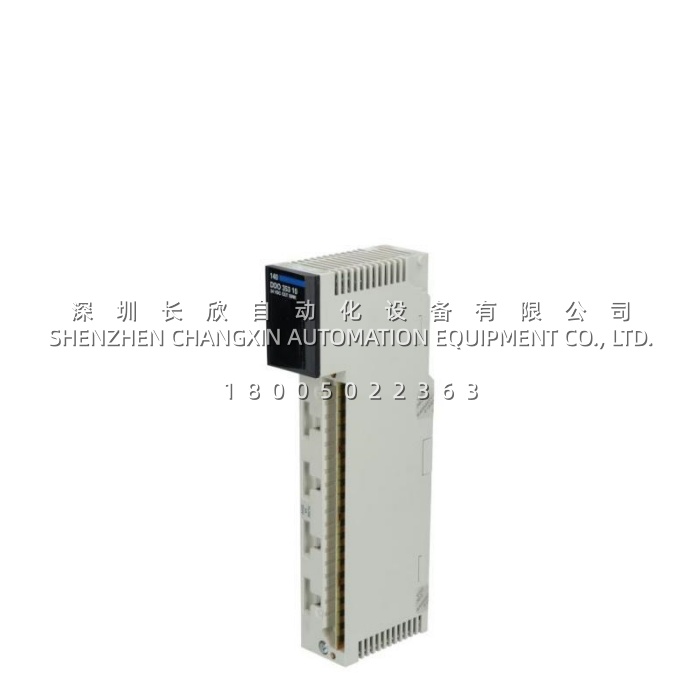
Technical Specifications
| Parameter Name | Parameter Value |
|---|---|
| Product Model | 140DDO35310 |
| Manufacturer | Schneider Electric |
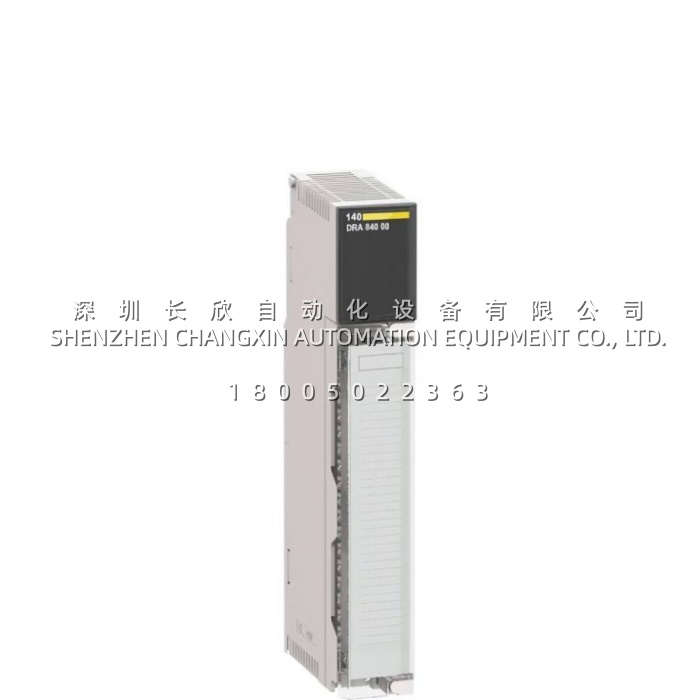
| Product Type | DC Discrete Output Module |
| Product Range | Modicon Quantum Automation Platform |
| Discrete Output Number | 32 |
| Group of Channels | 4 groups of 8, galvanically isolated |
| Discrete Output Logic | Negative logic (sink) |
| Addressing Requirement | 2 output words |
| Discrete Output Voltage | 24 V DC |
| Output Voltage Limits | 19.2 – 30 V DC |
| Absolute Maximum Output | 50 V for 1 s decaying pulse |
| Maximum Load Current | 16 A per module, 4 A per group, 0.5 A per point |
| Surge Current | 5 A for 1 ms |
| Voltage Drop (State 1) | < 0.4 V at 0.5 A |
| Leakage Current | 0.4 mA at 30 V DC |
| Response Time | ≤ 1 ms (state 0 to 1), ≤ 1 ms (state 1 to 0) |
| Maximum Tungsten Load | 12 W at 24 V DC |
| Protection Type | Internal output protection by 5 A fuse per group |
| Associated Fuse Rating | 5 A per group, 3 A per point |
| Fault Indication | Loss of field power, blown fuse |
| Isolation (Channels to Bus) | 1780 Vrms DC for 1 minute |
| Isolation (Group to Group) | 500 Vrms DC for 1 minute |
| Power Dissipation | 2.0 W + (0.4 V × total load current) |
| Bus Current Requirement | 330 mA |
| Local Signalling | 1 green LED (bus active), 1 red LED (external fault), 32 green LEDs (channel status) |
| Operating Temperature | 0 °C to 60 °C |
| Storage Temperature | –40 °C to 85 °C |
| Relative Humidity | Up to 95%, non-condensing |
| Standards and Certifications | UL 508, CSA C22.2 No 142, CE, FM Class 1 Div 2, RINA, GOST, C-Tick, RMRS |
| Module Format | Standard (single slot) |
| Net Weight | 0.45 kg |
Main Features and Advantages
High density without crowding the rack: Thirty-two outputs in one standard Quantum slot is the core economics of the Schneider 140DDO35310. Compared with eight- or sixteen-point cards, it halves or quarters the backplane slots needed for the same output count, which matters most in existing racks where spare slots are already gone and adding a drop means new cabling, new addressing and a shutdown window.Four isolated groups instead of one common: Because the Schneider 140DDO35310 separates its channels into four groups of eight, each with independent field power and fusing, a short circuit or a blown fuse takes out eight channels rather than the whole card. That containment is worth real money in continuous process plants, and it also lets one card serve circuits that must not share a supply.Protection and diagnostics designed for the field: Each group carries an internal 5 A fuse, and the module actively reports both blown fuses and loss of field power — a red fault LED on the front of the Schneider 140DDO35310, plus the corresponding diagnostic in the processor. Alongside 32 individual channel LEDs, this turns fault-finding from a multimeter exercise into a glance at the rack. In practice a large share of modules returned as “failed” have simply blown a group fuse because of an unsuppressed inductive load, which is visible immediately once you know where to look.Isolation that protects the processor: The 1780 Vrms barrier between field wiring and backplane bus is what keeps a field-side transient from reaching the CPU. For a plant running long cable runs to solenoids and motor starters, that barrier is the difference between a replaced output card and a replaced rack.Speed and no mechanical wear: Solid-state switching at ≤ 1 ms in both directions suits high-cycling packaging and sorting equipment, and with no relay contacts there is nothing to wear out, weld or replace.
.jpg)