WhatsApp:+86 18005022363 WeChat: +86 18005022363
  Email:
Description
Application Scenarios
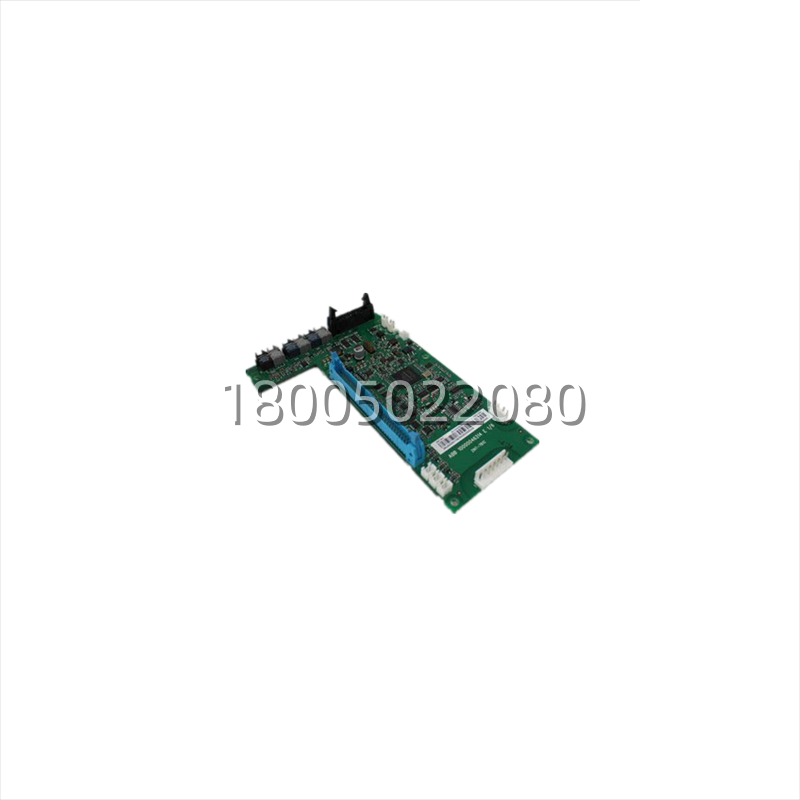
In a high-speed automated packaging line, multiple servo and variable frequency drives must be perfectly synchronized to coordinate the movement of conveyors, fillers, cappers, and labelers. The central PLC issues complex motion commands. The ABB ZINT-7B1C MC Interface Board, installed in each drive, is the critical component that receives these commands over a high-speed industrial network. It interprets the command packets, converts them into precise speed/torque references for the drive’s internal controller, and simultaneously packages real-time feedback data (current, speed, fault status) to send back to the PLC. This seamless, low-latency communication loop enabled by the ZINT-7B1C is what allows the entire line to operate as a single, coordinated machine, directly addressing the core pain points of synchronization accuracy, operational visibility, and rapid fault response in complex motion control systems.
Parameter
| Main Parameters | Value/Description |
|---|---|
| Product Model | ABB ZINT-7B1C MC Interface Board |
| Manufacturer | ABB (Asea Brown Boveri) |
| Product Category | Drive Communication Interface Board / Motor Control Interface |
| Primary Function | Protocol conversion, command processing, and data exchange between controller and drive |
| Host Interface | High-speed industrial fieldbus (e.g., PROFIBUS DP, PROFINET, EtherNet/IP) or dedicated drive link |
| Drive Interface | Proprietary internal bus to drive control board (e.g., to ACSxxx main control) |
| Supported Protocols | Likely PROFIBUS DP-V1, Modbus TCP, or other major industrial Ethernet [Defines network compatibility] |
| Data Exchange | Cyclic process data (PZD) and acyclic parameter data (PKW) [For real-time control and configuration] |
| Configuration | Via DIP switches, software, or keypad on drive |
| Isolation | Galvanic isolation between network and drive electronics [Protects against ground potential differences] |
| Operating Temperature | 0°C to +55°C or 60°C (typical for drive cabinet environments) |
| Power Supply | 24V DC (typical) or sourced from drive internal power |
| Typical Host System | Siemens S7 PLC (PROFIBUS), Allen-Bradley ControlLogix (EtherNet/IP), ABB AC 800M |
| Typical Drive | ABB ACS550, ACS580, ACS880, or similar variable frequency drives |
Technical Principles and Innovative Values
The ABB ZINT-7B1C functions as a dedicated communication co-processor, offloading the complex task of network protocol handling from the drive’s main controller to ensure deterministic performance.
- Innovation Point 1: Dual-Processor Architecture for Deterministic Performance. The board typically features a dedicated network processor alongside a drive interface processor. This architecture isolates the time-critical task of executing the drive’s control algorithm from the variable-timing demands of network communication. The ZINT-7B1C handles all protocol stacks, error checking, and data packaging asynchronously, delivering clean, jitter-free setpoints to the drive controller and ensuring the drive’s real-time performance is never compromised by network traffic, a key advantage for sensitive motion applications.
- Innovation Point 2: Comprehensive Parameter Mapping and Diagnostics. It provides a sophisticated, pre-mapped data interface. Standard process data objects (like control word, status word, speed reference, actual speed) are automatically mapped to readable/writable network variables. Furthermore, it grants direct, tool-free access to hundreds of the drive’s internal parameters (currents, temperatures, fault logs) over the network. This deep integration transforms the drive from a standalone device into an intelligent, fully transparent node on the automation network, drastically simplifying commissioning, monitoring, and predictive maintenance.
- Innovation Point 3: Robust Network Integration with Built-in Isolation. The ZINT-7B1C is engineered for industrial network reliability. It includes galvanic isolation and surge protection on the network port, safeguarding the drive’s sensitive electronics from electrical noise, ground loops, and transients common on plant floors. This robust physical layer integration, combined with support for industry-standard protocols, ensures reliable communication in electromagnetically harsh environments, solving a major source of intermittent drive faults and communication drops.