WhatsApp:+86 18005022363 WeChat: +86 18005022363
  Email:
Description
Application Scenarios
Consider a multi-megawatt onshore wind farm where a turbine suddenly reports erratic blade behavior and initiates repeated safety shutdowns, costing the operator thousands in lost revenue per day. The suspected cause is a failing control board within the nacelle’s Topbox cabinet. A maintenance team deploys to replace the degraded component with a GE 109W3914P002 unit from their spare inventory. The new module seamlessly integrates with the existing Mark VIe system, receives signals from blade angle encoders, and immediately restores precise closed-loop pitch control. Its local intelligence also ensures that when a violent gust is detected, the GE 109W3914P002 rapidly executes a safe “feathering” sequence to shed load and protect the turbine from overspeed damage.
In another scenario, an offshore wind platform in the North Sea is experiencing communication dropouts between the nacelle pitch system and the main SCADA during commissioning. The cause is traced to electrical noise affecting the data lines in the compact nacelle environment. Replacing the initial I/O modules with the GE 109W3914P002 resolves the issue due to its robust RS-485 communication interface and superior noise immunity, demonstrating that the GE 109W3914P002 is not just a spare part but a critical solution for maintaining reliable operations in electromagnetically noisy, offshore conditions.
Parameters
| Main Parameters | Value/Description |
|---|---|
| Product Model | 109W3914P002 (also referenced as IS200WETAH1A) |
| Manufacturer | GE Energy / General Electric |
| Product Category | Wind Turbine Control Module / Specialized PLC Board |
| Series/Platform | WETA Topbox A / Mark VIe Wind Energy Series |
| Core Functions | Pitch & Yaw Control, Safety Chain Logic, Condition Monitoring |
| Digital Inputs | 8 Channels (24V DC) – For limit switches, E-stops, status feedback |
| Digital Outputs | 6 Channels (24V DC / 0.5A) – For relay drivers, valve control, indicators |
| Analog Inputs | 4–20 mA / 0–10 V – For temperature, pressure, vibration sensors |
| Communication | RS-485 (Modbus RTU protocol) |
| Power Supply | 24V DC (Typical) / Wide Range: 12–48V DC |
| Power Consumption | ≤ 10W (Maximum) |
| Operating Temperature | -40°C to +85°C – Full industrial wind grade |
| Protection | Conformal coating for moisture, salt spray, and corrosion resistance |
| Dimensions / Weight | Approx. 63 × 52 × 70 mm / 0.4 kg |
Technical Principles and Innovative Values
Innovation Point 1: Wind-Specific Hardened Design for Extreme Environments
Unlike standard industrial PLC modules, the GE 109W3914P002 is engineered specifically for the extreme conditions inside a wind turbine nacelle. It operates reliably across a -40°C to +85°C range, tolerating summer heat above 60°C, sub-zero winters, constant low-frequency vibration, condensation, and salt spray. The PCB’s conformal coating protects against moisture and corrosive contaminants, giving the GE 109W3914P002 a significantly higher Mean Time Between Failures (MTBF) compared to generic automation cards in this demanding application.
Innovation Point 2: Autonomous Safety Chain Processing
A key safety feature is the GE 109W3914P002‘s ability to operate independently. It continuously monitors critical safety parameters—overspeed, emergency stop, vibration, and grid loss—using its own sensor inputs and built-in logic. Even if communication with the main Mark VIe controller fails, the GE 109W3914P002 can autonomously execute an emergency pitch-to-feather sequence. This localized failsafe protects the turbine’s multi-million-dollar mechanical assets and ensures personnel safety during system faults.
Innovation Point 3: High-Density Control Consolidation
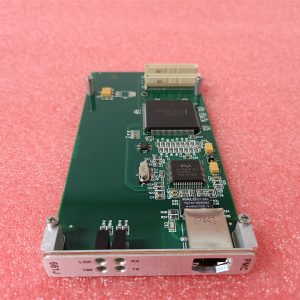
The GE 109W3914P002 integrates digital I/O (8DI/6DO), analog inputs, and communication interfaces onto a single, compact board. This dense consolidation minimizes the footprint inside the crowded nacelle Topbox cabinet and reduces the number of wiring harnesses and potential points of failure, simplifying maintenance and improving overall system reliability.
Innovation Point 4: Deterministic Communication via RS-485
Using a dedicated RS-485 interface with the Modbus RTU protocol, the GE 109W3914P002 ensures deterministic and noise-immune communication with the main controller and pitch drives. The reliable data exchange is essential for precise closed-loop control of blade pitch angle, which directly affects turbine efficiency and structural loading.