WhatsApp:+86 18005022363 WeChat: +86 18005022363
 Email:

Description
Application Scenarios
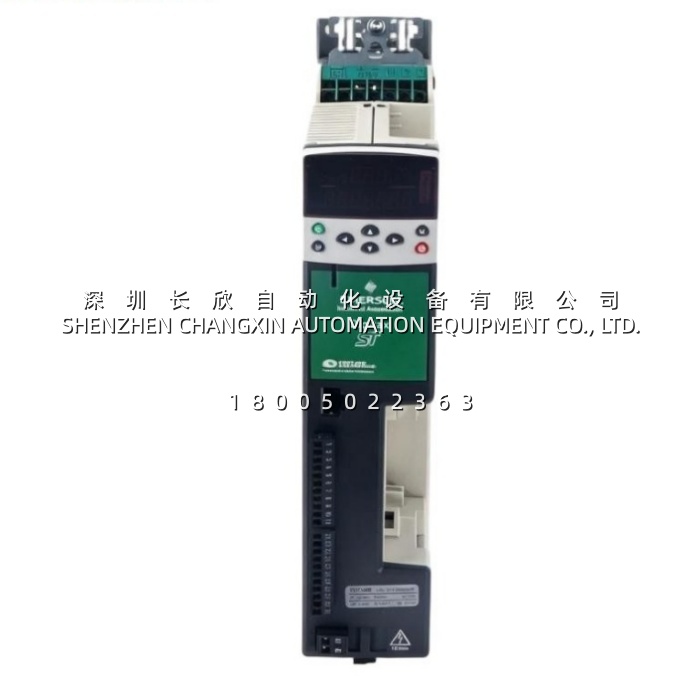
A carton-folder gluer runs the same profile every 1.2 seconds: a 4 kW servo pulls the web, the drive orders 24 A for 180 ms to hit the registration mark, then the load goes regenerative on the decel. The original drive had been “right-sized” on nameplate power and was thermally fine, but the 12 A peak part kept tripping over-current on the long splice runs. Swapping to a DST1405 changed nothing visible on the panel — same 62 mm width, same 400 V three-phase feed, same motor — and everything about the current budget. The 24 A peak is duty-cycle limited, so the drive now sits in the acceleration headroom instead of the fault log. More usefully, the on-board STO input let the plant wire the guard-interlock reset directly to the drive-disable terminals and retire a small safety relay from the bill of materials. The line speed went up 11 % that afternoon; the cabinet did not grow by a millimetre.
Parameter
| Main Parameters | Value / Description |
|---|---|
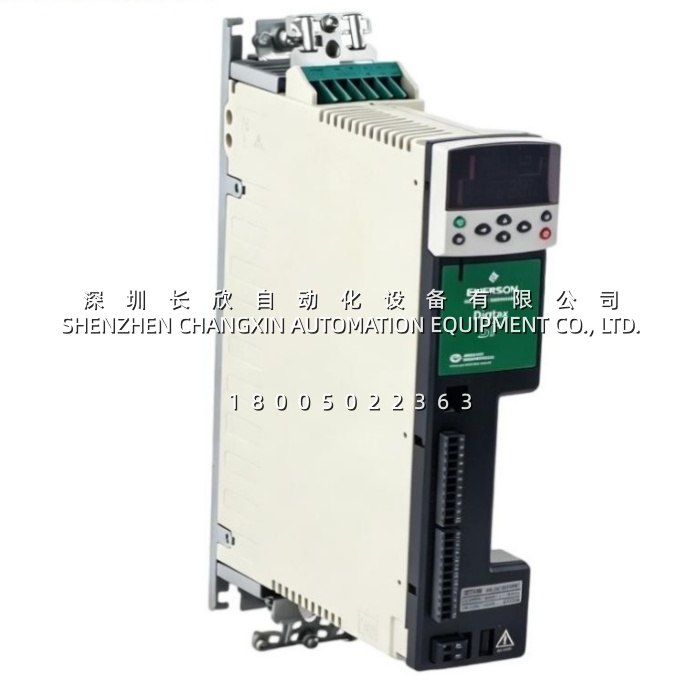
| Product Model | DST1405 — catalogue suffix letter (B / I / P / Z / E) defines the motion variant; bare frame is the ST-B base drive |
| Manufacturer | Nidec Control Techniques, originally Emerson / Control Techniques; still widely catalogued as Emerson CT |
| Product Category | AC Servo Drive / Servo Amplifier, single-axis, 400 V class |
| Supply Voltage | 380–480 V AC, three-phase only, ±10 %, 48–65 Hz — do not land single-phase 230 V on this frame |
| Input Current | 9.9 A rms from the line at 6 kHz switching (published Digitax ST rating table) |
| Continuous Output | 8.0 A rms (pulse-duty / 6 kHz rating); short-time service rating of 9.9 A also appears on the frame label |
| Peak Output | 24.0 A rms, ≈3× continuous, duty-cycle and thermal-model limited — the number that sizes the acceleration, not the nameplate |
| Matched Motor Size | Roughly 3–4 kW permanent-magnet AC servo, 5–7 N·m class continuous; final choice belongs to the duty/load profile, not the amp rating alone |
| Switching Frequency | 3 / 4 / 6 / 8 / 12 kHz selectable; 6 kHz is the rated-performance setting, and continuous current must be derated above 6 kHz |
| Control Loops | Torque, speed and position; current-loop bandwidth ≈1100 Hz, speed-loop bandwidth ≈160 Hz, speed accuracy ≈0.01 %, resolution 0.001 rpm |
| Feedback Support | Incremental encoder, SinCos, absolute (EnDat / SSI-style via option), analog position; Resolver needs the SM-Resolver option module |
| Encoder Throughput | Up to 500 kHz encoder response on the base feedback input; differential quadrature output to 512 kHz for the controller or PLC |
| Braking | Internal 70 Ω brake chopper element, 50 W average over 60 s; external braking resistor supported on the DC-bus terminals for long decel profiles |
| DC Bus | Internal 220 μF bus capacitance, expandable to 660 μF with the approved external capacitor arrangement — use it when the regen energy exceeds the internal chopper’s appetite |
| Drive Losses | 150 W @ 6 kHz · 169 W @ 8 kHz · 207 W @ 12 kHz — the reason the fan and the 40 °C derate exist |
| Digital Inputs | 3 dedicated DI + 3 bidirectional DI/DO, 10–30 V DC, sink/source configurable; one is the STO/drive-disable pair |
| Analogue Inputs | 1 × high-resolution ±10 V (16 bit + sign) plus 2 × general-purpose ±10 V / 0–20 mA / 4–20 mA (10 bit + sign); 1 µs Freeze input for capture-perfect registration |
| Analogue Outputs | 2 channels, ±10 V / 0–20 mA / 4–20 mA — typically speed, torque or motor-current monitor back to the PLC or chart recorder |
| Relay Output | 1 × “Drive OK” NO contact, 2 A @ 240 V AC (4 A @ 30 V DC resistive) — wire it to the panel beacon or the safety controller |
| Serial / Fieldbus | RS-485 two-wire Modbus RTU, 9,600–115,200 baud, native; everything else (EtherCAT, SERCOS, PROFIBUS-DP, CANopen, DeviceNet, EtherNet/IP) rides on the two SM plug-in option slots |
| Safe Torque Off | On-board STO, certified EN 61800-5-2 SIL 3, EN ISO 13849-1 PL e and EN 954-1 Category 3 — dual-channel, hardware-path断开, not a software trip |
| Protection | Over-current, over-voltage, under-voltage, over-temperature, motor thermal-model and encoder-loss detection; EN61800-3 immunity and emissions (2nd environment) with the on-board filter |
| Environment | 0 to +50 °C (derate above 40 °C); −40 to +70 °C storage; ≤95 % RH non-condensing; 0–3000 m, 1 % output loss per 100 m above 1000 m |
| Mechanical | ≈322 × 250 × 62 mm (12.7 × 9.8 × 2.4 in), net 2.1 kg (4.6 lb) excluding keypad and SM modules; panel or DIN-rail mount, IP20 / UL Type 1 / NEMA 1 |
| Lifecycle | Mature product, no longer a current-production shelf item in most regions; supplied as new-surplus, de-installed tested, or repaired against a revision-matched frame |
Technical Principles and Innovative Values
Innovation Point 1 — The frame is deliberately dumb until you tell it what network to speak. The DST1405 base drive carries only the RS-485 Modbus and the raw I/O. The two SM slots are the product’s real trick: snap in an SM-EtherCAT and it is a real-time distributed-clock axis; fit an SM-SERCOS and the fibre ring is native; fit SM-PROFIBUS or SM-CANopen and the same 62 mm wide drive talks to a Siemens, Rockwell or Bosch Rexroth controller. No external gateway, no second 24 VDC supply, no mapping box between the drive and the motion coordinator.Innovation Point 2 — Three times the current where it counts, not where it cooks. Peak ratings are easy to print and hard to deliver. The DST1405 publishes 24 A peak against 8 A continuous, but the fine print is honest: peak is duty-cycle limited and the thermal model runs on the drive, not on the installer’s optimism. That is why a regen resistor, a capacitor and a fan are part of the design instead of accessories. A machine that indexes twice a second sees a drive that is lazy between moves and violent during them — exactly the load profile a servo amplifier should be built for.Innovation Point 3 — STO without a safety PLC line item. Many drives call a digital input “disable” and leave the certification to the panel builder. The DST1405 brings dual-channel STO with SIL 3 / PL e paperwork on the terminal block, so a guard-door contact pair can kill torque through a hardware path while the logic supply and encoder stay alive. The axis is safe, the position is still known, and the restart does not require a re-homing marathon. It is not a substitute for a safety-rated design review, but it removes the usual excuse for skipping one.Innovation Point 4 — A 1 µs freeze input is a registration tool, not a marketing bullet. In web, print and rotary-cut applications the question is never “what was the speed?” but “where was the web when the mark arrived?” The DST1405 dedicates one input to latch the encoder position on a hardware edge, independently of the control-loop task and independently of a noisy PLC scan. Feed it the photoeye and the cut-length math stays honest at 500 kHz encoder rates. That is the difference between a machine that holds ±0.5 mm and one that drifts for two metres before the operator notices.Innovation Point 5 — Cloning is a screw-driver job, not a laptop dependency. Parameters, motor data, encoder setup and the sequential SFC program (on ST-I / ST-Z variants) sit on the SmartCard. Pull it from the donor DST1405, push it into the replacement, and the drive comes up identical — no CTSoft install, no license hunt at 3 a.m. Combined with the pluggable control connectors and the separate SM modules, a failed drive becomes a twenty-minute swap instead of a Sunday commissioning session.