WhatsApp:+86 18005022363 WeChat: +86 18005022363
  Email:
Description
Application Scenarios
In a large automotive manufacturing plant, the control network must accommodate hundreds of PLCs, HMIs, variable‑speed drives, and vision systems spread across multiple assembly lines. Without network segmentation, broadcast traffic and cyber threats can propagate across the entire plant, causing intermittent communication failures that halt production. The 1783‑RMS10T addresses this by providing Layer 3 routing at the industrial edge. Network engineers can configure VLANs to isolate each assembly line, then use the switch’s static or dynamic routing to enable controlled, secure communication between segments—ensuring that a problem on one line does not cascade to others -8. With support for up to 25 VRF instances, the 1783‑RMS10T also enables multi‑tenant network virtualization, allowing separate production zones to coexist on the same physical infrastructure with complete traffic isolation -1.
For a water utility upgrading its SCADA infrastructure, the 1783‑RMS10T serves as a core network aggregation point. Its dual‑power inputs and DLR (Device‑Level Ring) support provide the redundancy that mission‑critical monitoring systems demand. If a cable is severed on one side of the ring, the switch reroutes traffic in milliseconds, maintaining communication between remote pump stations and the central control room -2. The conformal coating on the 1783‑RMS10T board protects against moisture and corrosive gases commonly found in water treatment environments, giving operators confidence that the network infrastructure will withstand the test of time -7.
Parameter
| Main Parameters | Value/Description |
|---|---|
| Product Model | 1783-RMS10T |
| Manufacturer | Allen‑Bradley / Rockwell Automation |
| Series | Stratix 8300 (Layer 3 managed switch) -2-15 |
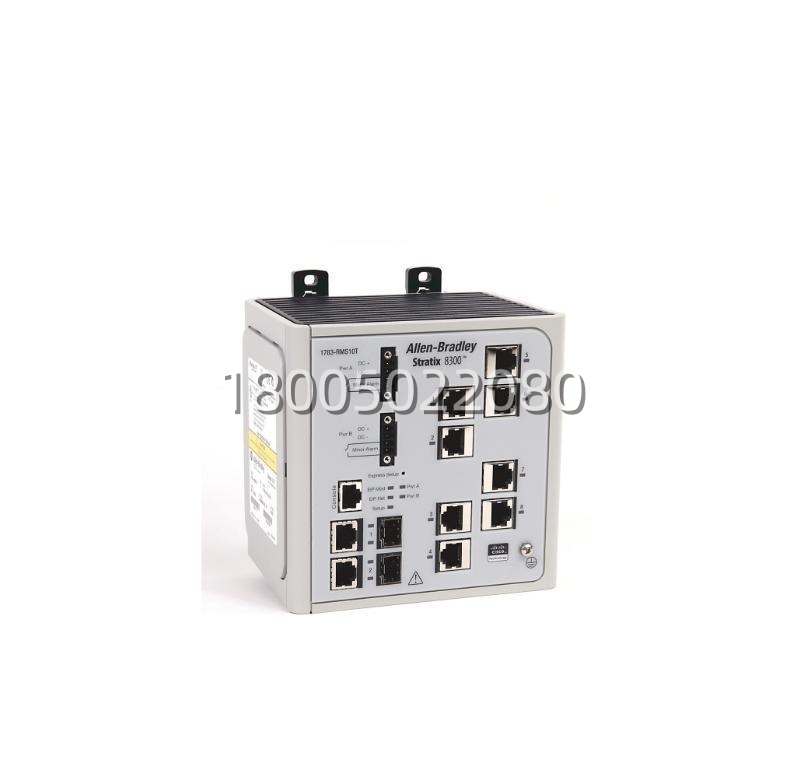
| Port Configuration | 8 x 10/100/1000BASE‑T RJ45 copper ports; 2 x combo ports (copper/SFP) -2-4 |
| Switching Capacity | 20 Gbps -2 |
| Packet Forwarding Rate | 14.88 Mpps -2 |
| Input Voltage | 18‑60 VDC (24V DC nominal) -7-10 |
| Inrush Current | 2 A -7-10 |
| Power Dissipation | 15.7 W max -7-10 |
| Alarm Relay | 30 VDC, 1 A -7 |
| Operating Temperature | 0 to 60°C (32 to 140°F) -2-7 |
| Temperature Code | T4 (North American and IEC) -14 |
| Insulation Voltage | 75 V -7-10 |
| Mounting | DIN rail (35mm) or panel mount; vertical orientation required -2-7 |
| Protective Coating | Conformal coating (board‑level protection) -7-11 |
Technical Principles and Innovative Values
Innovation Point 1: Layer 3 Routing at the Industrial Edge
Unlike standard industrial switches that operate at Layer 2 (bridging), the 1783‑RMS10T incorporates full Layer 3 routing capabilities, including static routes, RIP, OSPFv2, and policy‑based routing -2-8. This enables IT/OT convergence by allowing industrial control engineers to apply enterprise‑grade network segmentation within automation cells, without relying on a central core router. The switch supports static routes on switch virtual interfaces (SVIs) and VRF‑Lite virtualization, delivering the flexibility to securely segment networks for different production zones or security domains -1-8.
Innovation Point 2: Enterprise‑Grade Management with Cisco IOS CLI
The 1783‑RMS10T is built on a proven networking architecture featuring a Cisco‑based operating system, providing network engineers with a familiar command‑line interface (CLI) for configuration and diagnostics -2. This deep management capability includes SNMP v1/v2c/v3, web‑based GUI, SSH/SSL encryption for secure access, and access control lists (ACLs) for traffic filtering -7-12. The integration with Rockwell Automation’s Studio 5000 Logix Designer software allows controls engineers to discover, configure, and monitor the switch directly from the PLC programming environment—bridging the gap between controls and IT teams -2.
Innovation Point 3: Ruggedized Design for Harsh Environments
The 1783‑RMS10T is built for the factory floor, not the server room. Its conformal‑coated circuit board provides protection against moisture, dust, and chemical contaminants that would quickly destroy standard enterprise switches -7-11. The switch must be mounted in a vertical orientation to ensure proper convective cooling, a design choice that acknowledges the constraints of industrial enclosures -7-11. It carries hazardous location approvals (ATEX, IECEx) with a T4 temperature code, enabling installation in environments requiring explosion protection -14.
Innovation Point 4: Network Redundancy and Resiliency
The 1783‑RMS10T supports Device‑Level Ring (DLR) for Ethernet/IP networks and REP (Resilient Ethernet Protocol) for ring topologies, providing sub‑50ms recovery from a single point of failure -2-8. This capability is critical for applications like conveyor systems, processing lines, and utilities where network downtime translates directly to lost production. The switch also supports EtherChannel (LACP) for link aggregation, enabling up to 8 ports to be combined for higher bandwidth or redundancy -1.