WhatsApp:+86 18005022363 WeChat: +86 18005022363
  Email:
Description
Technical Specifications
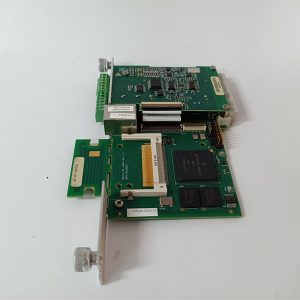
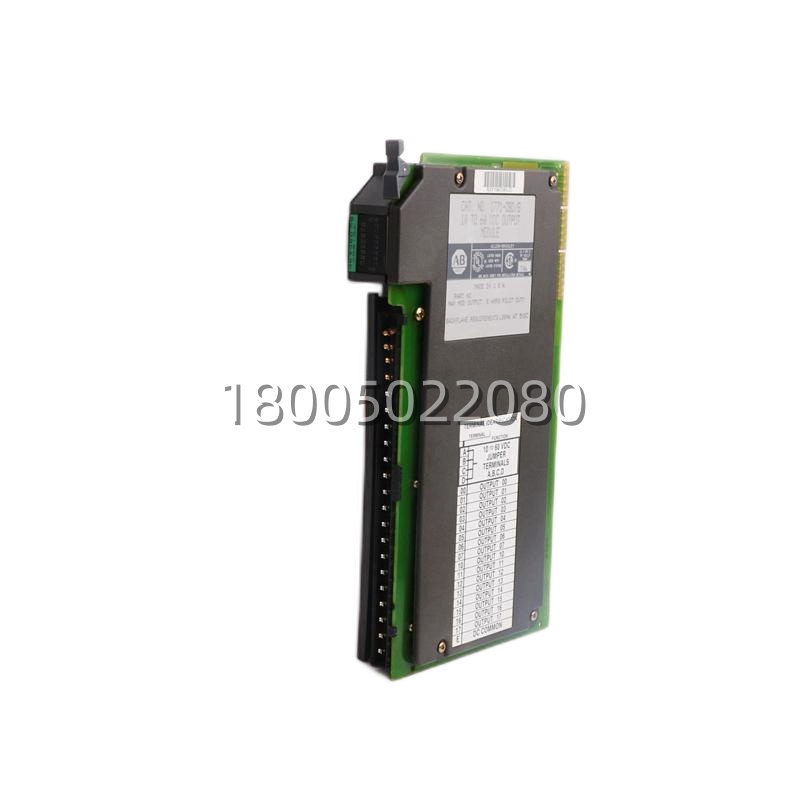
Product Model | 1771-OBN (also 1771-OBN/B, 1771-OBN/C)Manufacturer | Allen-Bradley / Rockwell AutomationProduct Type | 1771 Series 24 V DC Sourcing (PNP) Transistor Digital Output ModuleNumber of Outputs | 32 points (4 isolated groups × 8 points)Output Type | Sourcing (PNP) Solid-State Transistor (high-side switch to +V DC)Operating Output Voltage Range | 10 … 30 V DC (24 V DC nominal)Current per Output Point (max continuous) | 0.5 A @ 60 °C (1.0 A de-rated at lower temps per group limit)Current per Output Group (max) | 4.0 A (protected by 4 A slow-blow fuse per group)Surge Current per Point | 2.0 A for 10 ms, repeatable every 2 sON-State Voltage Drop (max) | 1.5 V DC @ 0.5 AOFF-State Leakage Current (max) | 1.0 mA @ 30 V DCTurn-ON Delay (typ / max) | 0.25 ms / 1.0 msTurn-OFF Delay (typ / max) | 0.25 ms / 1.0 msBackplane Current Draw | 330 mA @ 5 V DC; 0 mA @ 24 V DC (field supply not drawn from backplane)Isolation (Field to Backplane Logic) | 1500 V AC for 60 s; 750 V working (reinforced optical isolation)Fusing | One 4 A, 250 V, Time-Delay (Slow-Blow) fuse per output group; user-replaceableIndicators | 32 individual Output Point LEDs (green); 4 Group Fuse Status LEDs (amber); Module Active LEDTermination Style | 1771-series pivoting wiring arm with screw terminals (e.g., 1771-WN or 1771-WH)Slot Width | 1 standard 1771 slot (approx. 2.75 in / 69.9 mm)Operating Temperature | 0 … +60 °C (+32 … +140 °F)Storage Temperature | -40 … +85 °CHumidity (non-condensing) | 5 % – 95 % RHEnclosure Rating | IP20 (install inside control cabinet / 1771 enclosure)Certifications | UL Listed, cUL, CE Marked, RoHS compliant (later revisions)
Main Features and Advantages
High-density four-group sourcing architecture: The Allen-Bradley 1771-OBN packs 32 sourcing DC outputs into a single 1771 slot—among the highest-density DC output options in the 1771 family—while separating them into four independently fused, electrically isolated commons. This lets you power different machine zones, safety-rated sections, or segregated process areas from distinct 24 V DC supply feeds within one module, containing ground faults and simplifying troubleshooting. Each group’s +V DC terminal is wired to the positive of an external 24 V DC supply; the module sinks the return through the load to 0 V externally.Per-group fusing with front-panel indication: Unlike many generic I/O cards, the Allen-Bradley 1771-OBN includes a user-replaceable 4 A slow-blow fuse on each of the four output groups. If a short circuit occurs on one group, only that group’s fuse opens while the remaining three groups continue operating. An amber LED per group illuminates when the associated fuse is blown, so technicians can instantly see which group needs attention without probing with a multimeter. Spare fuses are standard 4 × 250 mm, 4 A, time-delay glass cartridge types.Optical isolation and transient protection: Reinforced isolation (1500 V AC tested) between the 1771 backplane 5 V logic and the 10–30 V DC field side protects the PLC-5 processor from voltage spikes, inductive kickback, or accidental cross-wiring on the output side. Although the Allen-Bradley 1771-OBN has internal transient suppression, best practice still dictates the use of flyback diodes across DC inductive loads (solenoids, relay coils) to prolong output transistor life.Legacy system compatibility & diagnostics: The Allen-Bradley 1771-OBN is fully recognized by PLC-5 processors (1771-PLC5/, 1785-Lxx), 1771-ASB remote I/O adapters, and compatible 1771 I/O scanners. Configuration is handled entirely through the PLC-5 programming software (RSLogix 5) by assigning the module’s slot position and word address—no DIP switches are required on the module itself. Thirty-two green point LEDs mirror the logic state of each output word bit, giving immediate visual confirmation of commanded output status at the rack.Sourcing (PNP) output suitability: The Allen-Bradley 1771-OBN sources current—i.e., when ON, the output terminal is switched to the group’s +V DC common. This is the conventional wiring method in North American 24 V DC control panels where NPN (sinking) inputs are common on the input side. Ensure your field devices are compatible with a sourcing output; if sinking (NPN) outputs are required, the 1771-ODD or 1771-OBS series should be considered instead of the Allen-Bradley 1771-OBN.
Application Field
The Allen-Bradley 1771-OBN is principally deployed in legacy PLC-5-based control systems that continue to operate in refineries, power generation auxiliaries, pulp & paper mills, metal rolling mills, water/wastewater treatment plants, and large-scale batch process facilities. In these environments, the Allen-Bradley 1771-OBN drives 24 V DC interposing relay coils that in turn energize AC motor starter contactors for pumps, compressors, agitators, and conveyors. It also directly switches 24 V DC solenoid-operated valves used in process skids—such as boiler fuel-gas shutoff, cooling-water diverter valves, and chemical-additive injection solenoids—where the high point count and grouped commons simplify distribution panel wiring.Discrete-manufacturing lines originally commissioned with PLC-5 controllers—automotive body shops, stamping presses, large assembly lines—use the Allen-Bradley 1771-OBN to activate pneumatic clamp solenoids, part-eject cylinders, stack lights (beacons & audible alarms), and guard-door release magnets across multiple machine stations, with each of the four groups mapped to a different cell or safety zone. In bulk-material handling and mining conveyor systems, the Allen-Bradley 1771-OBN operates local start/stop pushbutton indicator lamps, belt-alignment alarm beacons, and chute-jam annunciators fed from distributed 24 V DC power supplies. Because the module is backward-compatible with the extensive installed base of 1771 I/O racks (1771-A1B, A2B, A3B, A4B), the Allen-Bradley 1771-OBN is equally valuable as a direct replacement spare during life-extension programs, keeping mature assets running while longer-term migration to ControlLogix / Studio 5000 is planned. Care should be taken to confirm the PLC-5 program’s I/O image table mapping matches the physical slot position of the Allen-Bradley 1771-OBN, as 1771 I/O addressing is slot-dependent in PLC-5 architecture.