WhatsApp:+86 18005022363 WeChat: +86 18005022363
  Email:
Description
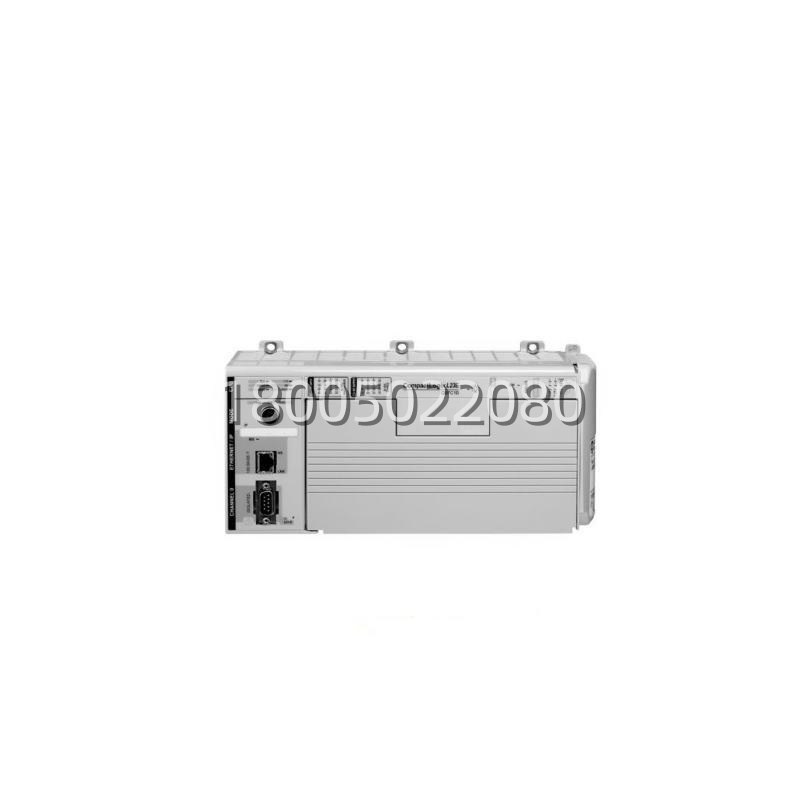
Application Scenarios
Picture a specialty food-packaging OEM designing a new rotary filler for deployment across multiple regional plants. The machine needs to read product-presence photo-eyes (digital inputs), drive pneumatic solenoid banks and indicator beacons (digital outputs), monitor fill-tank level and temperature via 4–20 mA transmitters (analog inputs), and command a variable-frequency drive with a 0–10 V speed reference (analog output)—all while communicating recipe data to a plant-wide MES over EtherNet/IP and allowing local HMI access. Instead of purchasing a separate CPU, power supply, digital I/O rack, analog modules, and communication card, the OEM installs a single 1769-L23E-QBFC1B in a compact NEMA enclosure. The built-in I/O covers the entire machine’s requirements, the Ethernet port connects directly to the plant network, and up to two optional 1769 expansion modules can be added later for extra thermocouple or relay I/O. This solves the classic OEM pain point: delivering full-featured Logix-platform control in the smallest possible panel, with fewer part numbers to source, stock, and wire. Every occurrence of the model number below is shown in bold as requested.
Parameter
| Main Parameters | Value / Description |
|---|---|
| Product Model | 1769-L23E-QBFC1B |
| Manufacturer | Allen-Bradley (Rockwell Automation) |
| Product Category | CompactLogix Packaged Controller with Integrated Power Supply & Embedded I/O |
| User Memory | 512 KB user program + data (battery-backed with 1769-BA); non-volatile retentive tags supported |
| Embedded Digital Inputs | 16 × 24 V DC Sink/Source (IEC Type 1/Type 2 compatible), 10–30 V DC range, 4 mA @ 24 V DC typical |
| Embedded Digital Outputs | 16 × 24 V DC Sourcing Transistor, 0.5 A max per point, 2.0 A max per commons group, short-circuit protected |
| Embedded Analog Inputs | 4 × Differential/Single-ended, selectable 0–10 V DC or 4–20 mA / 0–20 mA, 13-bit resolution + sign |
| Embedded Analog Outputs | 2 × Selectable 0–10 V DC or 4–20 mA / 0–20 mA, 13-bit resolution + sign, ±0.5% full-scale accuracy |
| High-Speed Counters | 4 channels, up to 100 kHz (single-phase) / 50 kHz (quadrature), with 2 HW outputs for PTO/PWM |
| Communication Ports | 1 × 10/100 Mbps EtherNet/IP (RJ45, implicit & explicit messaging, web server capable), 1 × Isolated 9-pin RS-232 (DF1, ASCII, Modbus RTU, DH-485) |
| Expansion Capacity | Up to 2 × 1769-series I/O or specialty modules (limited by backplane current draw) |
| Power Supply (Embedded) | 24 V DC nominal (20.4–26.4 V DC), input current ≈ 500 mA @ 24 V DC + load; 5 V backplane current draw 450 mA |
| Operating Temp / Humidity | 0 °C to +60 °C (32–140 °F); 5–95% RH non-condensing (IEC 61131-2) |
| Mounting / Dimensions | 35 mm DIN Rail (EN 50022) or panel mount; 90 mm × 267 mm × 132 mm (W × H × D approx.) |
| Certifications | UL Listed, cULus, CE, C-Tick, KC, ABS (Marine Optional) |
Technical Principles and Innovative Values
- Innovation Point 1 – True All-In-One Packaged Architecture: Unlike standard 1769 CPUs that require a separate 1769 power supply and individual I/O modules, the 1769-L23E-QBFC1B houses the AC/DC power converter, the Logix-engine CPU, and a full complement of mixed I/O on one PCB. This reduces bill-of-materials count from typically 4–5 items down to 1 (plus the mandatory 1769-ECR end cap), cutting panel space by up to 60% and eliminating inter-module wiring on the backplane.
- Innovation Point 2 – Tag-Based Logix Control with EtherNet/IP at Entry Level: The 1769-L23E-QBFC1B runs the same tag-based Logix control engine as larger ControlLogix and CompactLogix systems, programmed in Studio 5000 / RSLogix 5000 (v16–v20). Its embedded 10/100 Mbps EtherNet/IP port supports both I/O implicit messaging (for remote 1734, 1794 Point I/O) and explicit messaging (for HMI, drives, peer controllers), bringing enterprise-grade networking to standalone machines without add-on scanners.
- Innovation Point 3 – Integrated Mixed Analog + High-Speed Discrete Capability: With four 13-bit analog inputs and two analog outputs factory-calibrated for voltage or current mode, plus four high-speed counter inputs and PTO-capable outputs, the 1769-L23E-QBFC1B handles both discrete sequencing and basic process loops (temperature, pressure, flow) in one unit. This removes the need for a separate 1769-IF4 / 1769-OF2 module in many mixed-control applications.
- Innovation Point 4 – Field-Friendly Diagnostics & Program Retention: Front-panel LEDs indicate PWR, RUN, FORCE, I/O status per point, and COMM health. The controller supports forced I/O from the programming software and retains the user program via battery-backed RAM (1769-BA). A program-upload-with-data option in Studio 5000 allows full project recovery from the controller—critical when original source files are lost during machine reconditioning or relocation.
Application Cases and Industry Value
Case 1 – Dairy Bottle Rinse & Fill Station Retrofit:A dairy co-packer upgraded a manually operated rinse-fill station to automated control. The 1769-L23E-QBFC1B was installed in a small wall-mounted stainless enclosure. Sixteen 24 V DC PNP sensors detected bottle presence at each station (digital inputs), sixteen sourcing outputs actuated fill nozzles and diverter gates, the four analog inputs read tank-level (4–20 mA) and rinse-water temperature (0–10 V RTD conditioned), and one analog output set the CIP pump VFD speed. EtherNet/IP linked the controller to a local PanelView Plus HMI and the site SCADA. The result: 40% reduction in panel footprint vs. the originally quoted 1769-L32E + separate PSU + I/O, zero additional analog cards purchased, and recipe downloads pushed remotely by the OEM via the Ethernet port—reducing startup time by two days.Case 2 – Automotive Component Test Bench:An auto-parts supplier built a bench-top endurance tester for door-latch mechanisms using the 1769-L23E-QBFC1B. The four high-speed counter inputs tracked cycle counts from quadrature encoders on the test actuator, the 16 digital outputs switched pneumatic clamp/unclamp solenoids, and the two analog outputs drove servo-axis setpoints through a third-party amplifier. The RS-232 port logged pass/fail results to a PC running a custom LabVIEW utility via ASCII protocol. By consolidating all functions in one packaged controller, the lab saved bench space, standardized on the Logix platform already used on their production lines, and kept total BOM cost under USD $1,200 for the full control section.
-300x300.jpg)