WhatsApp:+86 18005022363 WeChat: +86 18005022363
  Email:
Description
Technical Specifications
| Product Model | 1769-ASCII |
|---|---|
| Manufacturer | Allen-Bradley / Rockwell Automation |
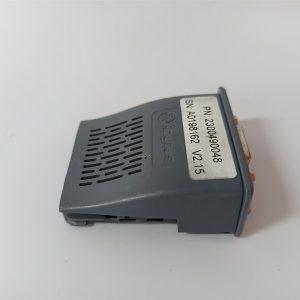
| Product Type | Compact I/O ASCII Serial Interface Communication Module |
| Number of Channels | 2 (Channel 0: RS-232 or RS-422; Channel 1: RS-232 or RS-485 half-duplex) |
| Connector Type | 2 × DE-9 (DB-9 male) |
| Baud Rate | 110, 300, 600, 1200, 2400, 4800, 9600, 19200, 38400, 57600, 115200 bps (per channel, independently selectable) |
| Data Format | 7 or 8 data bits, Odd / Even / No parity, 1 or 2 stop bits |
| Backplane Current Draw | 425 mA max @ 5 V DC (2.13 W typical power dissipation) |
| Isolation | 30 V continuous working, tested to 710 V DC / 500 V AC for 1 minute (port-to-backplane) |
| Handshaking | Hardware (RTS/CTS) and Software (XON/XOFF) |
| Maximum Receive / Transmit Buffer | 255 characters per message (configurable 1–255) |
| Power Supply Distance Rating | Must be within 4 modules of a 1769 power supply |
| Operating Temperature | 0 °C to +60 °C (32 °F to 140 °F) |
| Dimensions (H × W × D) | 142 mm × 34 mm × 87 mm (5.6″ × 1.34″ × 3.43″) |
| Mounting | 35 mm DIN Rail (EN 50022) or panel mount with screws |
| Certifications | UL Listed (UL 508), c-UL, CE marked, C-Tick, Class I Division 2 Groups A/B/C/D (when installed in suitable enclosure) |
Main Features and Advantages
The Allen-Bradley 1769-ASCII provides a uniquely flexible serial gateway capability that sets it apart from standard digital I/O modules, making it indispensable for plants needing to connect legacy or third-party serial equipment into modern Logix-based control architectures.Dual independently configurable isolated ports: Each channel of the 1769-ASCII can be set to a different physical layer (RS-232 vs. RS-422/RS-485) and different communication parameters (baud rate, parity, data bits, stop bits, delimiter settings). This allows one module to simultaneously talk to, for example, an RS-232 barcode scanner on Channel 0 and an RS-485 weigh scale on Channel 1—eliminating the need for two separate interface cards and reducing panel space and cost.Alternating and simultaneous operating modes: In Alternating Mode, a single physical port’s transmit and receive circuits are time-multiplexed to communicate with one device, useful for half-duplex devices. In Simultaneous Mode, both channels operate truly in parallel, each exchanging data with its own attached peripheral. This dual-mode architecture gives programmers precise control over how serial bandwidth is allocated in multi-device applications.User-programmable ASCII protocol handling: Unlike modules with fixed protocol stacks, the 1769-ASCII places full framing control in the hands of the control engineer. Start delimiters, termination delimiters (CR, LF, custom hex values), maximum receive length, ignore-delimiter rules, and timeout conditions are all configurable per channel. The associated Logix ASCII instruction set (ARD, AWA, AEX, ACN, ARL, ASC, DES) enables custom checksum validation, substring extraction, and dynamic message assembly—making the 1769-ASCII capable of interfacing with virtually any proprietary serial text protocol encountered in the field.Backplane-powered, compact, and easy to integrate: Drawing power from the 1769 bus removes the clutter of a separate 24 V DC supply and associated wiring. At only 34 mm wide (one 1769 slot), the 1769-ASCII mounts on standard DIN rail alongside other Compact I/O modules and is automatically recognized by RSLogix 5000 / Studio 5000 with the Add-On Profile (AOP), which creates I/O tags for direct access to transmit/receive buffers, status bits, and error codes without low-level register mapping.Robust industrial signaling and diagnostics: Port-to-backplane isolation protects the controller from ground loops and transient voltages commonly present on long serial runs in industrial facilities. Front-panel LEDs indicate module status (OK/FLT), per-port activity (TX/RX), FIFO status, and handshake line states, while the I/O image provides detailed fault codes (parity errors, buffer overflow, framing errors) accessible from the control program for alarm generation and troubleshooting.MicroLogix 1500 compatibility: In addition to CompactLogix racks, the 1769-ASCII can be used in a MicroLogix 1500 expansion chassis (1769 series rack with 1769-PA2/PA4 or 1769-PB2/PB4 power supply), programmed via RSLogix 500—extending its utility for legacy system upgrades where serial device integration is required without migrating the entire control platform.
Application Field
The Allen-Bradley 1769-ASCII is most commonly applied wherever a CompactLogix or MicroLogix 1500 controller must acquire data from or send commands to equipment that offers only a serial ASCII or raw-byte interface. In packaging and converting lines, the 1769-ASCII connects high-speed omnidirectional barcode scanners and vision-based ID readers to capture product traceability data in real time, appending check digits and forwarding validated strings to upstream MES or labeling systems. Food, pharmaceutical, and bulk-material processing plants use the 1769-ASCII to poll digital weigh scales, checkweighers, and loss-in-weight feeders that output weight values as comma- or delimiter-separated ASCII strings, enabling lot tracking and fill-control loops directly in the PLC program.In printing and converting operations, the 1769-ASCII drives inkjet or thermal-transfer printers by sending variable print-data messages (date codes, batch numbers, serial numbers) over RS-232, synchronized with the machine’s cyclic timing. For legacy equipment retrofit—such as older temperature controllers, analytical instruments, or custom-built test stands that communicate via RS-485 multi-drop ASCII—the 1769-ASCII in Simultaneous Mode can serve as a Modbus ASCII master/slave (via user-coded logic) or simply parse vendor-specific text frames, preserving the usefulness of otherwise “islanded” assets. Building automation and facility management systems also benefit from the 1769-ASCII, linking gas/energy sub-meters and environmental monitors that report via serial protocols into a central CompactLogix-based supervision and alarming scheme. Because the 1769-ASCII imposes no predefined protocol, it remains the go-to solution for one-off or custom serial integrations across automotive, semiconductor, water/wastewater, and discrete manufacturing sectors worldwide.
Related Products
- 1769-SC — Serial Communication Interface Module; single-channel RS-232/RS-485, lower-cost alternative to the 1769-ASCII when only one serial port is needed and dual-channel operation is not required.
- 1769-L33ER / 1769-L36ERM — CompactLogix 5370 L3 controllers with embedded Ethernet/IP and optional built-in RS-232 port; if ASCII needs are minimal, the embedded port can substitute for basic serial tasks, though the 1769-ASCII is preferred for dual-port or isolated requirements.
- 1769-IF4 / 1769-IF8 — 1769-series analog input modules; often installed in the same rack as the 1769-ASCII for hybrid applications combining serial instrument reading with analog sensor acquisition.
- 1769-OW8 — 1769-series 8-point relay output module; commonly paired with the 1769-ASCII in machine control panels to actuate devices based on decoded serial data.
- 1769-HSC — High-Speed Counter module for 1769 Compact I/O racks; used alongside the 1769-ASCII in packaging lines where encoder counts and barcode verification are both required.
- 1769-PA4 / 1769-PB4 — 1769 Compact I/O 120/240V AC or 24V DC power supply modules; the 1769-ASCII must be mounted within 4 slots of one of these to ensure adequate backplane current (425 mA @ 5V DC).
- 1747-ASB / 1761-NET-AIC — Legacy DH-485 to RS-232/RS-485 interface converters; sometimes used in SLC-500 systems as a conceptual predecessor, but not directly compatible with 1769 racks—confirming the unique role of the 1769-ASCII in CompactLogix.
Installation and Maintenance
Pre-installation preparation: Before installing the 1769-ASCII, verify that the 1769 system power supply can provide sufficient +5 V DC backplane current—the module draws a maximum of 425 mA at 5 V DC in addition to the base requirement of the CompactLogix processor and any other installed I/O. Ensure the 1769-ASCII will be placed no more than four module slots away from the 1769 power supply (power supply distance rating = 4). Disconnect AC/DC power to the rack before insertion. Slide the 1769-ASCII onto the DIN rail or align it with the tongue-and-groove bus connectors of the adjacent module, then seat it firmly until the latches click. Connect serial devices using shielded twisted-pair cable (Belden 8761 or equivalent recommended for RS-485; standard RS-232 cables for short runs) terminated to the DE-9 connectors observing correct pinouts per Publication 1769-IN068. For RS-485 multi-drop networks, terminate the furthest node with a 120 Ω resistor and ground the shield at one end only to prevent ground loops. After wiring, apply power and confirm the green OK LED is steady; a flashing OK indicates unconfigured or waiting for connection, while a solid red FLT indicates a hardware or configuration fault requiring review in Studio 5000.Maintenance recommendations: The 1769-ASCII contains no user-serviceable parts. Periodically inspect the DE-9 connector backshells and cable strain reliefs for looseness caused by vibration, particularly in high-cycle machinery areas. Clean dust from module ventilation slots during scheduled downtime using dry compressed air or a soft brush—do not use solvents on the plastic housing. Verify serial communication integrity during preventive maintenance by checking error counters (parity errors, overrun, framing errors) available in the module’s I/O image tags; consistently rising error counts may indicate grounding issues, incorrect baud/parity settings on the connected device, or excessive cable length beyond RS-485/RS-232 specifications. If replacing a faulty 1769-ASCII, download the existing controller project’s module configuration (or create a new module definition matching the old settings) in Studio 5000, then perform an online module replacement—retentive data is managed by the controller, so no on-module battery backup exists. Keep spare 1769-ASCII modules in critical-application MRO inventories due to the module’s role as a single point of serial connectivity for downstream devices.