WhatsApp:+86 18005022363 WeChat: +86 18005022363
 Email:

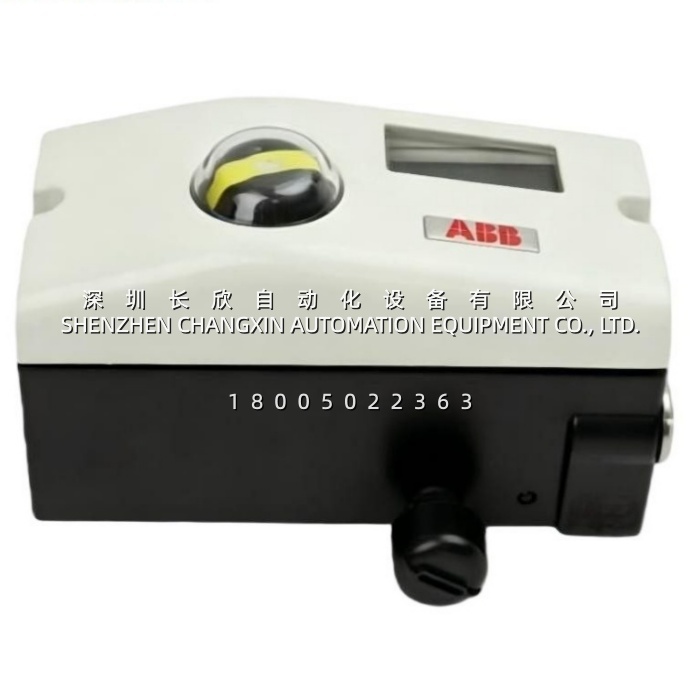
Description
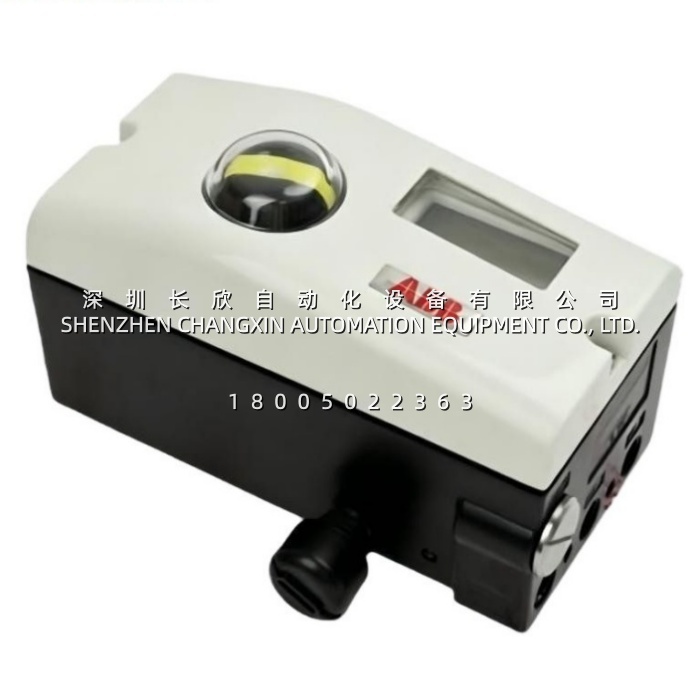
Technical Specifications
| Parameter | Value |
|---|---|
| Product Model | V18345-2010521001 |
| Manufacturer | ABB Process Automation |
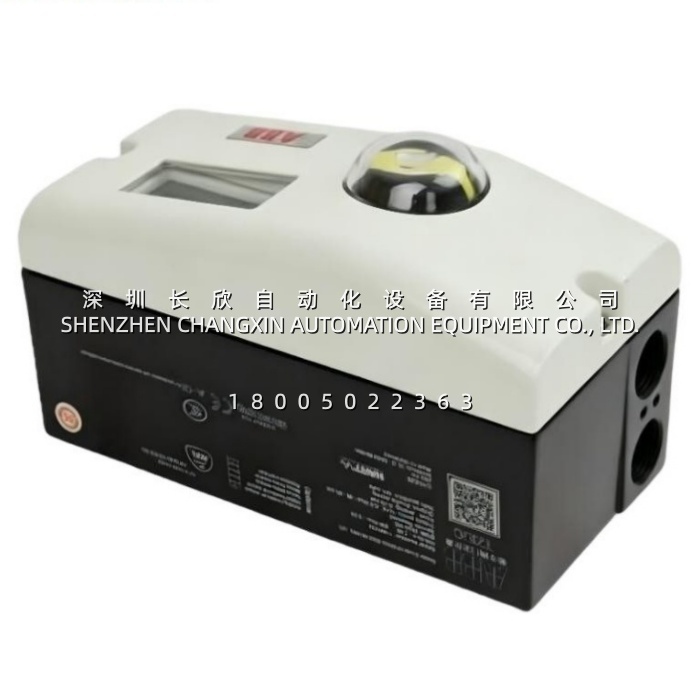
| Product Family | TZIDC / TZID-C smart electro-pneumatic positioner (18345 platform) |
| Device Type | Smart I/P valve positioner, closed-loop, piezoelectric pilot |
| Input Signal | 4–20 mA DC, 2-wire, Hart 5 / Hart 7 protocol |
| Supply / Loop Power | 10.5–30 V DC (Hart FSK superimposed) |
| Travel / Stroke | Linear actuator type; configurable end stops, max. linear travel per mounting kit |
| Valve Action | Fail-safe (configurable fail-to-open or fail-to-close) |
| Position Sensing | Non-contacting inductive travel sensor |
| Control Range Turndown | 20:1 (e.g. 3–15 psi down to ≈3–9 psi controlled region) |
| Pneumatic Output | 3-way / 5-way pilot action; separate supply, exhaust and actuator ports |
| Supply Air Pressure | 1.4–7 bar (20–100 psi) typical; max. per actuator/approval rating |
| Air Consumption | ≈ 0.05 Nm³/h (≈ 0.9 SCFH) quiescent; ≈ 0.5–0.7 Nm³/h under stroke |
| Accuracy / Hysteresis | ≤ 0.5% of span typical; hysteresis ≤ 0.3% typical |
| Sensitivity | ≤ 0.1% of span |
| Response Time | < 1 s to 63% stroke (application and actuator-volume dependent) |
| Ambient Temperature | −40 to +80 °C (−40 to +176 °F), LCD option narrows upper limit |
| Process / Media Temp | Limited by actuator and gland; positioner body −40 to +80 °C |
| Enclosure | Aluminium alloy, polyester powder-coated, epoxy-sealed |
| Protection Rating | IP66 / IP67 per IEC 60529; NEMA 4X / 6P equivalent |
| Hazardous-Area Approval | Ex ia IIC T6 / Ex ia IIB T6 (per certificate on unit label); FM / ATEX / IECEx |
| Ingress / Corrosion | Corrosion-resistant coating; not the 316L “High Corrosion” shell option |
| Vibration / Shock | IEC 60068-2 qualified; suitable for off-shore and rotating-equipment skids |
| Position Feedback | Not fitted in this config (see …102… feedback variants) |
| Communication | Hart 5, switchable to Hart 7; ABB Link Master / Asset Optimizer compatible |
| Diagnostics | Auto-tune, travel deviation, setpoint deviation, air-supply fault, sensor fault, Hart status word |
| Adjustment / Commission | Local pushbutton auto-calibration; Hart handheld or AMS/Asset Optimizer |
| Mounting | NAMUR/VDE actuator mounting, IEC 60534-6-1; stainless mounting kit per actuator |
| Pneumatic Connections | G 1/4 or 1/4 in NPT (per order-code fitting); silencer/exhaust as required |
| Electrical Entry | M20 × 1.5 or ½ in NPT cable gland (per approval/fitting option) |
| Indicator | Top-mounted LCD / pushbutton module (option-dependent); valve position scale |
| Weight | ≈ 1.5–2.0 kg (3.3–4.4 lb), housing and kit dependent |
| Country of Origin | DE / CH (TZIDC manufactured in Germany / Switzerland, batch-dependent) |
| Lifecycle | Active ABB platform; this specific order code is mature stock |
Main Features and Advantages
Piezoelectric control is why it does not stick.Every conventional positioner eventually fails the same way: a notched orifice silts up, a spool valve drags, or a rubber diaphragm takes a set. The V18345-2010521001 has none of those. The pilot is a ceramic piezoelectric element that bends under an electric field and returns to centre with no mechanical detent and no dynamic seal in the air stream. No friction, no stiction, no minimum-pressure threshold to push through before movement starts. In a clean-in-place line, a compressor-station blowdown, or a steam-trap header where contaminated instrument air is a fact of life, that architecture is the difference between a valve that re-tunes itself quietly and one that gets a weekly “slightly off” ticket.Twenty-to-one turndown without changing a spring.Small valves and severe-service trims spend most of their life at 10–30% stem. A fixed-range pneumatic positioner either gets a new spring or it lives with poor resolution in that region. The V18345-2010521001 measures the actual stem and scales the control region digitally, so the same unit that holds a 3–15 psi full stroke also holds a 3–9 psi trimmed region with the same 0.1% sensitivity. Commissioning sets the envelope once; the piezoelectric pilot does the rest. For a control loop with a 10:1 flow turndown, this is what finally lets the controller gain stay flat across the curve.Auto-tune that learns the valve, not the manual.One pushbutton and the V18345-2010521001 strokes to both ends, measures the breakaway friction, identifies the dead time introduced by the actuator volume, and writes a parameter set tuned to that specific valve and that specific air supply. It is not a generic PID copied from a data sheet. The practical gain is that a new-instrument gas-plant valve and a ten-year-old, slightly packed-gland reheater valve each get a curve that fits them, and neither needs an instrument engineer with an oscilloscope and a Saturday afternoon. Re-cal after a packing change or an actuator swap is the same one-button procedure.Hart without a second instrument.The 4–20 mA line carries the demand and the 24 V loop power; the Hart FSK rides on top of it, invisible to the analog controller. Read stem position, setpoint, deviation, air consumption and fault bits from a handheld, from AMS, or from ABB Asset Optimizer, and you have a valve-health picture without adding a position-feedback transmitter, a second pair of cores, or a field junction box. On a skid with forty valves, that is forty fewer instruments to buy, wire, calibrate and track. The V18345-2010521001 gives the DCS a process variable it previously had to infer from a control deviation alarm.Fail-safe that is configured, not hoped for.Loss of 4–20 mA, loss of Hart communication, loss of instrument air, and a broken travel sensor are four different failures, and the V18345-2010521001 treats them as four different states. The fail action — close, open, or hold within the actuator’s spring and volume limits — is set in commissioning and reported through the Hart status word. On a shutdown valve or a feed-control point, that explicit failure definition is what the cause-and-effect and SIL verification documents need to see. It is also why the unit must never be described as a safety shutoff device: it is a smart positioner with a defined fail state, not a certified final-element trip solenoid.Intrinsic safety and IP66 in one aluminium body.The Ex ia IIC T6 approval on the V18345-2010521001 lets it sit in a Zone 0/1 gas-compressor cell, a paint-booth solvent area, or a battery-limit hydrocarbon skid without a separate purged enclosure, provided the barrier and the loop are specified to the certificate. The polyester-coated aluminium housing and IP66/IP67 sealing keep washdown, salt spray and dust out of the travel sensor and the piezo cavity. It is the right compromise between the lighter plastic-bodied units (which struggle in impact and heat) and the 316L high-corrosion version (which costs like the exotic part it is).