WhatsApp:+86 18005022363 WeChat: +86 18005022363
  Email:
Description
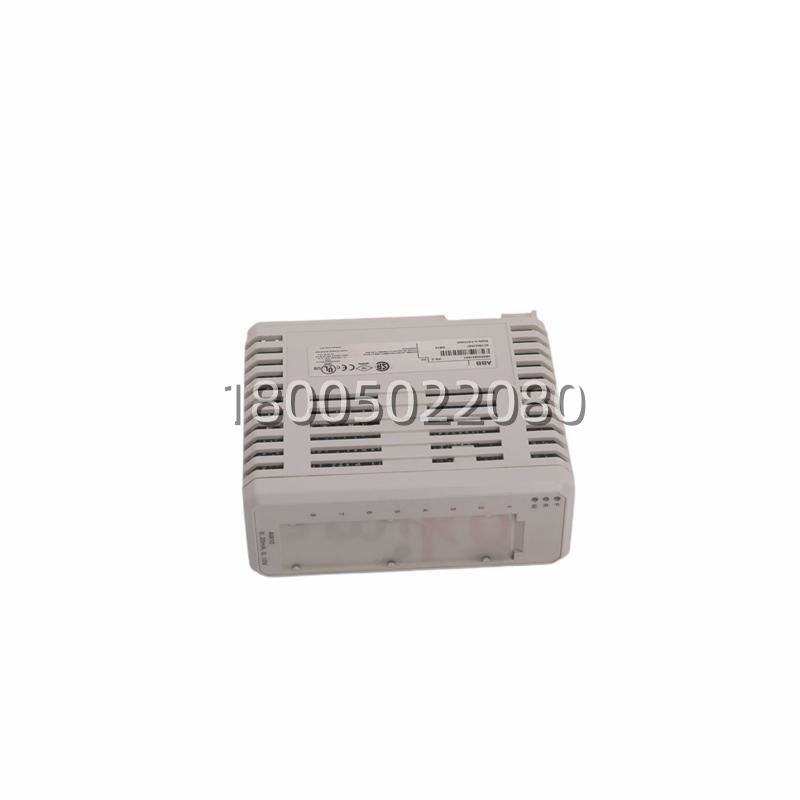
Technical Specifications
| Parameter Name | Parameter Value |
|---|---|
| Product Model | NINT-72C |
| Manufacturer | ABB |
| Article / Order Number | 64425552A |
| Product Type | Main Circuit Interface Board (Communication Board, power-section side) |
| Platform | ABB ACS800 drives, frames R6–R8; ACS800-based MultiDrive power sections |
| Predecessor / Siblings | NINT-61 (ACS600), NINT-62 (ACS600/early ACS800 small), NINT-71 (ACS800 R4–R5), NINT-73 (ACS800 larger) |
| Input Voltage | 24 V DC (from NPOW main auxiliary PSU) |
| Communication to Control Side | Backplane / ribbon to RMIO (drive CPU) — gating RX, fault/status TX |
| Communication to Power Section | Fiber-optic TX/RX to NGDR gate-driver boards (1 fiber per IGBT, 6 per inverter module) |
| DC-Bus Monitoring | Resistive divider from DC+/DC-, overvoltage threshold reported to RMIO |
| Temperature Inputs | NTC thermistor inputs from IGBT/heatsink modules (per-module, aggregated) |
| Fault Aggregation | Earth fault, IGBT desat (via NGDR), DC-overvolt, gate-driver supply fail (via NGPS/NPOW), NTC overtemperature |
| Outputs | Fault/status to RMIO; enable distribution to NGDR / NGPS |
| Coating | Conformal coat (C suffix); standard NINT-72 (uncoated) is separate article |
| Mounting | PCB mount in ACS800 inverter power-section bay |
| Operating Temperature | -20 … +70 °C (within drive cabinet envelope) |
| Related Power-Section Boards | NPOW (main PSU), NGPS-12 (gate-driver PSU, R12i+), NGDR (gate driver, 1 per IGBT), NRED (690 V hybrid) |
Main Features and Advantages
Fiber-optic gating to NGDRs with kV/µs noise immunity. The defining discipline of the NINT-72C is that the last hop from drive logic to IGBT gate is optical — the RMIO → NINT → fiber → NGDR chain keeps the gate-pulse signal out of the power-section’s electromagnetic envelope, where each IGBT commutation pumps several kV/µs dV/dt onto the emitter/source plane and where a hard-switch fault can inject kV-scale transients onto any nearby copper. The NINT-72C carries the transmit drivers for those fibers (TX to each NGDR) and the receive phototransistors for the return channel (NGDR → NINT: Vce-desat flag, gate-driver supply OK, NTC-alarm). In DTC operation, where the PWM pattern is asynchronous and the gating can toggle at >4 kHz with very short deadtimes, the fiber link’s jitter budget matters — the NINT-72C is specified to sub-100 ns TX/RX consistency, which keeps DTC’s stator-flux estimation from accumulating angle error on fast torque steps. A failure mode worth knowing: if one fiber (say, T-phase-high-side NGDR) is seated poorly, the NINT-72C will receive no return from that NGDR and will flag “IGBT short / gate driver fail” on T+ — the drive trips, the maintenance tech swaps the NGDR first (cheaper), but sometimes it’s the NINT-72C‘s TX port that’s weak (LED aging on the TX side, visible with a fiber scope as dimmer-than-spec launch). The fiber ecosystem (OM1 62.5/125, typical ABB spec) is robust, but 15-year-old NINT-72C TX elements do fade — a spare on the shelf covers this.DC-bus overvoltage and NTC thermistor aggregation. The NINT-72C is the RMIO’s “eyes” into the DC bus and the IGBT heatsinks. The DC-divider is a high-impedance resistive ladder (rated for the bus’s max working voltage, several hundred V to ~1000 V on 690 V-class) that feeds a comparator on the NINT-72C; if the bus overshoots (regen event, line-overvoltage transient, brake-chopper failure), the comparator trips, the NINT-72C asserts the DC-OV line to RMIO, and the drive coasts/ramps down depending on parameter 30.11–30.15 settings. The NTC inputs are equally critical: each IGBT module carries one or two NTC thermistors embedded in the heatsink; the NINT-72C reads them through a current-source and compares against the “heatsink overtemperature” threshold (parameter 30.04 on ACS800). If any one NTC opens (typically 110–120 °C module temp), the NINT-72C sends the fault upstream — this is what prevents a 3k IGBT module from cooking into a 15k repair because a cooling fan died or a heatsink fin clogged with paper-fiber dust. In plants where the drive shares an E-room with a bleach plant or a salt-spray intake, the NINT-72C‘s conformal coat (the “C” in 64425552A) protects the divider resistors’ terminations and the NTC comparator circuitry from creep corrosion — a standard NINT-72 in that environment would develop high-impedance on the NTC lines within 5–7 years, giving spurious “heatsink OT” trips that vanish on reseat (oxide on the NTC plug) and eventually become permanent.Fault-aggregation funnel to RMIO. A large ACS800 R6–R8 inverter module can have half a dozen fault sources in the power section alone: NPOW sag (POW), NGPS-12 rail collapse (gate-driver supply fail), NGDR Vce-desat (IGBT short), NRED earth-fault detect (690 V class), DC-overvolt, NTC overtemperature, and the mechanical door/interlock switches. The RMIO has a limited number of direct digital-input pins; the NINT-72C multiplexes these into a smaller fault-bus back to the RMIO and also asserts a single “power-section fault” line that forces an RMIO immediate trip while the detailed 31.xx code tells the maintenance tech which sub-fault. This architecture means a “POW” trip could trace to NPOW, NGPS-12, or even a loose 24 V feed from NPOW to NINT-72C — the triage path is: check NPOW LEDs (green = NPOW healthy), then NGPS-12 indirect signs, then NINT-72C 24 V input at the header. Because the NINT-72C itself has no firmware, a “NINT fault” logged by RMIO almost always means either (a) the 24 V input from NPOW is missing/sagging, (b) a fiber TX/RX has failed, or (c) the DC-divider or NTC input has drifted — all diagnosable with a DMM and the ACS800 HW manual’s NINT-72C test-point table.Conformal-coat “C” for harsh-environment plants. The 64425552A article (NINT-72C) versus the uncoated NINT-72 article — the BOM underneath is identical: same PCB layup, same fiber transceivers, same divider resistors, same NTC comparators, same backplane header. The only delta is the lacquer pass after board-level test. This means a plant can standardize on NINT-72C (64425552A) for all spares even if the live drives currently carry the uncoated version — the swap is drop-in, the lacquer adds ~0.05 mm thickness (irrelevant to the bay), and the coated spare survives longer on a non-climate-controlled storeroom shelf. For pulp & paper (bleach, recovery boiler), mining (conveyor E-rooms with crusher dust), marine (salt-air even in “closed” E-rooms), and chemical (Cl₂/H₂S vapor), the NINT-72C is the default spare — the price delta over uncoated is trivial compared to one unplanned stoppage from a corroded NTC input.No firmware, no user-adjustment, stable BOM. Like its power-section siblings (NPOW, NGPS-12, NGDR), the NINT-72C carries no processor and no firmware revision to track. The “logic” is largely comparator/aggregator + fiber PHY — no parameterization, no MC card, no D7-SYS equivalent. This makes the spare strategy clean: a NINT-72C (64425552A) bought today drops into a 2002-vintage ACS800 R6 and a 2014-vintage ACS800 R8 the same way. The only compatibility watch-outs are mechanical: the NINT-72 form factor fits R6–R8 bays; forcing it into an R4–R5 (NINT-71 bay) or R10+ (NINT-73 bay) won’t seat because the standoff pattern and backplane header keying differ. And the fiber count: an R6 inverter module has 6 NGDRs (6 TX + 6 RX fibers to the NINT-72C); an R8 with dual IGBT modules per leg or a different topology may have 12 — the NINT-72C itself supports the fiber port count for the R6–R8 envelope, but the harness (ribbon from NINT to the fiber breakout block) is frame-specific, so when swapping a NINT-72C, reuse the existing fiber harness; don’t try to cross-harness R6 ↔ R8.
Application Field
The NINT-72C (64425552A) lives inside ABB ACS800 drives of frames R6 through R8 — that’s roughly the 75 kW to 500 kW / 100 HP to 700 HP envelope at 400 V, and proportionally higher at 500 V / 690 V — and in ACS800-based MultiDrive power sections where the inverter module mechanicals follow the same R-frame progression. The canonical deployments are pumps, fans, compressors, conveyors, crushers, marine thrusters, winches, and paper-machine drive sections that sit in the mid-power band where an ACS800 R6–R8 is the right price/power point (below this, ACS580/ACS880-01; above this, ACS800 R10+ or MultiDrive R12i+). In these drives, the NINT-72C is the silent workhorse — it fires six times per PWM cycle (per IGBT), aggregates NTC temps from six IGBT modules, watches the DC bus, and forwards any anomaly to the RMIO. A cement plant’s raw-mill exhaust fan at 315 kW on an ACS800 R7, a mine’s conveyor head-drive at 250 kW on an ACS800 R6, a ship’s thruster converter at 400 kW on an ACS800 R8, and a pulp-mill refiner feed-conveyor at 160 kW on an ACS800 R6 all carry a NINT-72C in the inverter power section.Harsh-environment variants push toward the coated NINT-72C (64425552A) specifically. A pulp mill’s bleach-plant filtrate pump (ACS800 R6, chlorine dioxide vapor) will corrode an uncoated NINT-72’s NTC input solder joints in 6–8 years; the NINT-72C extends that to 12–15. A marine azimuth-thruster drive (ACS800 R8, saltwater-ingress risk even in IP54 E-room) benefits from the lacquer on the DC-divider terminations — a salt-creep path across the divider resistors would fake a DC-overvolt trip mid-maneuver, which on a docking tug is expensive. Mining conveyor rooms (crusher dust conductive, carbon-black-like) see the NINT-72C‘s coated PCB resist dendrite growth on the fiber TX/RX solder pads — the TX dimming failure mode mentioned earlier accelerates in dusty environments because the dust + humidity makes a weak leakage path on the PCB that steals bias from the TX LED, accelerating fade.Retrofit and spare strategy: because the NINT-72C has no firmware and the 64425552A BOM has been stable across the ACS800 production run (late 1990s through today, with the ACS800 still in “active mature” status even as ACS880 took greenfield), the spare is low-risk. A plant with 10–15 ACS800 R6–R8 drives (typical mid-size plant: water-treatment pump station, small cement mill, regional port crane powerhouse, offshore-platform utility drives) justifies 1–2 spare NINT-72C (64425552A) on the shelf, ideally coated even if the live drives are uncoated. The NINT-72C rarely fails catastrophically — the more common pattern is gradual: fiber TX fade (dim launch, intermittent “IGBT short” on one leg that clears on reboot), NTC input drift (spurious heatsink OT in humid weather), DC-divider resistor drift (false DC-overvolt on regen). These are annoying, not destructive, but they eat hours of troubleshooting before someone thinks to swap the NINT-72C — hence the spare-on-shelf logic. Because ACS800 is transitioning toward “later-support” as ABB pivots to ACS880/SINAMICS for new projects, the NINT-72C (64425552A) is an aftermarket-focused SKU — new-old-stock and refurbished units circulate, and the coated version is the one to prioritize for any plant still running ACS800 R6–R8 into the 2030s.
.jpg)