WhatsApp:+86 18005022363 WeChat: +86 18005022363
  Email:
Description
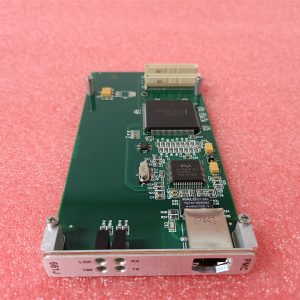
Technical Specifications
| Parameter Name | Parameter Value |
|---|---|
| Product Model | NINT-44 (also written NINT44) |
| Article Reference | 61353261E |
| Manufacturer | ABB Oy / ABB Drives |
| Product Type | System Interface & Communication Card (ACS600) |
| Compatible Drive | ABB ACS600 series (single-drive & MultiDrive, LV & MV) |
| Digital Inputs | 8 ch (24 V DC class, internal sinking/sourcing per ACS600 spec) |
| Relay Outputs | 4 ch (potential-free NO/NC, typical 250 V AC / 2 A rating) |
| Fiber Interface | 2× ST multi-mode (DDCS bus, up to 100 Mbps, ≥2000 V AC isolation) |
| Ethernet | RJ45, 10/100 Mbps, TCP/IP, Modbus TCP |
| Fieldbus | Profibus DP V1 (D-sub 9), Modbus RTU, EtherNet/IP (fw-dep) |
| Power Supply | 24 V DC ±10 %, ~8 W (from ACS600 internal auxiliary SMPS) |
| Isolation | ≥2500 V AC (fiber port to ground, control/power separation) |
| Mounting | ACS600 internal card-cage slot (not DIN-rail) |
| Dimensions (mm) | ~120 × 75 × 28 (sources vary 120–205 × 75–140; 61353261E Rev. C typical ~120 × 75) |
| Weight | ~0.24 kg |
| Operating Temp. | –20 … +70 °C |
| Protection | IP20 (cabinet internal) |
| Predecessors | NINT-42C (main IF), NINT-43C (fiber DDCS, no Ethernet) |
| Successor Platform | ACS800/ACS880 (RMIO + NETA/NETB, not directly compatible) |
Main Features and Advantages
Consolidated System Interface + Communications. The NINT-44 does two jobs that on newer platforms are split across two or three modules. First, the system-interface job: the 8 DI and 4 RO on the NINT-44 land the drive’s local control and status signals — start/stop pushbutton, enable from upstream guard, reset, fault-relay to MCC beacon, ready contact to PLC DI, watchdog to annunciator. These are wired to the NINT-44‘s terminal header (via the ACS600 control-terminal strip that fronts the card cage), not to a separate digital-I/O module, which keeps the ACS600 inverter book compact. Second, the communications job: the same NINT-44 hosts the protocol stack that translates between the ACS600’s internal DDCS fiber world and the plant’s Ethernet/Profibus/Modbus layer. A single NINT-44 therefore replaces what on an ACS800 would be “AINT-14 + NDCU-04 + NETH-21 + a few DI/DO terminals” — fewer cards, fewer spares SKUs, simpler BOM. For OEMs who standardized on ACS600 for a generation of machinery (paper-machine sections, mine-winder drives, cement-kiln ID fans), the NINT-44 is the one-card solution that keeps the inverter book’s BOM lean.Dual ST DDCS Fiber + Multi-Protocol External. The two ST multi-mode ports (V41/V42) implement ABB’s DDCS (Distributed Digital Control System) fiber bus — this is the high-speed, optically isolated backbone that links multiple ACS600 inverter books in a MultiDrive chassis, or links the drive to an optional master controller (e.g., an ABB AC 800M / Advant OCS via a fiber interface). DDCS runs ~100 Mbps, galvanically isolated (≥2000 V AC fiber-to-ground), immune to the EMI that swirls around a drive MCC room — important when the ACS600 sits next to 690 V IGBT switching. Off that same NINT-44, the RJ45 adds Ethernet (TCP/IP + Modbus TCP, 10/100 Mbps) and the D-sub 9 adds Profibus DP V1 or Modbus RTU — so the same inverter can talk DDCS to its sister books in the MD chassis and simultaneously talk Modbus TCP to a plant-level SCADA or Profibus to an S7-400, without extra gateway hardware. The NINT-44 effectively bundles what used to be “NINT-43C (fiber) + external gateway” into one slot.Seamless Upgrade from NINT-42C / NINT-43C. Plants that originally built ACS600 cabinets with NINT-42C (main system IF) and NINT-43C (fiber DDCS, no Ethernet) can slot a NINT-44 into the same cage position — the 61353261E retains the same mechanical envelope and board-to-board header, and the ACS600 drive firmware recognizes it as a compatible IF card. After the swap, the engineer configures the Ethernet address and protocol in the drive’s Group 98 (communication) parameters; the core control program (motor data, ramp, torque/speed cascade) lives on the ACS600’s main CPU board, not on the NINT-44, so no CFC or CoDeSys rework is needed. This is the primary reason NINT-44 has become the de-facto spare standard for ACS600 fleets — even slots that originally held -43C get upgraded to -44 when the card fails, gaining Ethernet visibility for free.8 DI + 4 RO Local I/O. The digital side of the NINT-44 is not an afterthought — 8 DI at 24 V DC (sinking/sourcing per ACS600 terminal-scheme) covers the typical drive’s local-needs: DI1=Start, DI2=Stop/Enable, DI3=Reset, DI4=Ext-Fault-Ack, DI5=Speed-Ref-Select-High, DI6=Local/Remote, DI7–8=spare/aux. The 4 RO relays (potential-free NO/NC, typical 250 V AC / 2 A) drive the fault-relay pair (one NO for beacon, one NC for safety-chain), the ready-contact to PLC DI, and a spare for watchdog or annunciator. Having these on the NINT-44 itself means the ACS600 inverter book needs no external DI/DO terminal block — the control-cage terminal strip fronts the card, and wiring lands there. For retrofits where an old NINT-42C is failing and the plant wants fewer spare SKUs, swapping to NINT-44 (which subsumes both -42C and -43C roles on some BOM variants) can consolidate two card-cage slots into one — though verify the exact ACS600 build: some cabinets separate “system IF” (NINT-42C) and “fiber IF” (NINT-43C) into two slots, and the NINT-44 may replace only the -43C slot while the -42C stays — ABB’s ACS600 manual defines the slot-map, and the spare buyer should cross-check.DriveWindow Diagnostics & Non-Hot-Swap. The NINT-44 is visible to ABB DriveWindow over Ethernet (RJ45) or over DDCS (via a fiber adapter), letting a commissioning engineer pull parameter backups, stream fault buffers, and watch drive-state online without opening the cabinet door. Important warning: the NINT-44 is not hot-swappable — unlike some modern ET 200 or Profinet IO modules, pulling/reseating the NINT-44 while the ACS600 is powered will damage the board and possibly the backplane header. Swap requires full LOTO on the ACS600 3-phase supply, discharge of DC-link, and confirmation that the 24 V DC auxiliary (internal SMPS) is also down — only then unclip the NINT-44 from the card cage. This is a common mistake on Friday-night callouts (“the network dropped, I’ll reseat the comms card live”) that turns a comms fault into a scrapped NINT-44.