WhatsApp:+86 18005022363 WeChat: +86 18005022363
  Email:
Description
Product Overview
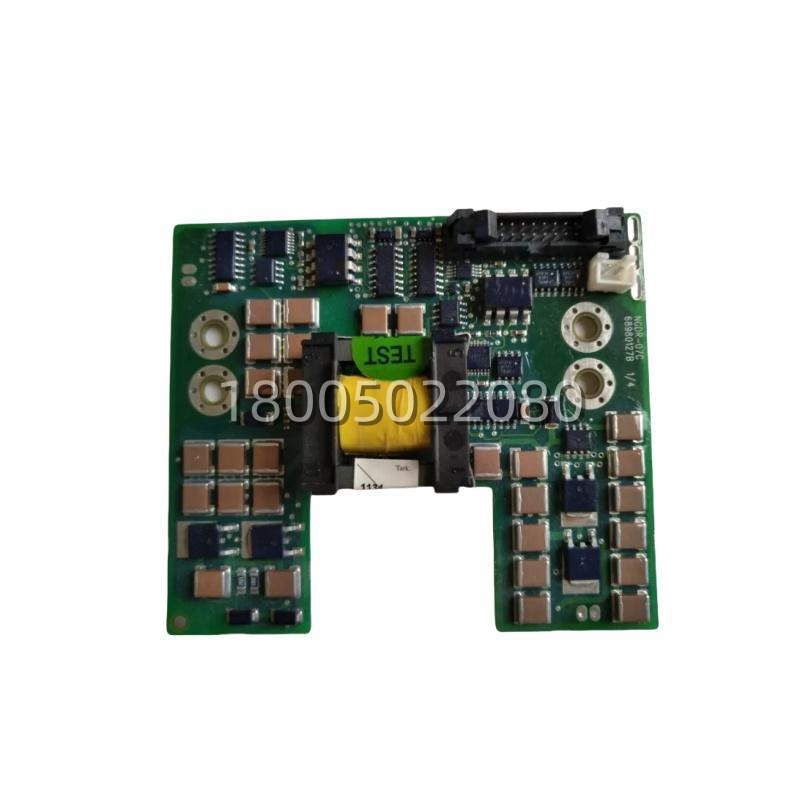
The ABB NGDR-07C (article reference 68980127B) is an IGBT gate-driver / inverter trigger plate belonging to ABB’s NGDR family, which serves as the RoHS-compliant successor to the earlier AGDR-07C in the ACS800 drive platform. The NGDR-07C is purpose-built for the 690 V voltage class of ABB ACS800 inverter modules — specifically the ACS800-107 (525–690 V) single-drive and the 690 V inverter “books” that populate an ACS800 MultiDrive (MD) chassis. In the layered architecture of an ACS800 inverter, the NGDR-07C sits at the power-control boundary: the NDCU-04 drive CU talks to the AINT-14 interface board via ribbon, and the AINT-14 in turn sends low-level gating commands and receives fault/status across to the NGDR-07C, which translates those into the +15 V / –8 V (typical) gate pulses that switch the inverter’s IGBT modules, while simultaneously monitoring desaturation (desat), undervoltage on the gate supply, and short-circuit events on the motor-phase legs.The “07” in NGDR-07C maps to the 690 V drive class (ACS800-104 = 380–500 V, ACS800-107 = 525–690 V), and the “C” suffix denotes the hardware revision within the NGDR-07 sub-family. The NGDR-07C is mechanically and electrically interchangeable with the AGDR-07C it replaces — same mounting points onto the IGBT power stack, same ribbon/header to the AINT-14, same gate-terminal pinout to the IGBT modules — so a plant with a frozen ACS800-107 BOM can swap AGDR-07C → NGDR-07C without re-validation, gaining RoHS compliance (lead-free solder, revised componentry) without changing the drive’s behavior. This backward compatibility is the primary reason the NGDR-07C remains an active spare-line item even as ABB has pushed ACS880 for greenfield: the installed base of ACS800-107 units across marine propulsion, mining 690 V conveyors, offshore cranes, and 690 V pump/fan stations is large, and the gate-driver plate is one of the higher-stress components in the inverter — it takes the hit when an IGBT shorts, when a motor-phase sees a ground fault, or when a commutation overshoot stresses the desat detector.The NGDR-07C is not a user-configurable board — no DIP switches, no parameter storage. Its “configuration” is implicit in the hardware revision (C) matching the AINT-14 firmware expectation and the IGBT module type (typically ABB/semikron-style dual IGBTs for the 690 V class, 2-level inverter). The 68980127B marking on the PCB is ABB’s internal article/serial reference used in SPARE parts ordering and traceability; when procuring, quote both “NGDR-07C” and “68980127B” to avoid substitution with a different NGDR-xx class (e.g., NGDR-01C for 400 V class would be physically similar but gate-supply and desat thresholds differ — dangerous to mix).
Technical Specifications
| Parameter Name | Parameter Value |
|---|---|
| Product Model | NGDR-07C |
| Article Reference | 68980127B |
| Manufacturer | ABB Oy / ABB Drives |
| Product Type | IGBT Gate Driver / Inverter Trigger Plate |
| Compatible Drive | ABB ACS800-107 (525–690 V) SingleDrive & ACS800 MD 690 V inverter modules |
| Predecessor | AGDR-07C (non-RoHS; NGDR-07C is RoHS-compliant replacement) |
| Upstream Interface | AINT-14 (or AINT-12 on older builds) via ribbon / header |
| Downstream Interface | IGBT modules (gate, emitter sense, desat sense, gate-voltage supply) |
| Gate Drive Voltage | Typically +15 V / –8 V (IGBT-standard, ABB ACS800 implementation) |
| Protection Functions | Desaturation (desat) detection, gate undervoltage, short-circuit reporting to AINT |
| Mounting | Directly onto IGBT power stack (inverter “book” chassis) |
| Revision | C (07C sub-family) |
| Compliance | RoHS (lead-free, successor to AGDR-07C) |
| Interchangeability | Pin/mechanical compatible with AGDR-07C; firmware-aware pairing with AINT-14 recommended |
| Handling | ESD-sensitive; requires wrist-strap / ESD mat during installation |
Main Features and Advantages
Gate Pulse Generation & IGBT Switching. The core job of the NGDR-07C is to take the PWM gating commands from the AINT-14 (which itself receives torque/switching-duty from the NDCU-04 CU’s DTC/vector algorithm) and amplify them into the current-capable +15 V / –8 V gate pulses that turn the 690 V IGBT modules on and off cleanly. The “–8 V” negative off-state bias is important at 690 V class — it holds the IGBT off against dv/dt-induced spurious turn-on during the commutation of the other leg, which is more aggressive at 690 V than at 400 V. The NGDR-07C implements this with dedicated gate-drive ICs (typically CONCEPT/Power Integrations-style or ABB-custom silicon) and local bulk/storage caps near the gate terminals, so the pulse edge stays sharp even when the IGBT module’s gate capacitance is in the nF range and the commutation loop is tight inside the inverter book.Desaturation (Desat) Protection. The NGDR-07C continuously monitors the IGBT collector-emitter voltage during the on-state via a desat sensing network (diode string + sense resistor + blanking time). If an IGBT begins to saturate (Vce rises above threshold, typically ~7–8 V for 1700 V class IGBTs, adjusted for 690 V / 1200 V class), the NGDR-07C detects it within microseconds and asserts a fault back to the AINT-14, which in turn forces the NDCU-04 to trip (F001 overcurrent or F00x hardware fault depending on the fault path). This desat path is the last line of defense before the IGBT goes into destructive latch-up — and the NGDR-07C is the component that implements it. In practice, when a motor-phase shorts to ground or an IGBT fails short-collector, the NGDR-07C typically sacrifices itself (desat IC, gate-output stage) to protect the IGBT module and the DC-link caps — which is exactly why gate-driver plates are a recurring spare item in ACS800 MD chassis.Gate-Voltage Supply & Undervoltage Lockout. The NGDR-07C derives its gate-drive rails (+15, –8, and logic 5 V) from an isolated DC-DC stage that is either onboard (small flyback/forward) or fed from the AINT-14’s isolated supply — ABB’s ACS800 inverter books use a distributed isolation scheme where the AINT feeds isolated low-voltage to the NGDR. The NGDR-07C monitors these rails and will inhibit gating (and report fault to AINT) if the gate supply sags — preventing “half-on” IGBT drive that would cause shoot-through. This undervoltage lockout (UVLO) is hardware-level, faster than any firmware trip on the NDCU-04.RoHS Compliance & AGDR-07C Interchange. The NGDR-07C is the RoHS iteration of AGDR-07C — same footprint, same connector pinout to AINT-14, same gate-terminal layout to the IGBT modules, revised componentry (lead-free solder, updated semiconductors where RoHS forced substitution). For plants under EU RoHS/MRL compliance auditing, swapping a failed AGDR-07C for an NGDR-07C is the clean path — no re-certification of the drive needed because ABB validated the NGDR as form-fit-function replacement. The “C” revision also incorporates errata fixes from earlier AGDR-07x builds (specific to 690 V class desat threshold tuning and EMI hardening on the gate-return path), so NGDR-07C is marginally more robust than late-build AGDR-07C in high-dv/dt 690 V environments (long motor cables, VFD-output dV/dT filters, etc.).ESD-Sensitive & Precision Placement. The NGDR-07C is packed with fine-pitch SMT gate-drive ICs, desat comparators, and isolated data paths — it is ESD-sensitive and should be handled with wrist-strap / ESD mat during installation. The board mounts directly onto standoffs/pins of the IGBT power stack inside the inverter book; the gate leads (usually short thick wires or pins) land on the IGBT module’s gate and emitter-sense terminals, and the ribbon to AINT-14 carries the low-level PWM, fault, and supply lines. Because the NGDR-07C sits in the same airflow as the IGBTs (shared inverter-book cooling fan), it sees the same ~40–50 °C ambient that the ACS800 control-section sees — conformal coating on production batches handles the conductive dust of a drive MCC, but in salty (marine) or cement-dust environments, the NGDR-07C can accumulate creepage that eventually triggers a spurious desat or UVLO — hence periodic (2–3 year) inverter-book cleaning is advised for harsh sites.