WhatsApp:+86 18005022363 WeChat: +86 18005022363
 Email:

Description
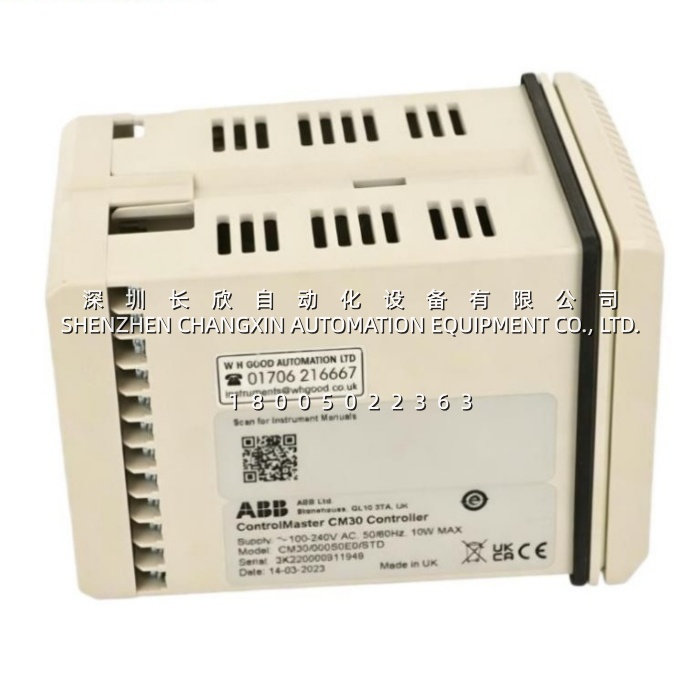
Technical Specifications
| Parameter | Value |
|---|---|
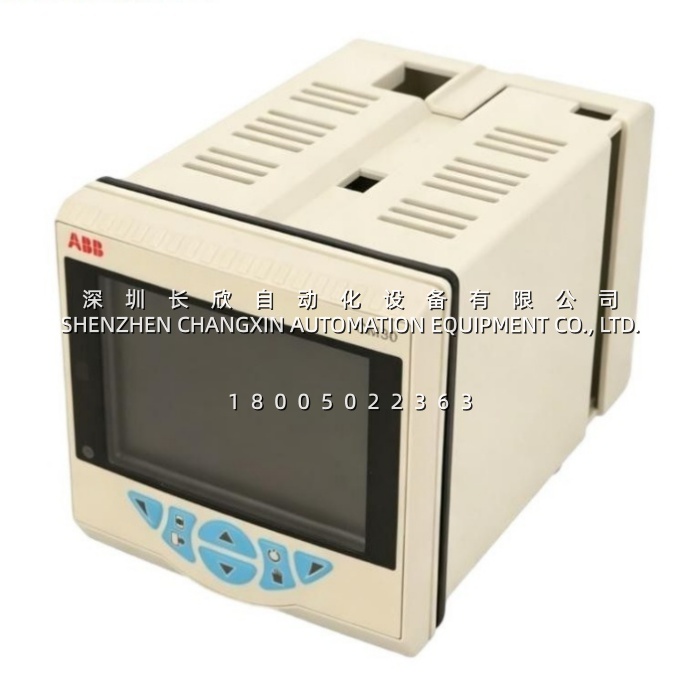
| Product Model | CM30/2 (typical full code CM30/2S0S0E0/STD) |
| Manufacturer | ABB Process Automation / Measurement & Analytics |
| Product Type | Universal PID process controller, panel mount, 1/4 DIN |
| I/O Build | 2 analog inputs + 1 analog output + 2 relay outputs (Basic + Option Board 1a) |
| Input 1 Type | Universal: TC, Pt100, Ω, mA, V, mV, frequency, volt-free / 24 V digital |
| Input 2 Type | Process: TC (when In1 = TC), mA, V, mV, volt-free / 24 V digital |
| Thermocouple Types | B, E, J, K, L, N, R, S, T |
| RTD | Pt100, 3-wire |
| Frequency Input | 0…6000 Hz (0-signal –3…5 V, 1-signal 15…30 V) |
| Input Resolution / Accuracy | 16-bit conversion path; analog accuracy 0.25% F.S. |
| Update Rate | 125 ms |
| CMRR | >120 dB @ 50/60 Hz with 300 Ω imbalance |
| Normal Mode Rejection | >60 dB @ 50/60 Hz |
| CJC Rejection | 0.05 °C/°C ambient change |
| Temperature Stability | 0.02 %/°C (2 µV/°C, 1 µV/°F) |
| Input Impedance | 10 MΩ (mV), 10 Ω current-shunt path |
| Analog Output | 0…20 mA / 4…20 mA, galvanically isolated, max load 750 Ω |
| Relay Output | 2 × changeover (1 A/O fitted, 1 added by Board 1a); 5 A @ 240 V AC rated |
| Control Modes | On/off, time-proportioning, current-proportioning, motorised valve, manual reset, gain scheduling (3 sets), autotune |
| Advanced Strategies | Cascade, feed-forward, ratio, predictive, adaptive; dual-loop capable |
| Math & Logic | 8 math blocks, 2 custom linearisers (20 breakpoints), 8 logic equations, totalization, timers, multiplexer |
| Setpoints | 4 local, selectable from front panel or digital input |
| Process Alarms | 8, high/low and latched, individually enable/disable by digital signal |
| Trend Memory | 2-channel live trend, 272 samples |
| Communications | Ethernet: Modbus TCP, web server, email; RS-485 Modbus (half/full duplex) |
| Configuration | Front-panel menus, IrDA port, ConfigPilot PC software (offline project + report generation) |
| Display | 3.5 in. color TFT, user-customisable, 6 tactile membrane keys |
| Transmitter Supply | 2-wire, 24 V DC, 45 mA max per input |
| Supply Voltage | 100…240 V AC, 50/60 Hz (option 10…36 V DC on selected builds) |
| Power Consumption | ≤10 W |
| Front Protection | IP66, NEMA 4X |
| Rear Protection | IP20 |
| Operating Temp | 0…55 °C (32…131 °F) |
| Storage Temp | –20…70 °C (–4…158 °F) |
| Humidity | 5…95% RH, non-condensing |
| Panel Cutout | 92 × 92 mm (3.6 × 3.6 in), tolerance +0.8/–0 mm |
| Overall Dimensions | 97 × 97 × 141 mm (3.8 × 3.8 × 5.5 in); 121 mm behind panel |
| Weight | ≈0.5 kg (1.1 lb) unpacked; shipped pack ≈0.85 kg |
| Enclosure / Safety | Glass-filled polycarbonate, Insulation Cat. II, Pollution Degree 2, EN 61010-1 |
| Approvals | CE, cULus, DNV marine; EMC IEC 61326 industrial environment |
| Included Accessories | Panel clamps, bezel release tool, cold-junction thermistor, manual |
| Lifecycle Status | Active, repairable/replaceable via ABB R&C spares |
Main Features and Advantages
A dual-loop controller that fits a single DIN hole:The defining advantage of the CM30/2 is density of function, not density of channels. Two inputs, one analog output and two relays occupy exactly the same 92 × 92 mm panel opening as a base CM30, yet the build supports a complete cascade or ratio strategy. That matters on a skid where the panel was cut twenty years ago and there is no room for a second instrument. Input 1 takes the master variable — product temperature or tank level — while Input 2 takes the slave — jacket temperature or pump delta-P — and the controller closes both loops with one autotune, one trend buffer and one alarm summary.Input universality that removes the signal conditioner:A single ABB CM30/2 will accept a type J thermocouple on a burner, a Pt100 on a vessel wall, a 4–20 mA from a Coriolis meter, a 0–10 V from a pressure cell and a frequency pulse from a turbine flowmeter, all without an external transmitter or isolation amplifier. The 24 V two-wire transmitter supply is built into the input, so a loop-powered pressure transmitter lands on two screws and is powered from the controller. For a small boiler, a lab oven or a packaging machine, that eliminates an entire DIN-rail power supply and the wiring that goes with it.Control strategies you can select, not program:The template system is the quiet differentiator. Instead of writing ladder or function blocks, the commissioning engineer picks “Cascade”, “Feed-forward”, “Ratio” or “Predictive” from the template menu and the internal signal routing appears pre-wired. Gain scheduling gives three PID sets selected by setpoint or digital input, which is the correct way to control a process whose dynamics change between heat-up and soak. Autotune then fills the gains from a step response. The result is a controller that behaves like a DCS loop without needing a DCS, and the configuration can be saved as a ConfigPilot project for the next identical skid.Ethernet that reports rather than just talks:The “E” in CM30/2S0S0E0/STD is the Ethernet option, and it is not a decorative port. The controller serves its own web pages, exposes Modbus TCP registers, and can email an alarm snapshot or a daily trend to a distribution list. That turns a panel-mounted regulator into a node that a remote operator can glance at from a browser, without adding an HMI licence or a SCADA tag. For a water pumping station, a rooftop AHU or a weekend-shift reactor, the email-forwarded high-temperature alarm is often the only automation the site owns — and it is enough.Front panel built for the real world:IP66 and NEMA 4X on the front means a hose-down, a sugar washdown or a dusty cement wall does not kill the display. The color TFT shows PV, SP and output percentage on one screen, so an operator can see that the loop is not “at 900” but that the output is already at 86% and climbing — a diagnostic distinction that a three-digit LED cannot give. The 272-sample trend is held in the controller, so a night-shift upset can be replayed the next morning without having exported a single CSV.Diagnostics in plain language:The CM30/2 does not hand the operator an error code and walk away. An open thermocouple, a burnt-out transmitter, a relay load fault or a communications timeout is announced as a text prompt tied to the input or output name. That shortens mean-time-to-repair dramatically in plants where the person on the midnight shift is not the person who tuned the loop.