WhatsApp:+86 18005022363 WeChat: +86 18005022363
  Email:
Description
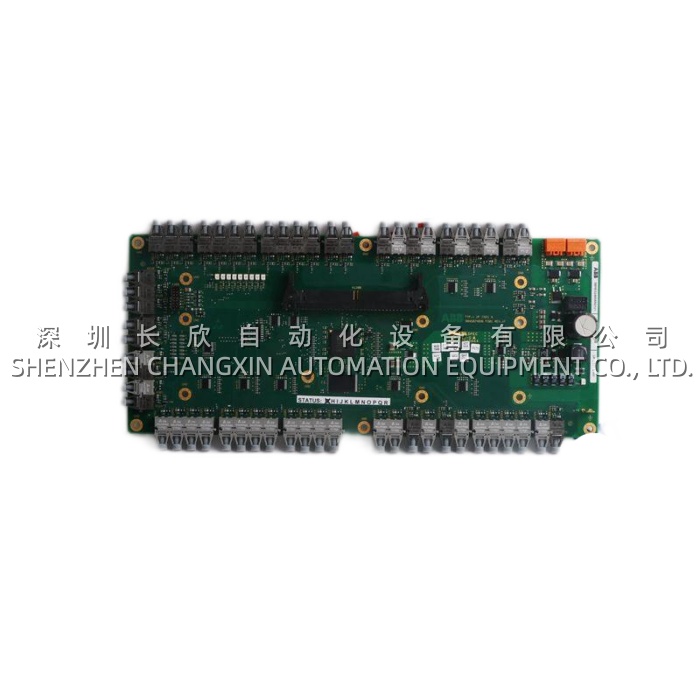
Application ScenariosA regional bottling plant’s conveyor line had a chronic pile-up problem at Transfer Point B: Belt A (main infeed) and Belt B (accumulation) were hard-wired to start simultaneously, so when a slug of empty bottles hit the transfer, they’d cascade over the guard. The panel builder’s original design used a pneumatic dashpot timer (±20% accuracy, temperature-sensitive) set to 2 s delay on Belt B — but on cold Monday mornings the dashpot stretched to 3.5 s (bottles backed up the other way), and on hot afternoons it collapsed to 1.2 s (pile-up returned). The maintenance lead replaced the dashpot with a 1SAR330020R0000: dialed to ON-delay mode, range switch to 0.05–5 s, potentiometer to 2.0 s. Because the 1SAR330020R0000 uses a quartz-crystal timebase (±1% accuracy, no temperature drift across -25°C to +55°C), the 2 s hold is 2.0 s whether it’s 5°C or 40°C in the filling hall. The plant also exploited the 1SAR330020R0000‘s 16 A contact rating to delete the auxiliary interposing relay that previously sat between the timer and the Belt B contactor coil (9 A AC-3) — one less point of failure in the sequence. Three years later, zero timer-related line stops. This case captures the module’s sweet spot: panel builders and retrofit techs who need one flexible timer that covers ON-delay / OFF-delay / star-delta / cycle across both 24 V DC (MCC common) and 230 V AC (building power) without swapping part numbers.
Parameter
| Main Parameters | Value/Description |
|---|---|
| Product Model | 1SAR330020R0000 |
| Manufacturer | ABB (CR-M / CT-M Series, Multifunction Timer) |
| Product Category | Electronic Time Relay (Multifunction, DIN Rail) |
| Supply Voltage | 24–240 V AC / DC, auto-sensing, 50/60 Hz |
| Power Consumption | ≤ 2.5 W |
| Time Range | 0.1 s – 100 h (multi-range, selector switch + potentiometer) |
| Timing Functions | 8 modes: ON-delay, OFF-delay, interval, symmetrical cycle, star-delta, pulse former, accumulative ON-delay, ON/OFF |
| Output Contact | 1 C/O (SPDT: 1 NO + 1 NC) |
| Contact Rating | 16 A / 250 V AC (resistive); 2 A / 250 V AC (inductive AC-15) |
| Time Accuracy | ±1% of setting ±20 ms (quartz-crystal base) |
| Indicators | Dual-color LED: green = supply OK, red = output active |
| Mounting / Width | 35 mm DIN rail (TH35, IEC 60715); 22.5 mm module width |
| Operating Temp / Protection | -25°C to +55°C; IP20 (front) / IP40 (terminals); UL, CE, CCC, IEC 61812-1 |
Technical Principles and Innovative Values
- Innovation Point 1: Universal 24–240V AC/DC Auto-Sensing. Most timers force you to pick a voltage variant at order time — 24 V DC, 110 V AC, or 230 V AC — and if the panel spec changes, you re-order. The 1SAR330020R0000 internally rectifies and regulates, accepting anything from 24 V DC battery-backed MCC power to 240 V AC mains with no jumper change. For OEMs shipping panels to both 230 V EU and 120 V NA sites, one spare part covers both — halves the spare-holding SKU count.
- Innovation Point 2: Quartz-Crystal Timebase vs. RC or Dashpot. Entry-level electronic timers use RC oscillator chains — cheap, but ±5–10% accuracy and bad tempco (0.1%/°C drift isn’t rare). Pneumatic dashpots are worse (±20%, humidity-sensitive). The 1SAR330020R0000 uses a quartz-derived clock, holding ±1% from -25°C to +55°C. For star-delta transitions (where the 30–80 ms window matters to avoid overlap current) and pump lead/lag alternation (where a 5-min cycle must stay 5 min, not 5:20), that precision prevents the “timer drift” nuisance calls that eat maintenance hours.
- Innovation Point 3: 16 A SPDT Direct-Drive Capability. The 1SAR330020R0000‘s 16 A / 250 V AC contact rating means it can switch a typical 9 A AC-3 contactor coil (e.g., LC1D09, AF09) directly — no interposing relay needed. That saves a DIN slot, a terminal row, and a failure point. The trade-off: ABB still recommends against switching >2 A inductive (AC-15) directly for longevity, so for big contactors (LC1D32+, 32 A coil), keep the aux relay. But for the 80% of panels running 9–12 A coil contactors, the 1SAR330020R0000 stands alone.
- Innovation Point 4: Front Dial + Dual-Color LED Debugging. The 1SAR330020R0000 has a two-tier front interface: a rotary switch selects function (ON-d, OFF-d, star-delta, etc.), and a second rotary sets range (0.1 s–100 h across 7–8 bands), with a slot-type potentiometer for fine-set within the band. Green LED = supply alive, red LED = output energized. During commissioning, you can verify the timer fired without a meter — and the red LED blinking in cycle mode tells you the potentiometer is live.
Application Cases and Industry ValueCase 1 – Municipal Booster Pump Station, Northern Europe. Two 15 kW centrifugal pumps run lead/lag with weekly alternation. The original panel used two electromechanical timers (ON-delay for lead pump start, OFF-delay for lag pump dropout) plus an aux relay for alternation logic — three DIN slots, and the electromechanical units drifted 8–12% per year, causing the lag pump to “shadow start” 3 seconds early and hammer the check valve. The retrofit replaced both electromechanical units with one 1SAR330020R0000 in ON-delay mode (lead pump, 3 s soft-start delay) and a second 1SAR330020R0000 in interval mode (lag pump, lead-run-30s → lag-ON, lead-stop → lag-continue-60s → lag-OFF). The quartz accuracy held the 30 s lead-run window to ±0.3 s across seasonal temps (-18°C winter to +34°C summer pump house). The station chief: “We deleted the aux relay entirely — the 1SAR330020R0000 drives the lag contactor coil (AF16, 9 A AC-3) direct. Two years, zero timer callbacks.”Case 2 – Commercial Bakery Dough Divider, Central Europe. The divider’s star-delta starter on the 11 kW main auger motor used a cam timer that failed every 14–18 months (flour dust + warmth killed the cam contacts). The panel builder swapped to a 1SAR330020R0000 dialed to “star-delta” function, range 0.5–5 s, pot set to 1.8 s (matched the motor’s inrush decay). The 1SAR330020R0000 sits in the same 22.5 mm slot the cam timer occupied — no panel remodel. 26 months later, the green LED is still lit, red LED blips at every start cycle. Maintenance lead: “The cam timer was €18 cheaper upfront. The 1SAR330020R0000 cost €41 but we haven’t touched it since install. Math isn’t close.”