WhatsApp:+86 18005022363 WeChat: +86 18005022363
  Email:
Description
Application Scenarios
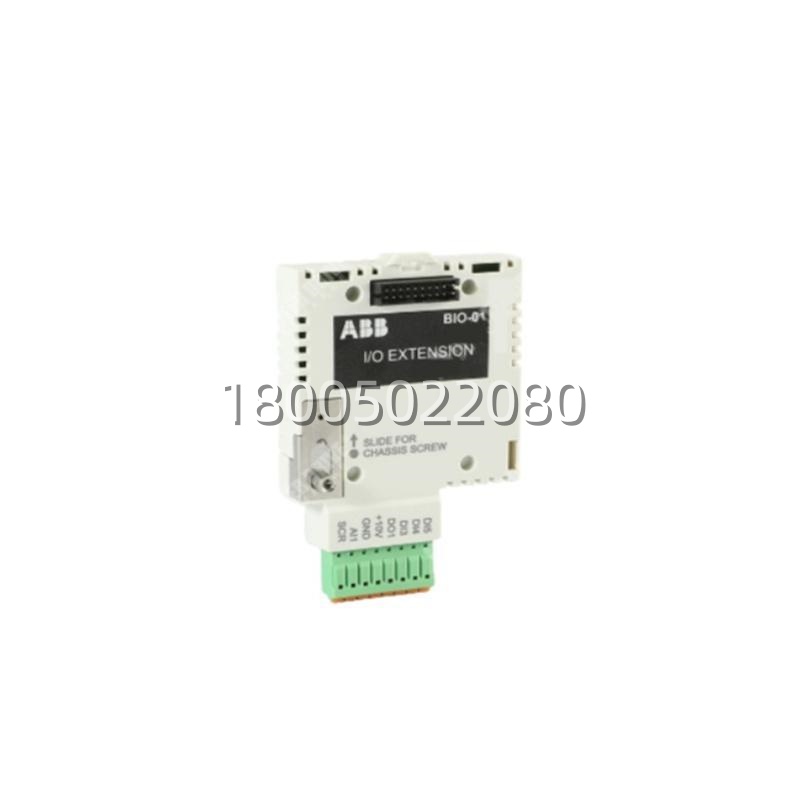
In a cement plant in Southeast Asia, three ABB ACS880 drives controlling the raw mill bucket elevators were running out of local DI/DO points—the original drive I/O terminals were already fully occupied by start/stop, fault reset, and speed-reference wiring. Adding a separate remote I/O station would have meant new conduits, a profibus drop, and a week of commissioning. Instead, the maintenance team slotted a ABB 1KHL178013R0001M BIO01 onto the DIN rail inside each drive cubicle, wired the elevator zero-speed switch, rope-slack alarm, and two local HMI lamp drivers into the BIO01, and mapped the points back through the drive’s fieldbus. The whole retrofit took one afternoon per drive. More importantly, the BIO01‘s optical isolation between channel groups prevented false triggering from the nearby VFD switching noise—a chronic pain with generic third-party I/O boards the plant had tried before. Downtime dropped, and the electricians finally stopped blaming “ghost signals” on Monday mornings.
Parameter
| Main Parameters | Value/Description |
|---|---|
| Product Model | 1KHL178013R0001M (BIO01) |
| Manufacturer | ABB |
| Product Category | Binary I/O (Digital Input/Output) Expansion Module |
| Input Channels | 8 or 16 × Digital Input (Sink/Source, 24 V DC) |
| Output Channels | 8 or 16 × Digital Output (Transistor or Relay, depending on batch) |
| Rated Voltage | 24 V DC (range 19.2 – 30 V DC typical) |
| Output Drive Capability | ≤ 0.5 A/ch (transistor) or 250 V AC / 10 A (relay, batch-dependent) |
| Response Time | Input < 1.5 ms, Output < 1 ms |
| Isolation | Channel-to-backplane optocoupler; group-to-group galvanic |
| Communication / Bus | Dependent on version – Modbus, Profibus DP, or Profinet capable |
| Connection Type | Screw terminals or M12 (version-specific) |
| Mounting | Standard DIN rail (TS35) |
| Operating Temperature | -25 °C to +60 °C |
| Protection / Size | IP20, approx. 102 × 119 × 45 mm, ~0.3–0.4 kg |
📌 Note: Output type (transistor vs. relay) and fieldbus protocol vary by manufacturing batch. Verify the terminal-cover label or white sticker on the module before ordering replacements.
Technical Principles and Innovative Values
- Innovation Point 1: Batch-Flexible I/O Architecture. Unlike rigid I/O cards locked to one bus, the BIO01 exists in multiple hardware variants (Modbus RTU/485, Profibus DP, Profinet) sharing the same mechanical envelope and order number 1KHL178013R0001M. This lets procurement stock one “family” while matching the protocol to each project—reducing spare-parts SKU sprawl.
- Innovation Point 2: Channel-Group Optoisolation Against VFD Noise. The BIO01 uses grouped optocoupler isolation rather than the cheaper “common-ground” approach found on many third-party clone boards. In cabinets where 100+ A drive switching shares the same rail, this design prevents the classic “limit switch reads ON when the motor ramps” ghost-trigger problem.
- Innovation Point 3: Drive-Cabinet Ergonomics. At ~102 mm depth, the BIO01 tucks behind door-mounted HMI panels or beside a drive’s control terminations without re-cutting DIN rail. Spring/ejector locking means a technician can swap a suspect board in <3 minutes—no tools beyond a screwdriver for the terminal screws.
Application Cases and Industry Value
Case 1 – Metals Rolling Mill (China, 2023 retrofit): A steel hot-rolling line used ABB ACS800 drives with F-series fieldbus adapters, which consumed most of the drive’s local I/O. To add roll-gap limit switches and cooling-spray solenoid drivers, the integrator chose the ABB 1KHL178013R0001M BIO01 as a bolt-on expansion. Because the BIO01 could hang off the same Profibus drop as the F-series card, no extra DP coupler was needed. Commissioning time per stand dropped from an estimated 2 days to 4 hours. The plant reported zero spurious DI trips in the 12 months post-retrofit, attributing it to the BIO01‘s optoisolated input groups.Case 2 – Water Treatment Pump Station (Nordics): A municipal station expanded from 4 to 7 duty/standby pumps and ran out of DI for float-switch alarms. Rather than upgrade the AC 800M CPU rack (cost-prohibitive), they added three BIO01 modules on Profinet, each serving 16 DI from float switches and 16 DO to local beacon stacks. Total material cost was under €900; the station kept the original controller. The utility’s O&M lead noted that having the BIO01‘s status LEDs visible through the cabinet window cut “is the float stuck?” troubleshooting calls by half.
Related Product Combination Solutions
The ABB 1KHL178013R0001M BIO01 rarely works alone—here are the usual companions:
- ABB ACS880 / ACS580 Drives – The primary host context; the BIO01 often lives inside the same cubicle, expanding the drive’s local DI/DO budget.
- ABB F-series Fieldbus Modules (e.g., FENA-11, FSCA-01) – Sit on the same drive option slot / bus as the BIO01; together they give you both fieldbus connectivity and extra binary points.
- ABB DI810 / DO810 (S800 I/O) – If you’re scaling beyond what the BIO01 offers, these 16-channel S800 slices are the natural step-up in a centralized rack.
- ABB TU810 / TU812 / TU830 MTU Baseplates – When the BIO01 is specified as part of an S800-adjacent distributed node rather than a drive cabinet.
- ABB 1KHL178012R… / 1KHL178014R… – Sister modules in the same 1KHL option family; often quoted together for multi-bay drive lineups.
- ABB CP600 / CP400 HMI Panels – Frequently the “other end” of the DI/DO logic sourced from a BIO01 in skid-mounted packages.