WhatsApp:+86 18005022363 WeChat: +86 18005022363
  Email:
Description
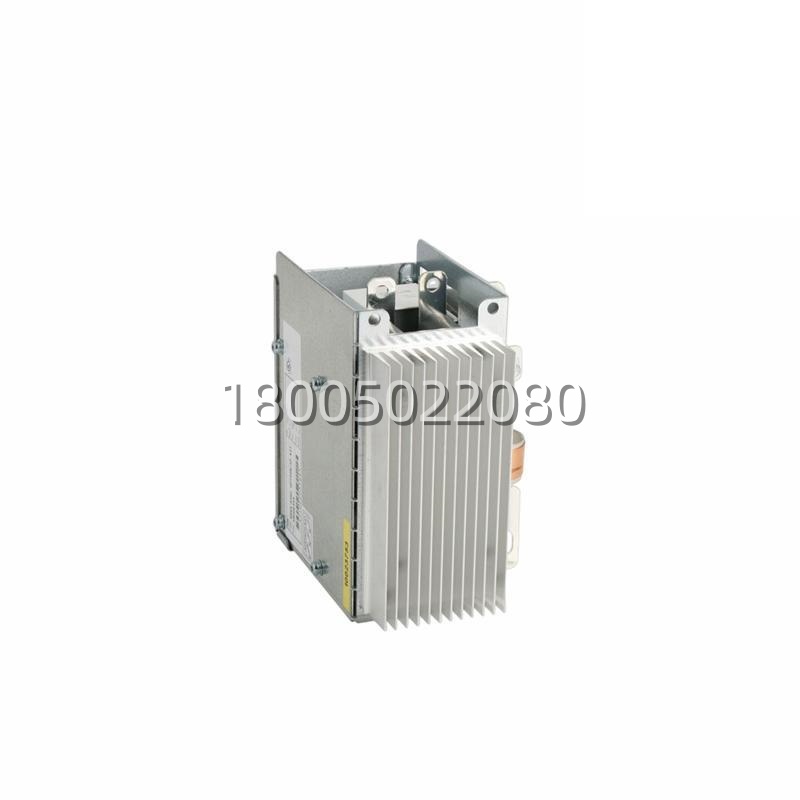
Technical Specifications
| Parameter Name | Parameter Value |
|---|---|
| Product Model | NBRA-656C |
| Manufacturer | ABB |
| Order Number | 59006444 / 3ABD58930784 |
| Product Type | External Braking Chopper (NBRA-65x family) |
| Compatible Drives | ABB ACS600, ACS800, ACS850, ACS510, ACS550; DC-bus compatible with third-party 230-500 V inverters |
| Input Voltage Range | 230 / 400 / 500 V AC (auto-adapt) |
| DC Bus Range | 320 – 800 V DC |
| Continuous Braking Power | 9 kW (@400 V system) / 6 kW (@500 V system) |
| Peak Braking Power | 79.5 kW (@400 V, 60 s / 10 min) / 88.4 kW (@500 V, 60 s / 10 min) |
| Energy Capacity | 2400 kJ |
| Rated Current | 25 A |
| Minimum External Brake Resistor | ≥2.7 Ω (@230 V) / ≥4 Ω (@400 V) / ≥6 Ω (@500 V) |
| Chopping Frequency | Default 4 kHz, adjustable |
| Response Time | ≤ 2 ms |
| Protection Functions | DC bus overvoltage, IGBT overcurrent/short, overtemperature (built-in thermal sensor), brake resistor open/short detection |
| Control Interface | Digital enable input; fault relay output (NO/NC) |
| Parallel Capability | Yes, multi-unit fiber-sync |
| Cooling | Cabinet forced air (external air cooling) |
| Protection Rating | IP20 |
| Operating Temperature | -20 … +50 °C |
| Storage Temperature | -40 … +70 °C |
| Dimensions (W × D × H) | 145 mm × 157 mm × 177.5 mm |
| Weight | ~2.9 kg |
| Cable Specification (to resistor) | 3 × 35 + 16 mm² Cu (recommended) |
Main Features and Advantages
IGBT-based high-speed chopping with adjustable frequency. The NBRA-656C uses industrial-grade IGBTs as the switching element — not the lower-grade GTO or bipolar transistors found on economy brake units — and switches at a default 4 kHz chopping frequency that is adjustable to tune acoustic noise and resistor ripple-current. The ≤2 ms response time from bus-overvoltage detection to first IGBT on-pulse matters in high-inertia decels: a 2000 kg hoist load dropping at 2 m/s can regenerate several hundred kW into the DC bus for a fraction of a second; if the chopper lags, the bus overshoots and the drive trips, the mechanical brake slams on, and you get rope jerk. The NBRA-656C keeps the bus pinned to the threshold window (e.g., 780 V on / 750 V off in 400 V mode) across the whole 60-second peak window.Voltage-class jumper and wide auto-adapt range. A frequent cause of “why won’t my chopper fire” calls is the internal voltage-selection jumper: the NBRA-656C must be jumpered to match the supply class — 230 V, 400 V, or 500 V. The jumper sets the overvoltage threshold (the “maximum limit” per ABB docs = 1.21 × 1.35 × U1max, where U1max = 415 V for 400 V selection, 500 V for 500 V selection). If a 400 V supply is jumpered to 500 V, the threshold sits ~780-800 V, but the bus on a 400 V drive only climbs to ~720-740 V under regen, never hits the threshold, and the chopper never fires — the drive then trips on overvoltage while the chopper sits idle. The NBRA-656C‘s jumper is the first thing to check on commissioning, and the second thing after any drive replacement.Full protection suite with relay fault output. The onboard NBRC control board monitors four fault classes and drops the relay if any trigger: (1) brake resistor or resistor cable shorted, (2) IGBT shorted, (3) control board failure, (4) enable input lost. The relay is a form-C (NO/NC) changeover, so the cabinet can wire it to the drive’s fault-tree or to a PLC DI — when the NBRA-656C disables itself (resistor disconnected from DC bus), the relay releases and the fault propagates upstream. One caveat ABB documents clearly: the chopper cannot clear a short-circuit current itself — the IGBT will fail if the resistor shorts and the drive’s own DC-fuse / breaker doesn’t clear. This is why the resistor cable must be short (≤10 m), shielded, and both-end grounded — a long unshielded run invites inductive kick and common-mode that fools the current sense.Parallel fiber-sync for power scaling. A single NBRA-656C tops out at 88.4 kW peak / 9 kW continuous — adequate for a single 30-55 kW hoist drive or a 75 kW centrifuge, but undersized for a 200 kW downhill conveyor or a multi-motor winding deck. The module includes a fiber-sync port that lets two or more NBRA-656C units parallel their enable/gating so they share the braking current proportionally. This avoids the “one big chopper” procurement constraint and lets plants scale: start with one NBRA-656C on a 55 kW hoist, add a second later when the hoist is upsized to 110 kW, re-use the first unit, fiber-sync them, done. The SAFUR resistor bank also scales — ABB offers multiple NBRC resistor elements that the NBRA-656C can drive in parallel strings.Mechanical fit for ACS800 cabinet integration. ABB designed the NBRA-656C footprint (145 × 157 × 177.5 mm) to drop into the designated brake-chopper bay of an ACS800 cabinet — wall-mount version of the drive has pre-drilled positions, and the DC+/DC- and R+/R- terminals land on the ACS800’s internal bus and resistor feeder without custom fabrication. Clearances are called out in the HW manual: ≥26 mm above, ≥51 mm to each side, to keep forced-air path open. For retrofit onto non-ABB drives, the NBRA-656C mounts on the cabinet wall near the DC bus bars, with DC+/DC- landed onto the drive’s DC-link terminals (many drives expose these as P+/N- studs even if they don’t document brake-chopper support). The 2.9 kg mass and IP20 rating mean it lives inside the cabinet, not exposed — the cabinet’s own enclosure (IP21/IP41/IP54) provides the environmental seal.SAFUR resistor ecosystem compatibility. ABB markets the SAFUR braking-resistor family (NBRC-xxx part numbers) as the matched load for the NBRA-656C — the resistor’s thermal inertia, ohmic value steps (2.7 / 4 / 6 Ω minimums per voltage class), and 2400 kJ energy rating align with the chopper’s 60s/10min cycle. Using a non-SAFUR resistor is permissible (minimum ohms must be respected or the IGBT overcurrents), but the SAFUR’s mechanical form factor and thermal-contact switch (wired to the NBRA-656C enable input) give a “designed together” commissioning path — the resistor’s thermostat opens the enable if the resistor overheats from consecutive heavy decels, the chopper stops switching, the bus rises, the drive trips — graceful degradation instead of a burned resistor.
Application Field
The NBRA-656C is deployed wherever an ABB ACS600/ACS800/ACS850 (or any 230-500 V drive with DC-bus access) feeds a load that regenerates meaningful energy on deceleration, and where letting the bus climb to the drive’s overvoltage trip is unacceptable — either because the process can’t tolerate the trip (hoist safety chain, conveyor product loss) or because the drive’s built-in brake unit is undersized for the inertia. The textbook application is overhead cranes and hoists: a 30 kW hoist motor lowering a 5-ton load regenerates roughly 20-30 kW back into the DC bus; the drive’s internal brake unit (often 2-4 kW class) saturates in seconds, the bus climbs, the drive trips, the mechanical brake snaps on — bad for rope life and for load swing. Adding a NBRA-656C with a SAFUR resistor sized to 4 Ω (400 V class) or 6 Ω (500 V class) absorbs the regen, holds the bus at ~770-780 V, and the hoist decelerates smoothly under control. Multiple hoists in a steel-service center or a shipyard gantry will each carry their own NBRA-656C, and the parallel-fiber option lets a dual-hoist trolley share a resistor bank if the electricals design calls for it.Elevators and lifts are a second domain — traction machines with counterweight-regeneration on down-fast runs; the NBRA-656C sits in the machine-room cabinet alongside the ACS800, and the resistor often goes into a separate vented enclosure (resistor gets hot — 2400 kJ is a lot of joules). Metallurgy applications — reheating-furnace pusher decels, roller-table retraction, shear flywheel spins-down — use the NBRA-656C because the duty is frequent-start-stop with high inertia; the 60s/10min cycle rating matches the furnace’s batch cadence. Fan and pump retrofit “heavy reduction” cases — a centrifugal fan spun down from 1500 rpm under VFD control where the dampers are closed and the inertia of the impeller + hub is 10× the motor — also benefit; the built-in brake unit on a standard HVAC drive is sized for the fan’s normal decel ramp, not for an emergency-stop from full speed, and the NBRA-656C fills that gap without upsizing the whole drive.Conveyor systems — especially downhill aggregate conveyors, mine-belt conveyors with loaded downhill sections, and parcel-sortation spirals — regenerate continuously while the belt runs; the NBRA-656C can be set up in a “continuous light regen” mode (the 6-9 kW continuous rating) with a larger SAFUR resistor bank, and the chopper holds the bus while the drive operates in regen steady-state. Engine and dyno test benches are another fit: the load machine (motoring the test article) regenerates to the DC bus, the NBRA-656C dumps it to resistors so the drive doesn’t feed it back to the grid (or the grid connection doesn’t permit reverse power). Wind-turbine converter DC-bus stabilization (especially retrofit on older doubly-fed units) also appears in the application list — the NBRA-656C manages bus overvoltage during gusty decels where the grid-side converter can’t sink fast enough.Retrofit and spare strategy: because the NBRA-656C talks to the drive only through DC+/DC- and the enable/fault relay, it is drive-generic within the 230-500 V / 320-800 V DC envelope. A plant running a mix of ACS800-04 (cabinet) and ACS850 (machinery drive) and even some non-ABB 400 V drives can standardize one NBRA-656C spare for all — the only variable is the voltage jumper and the SAFUR resistor value. For plants with multiple hoists or cranes, stocking 1 NBRA-656C per 3-4 units, plus a spare SAFUR resistor stack, covers the majority of braking-related downtime scenarios.