WhatsApp:+86 18005022363 WeChat: +86 18005022363
  Email:
Description
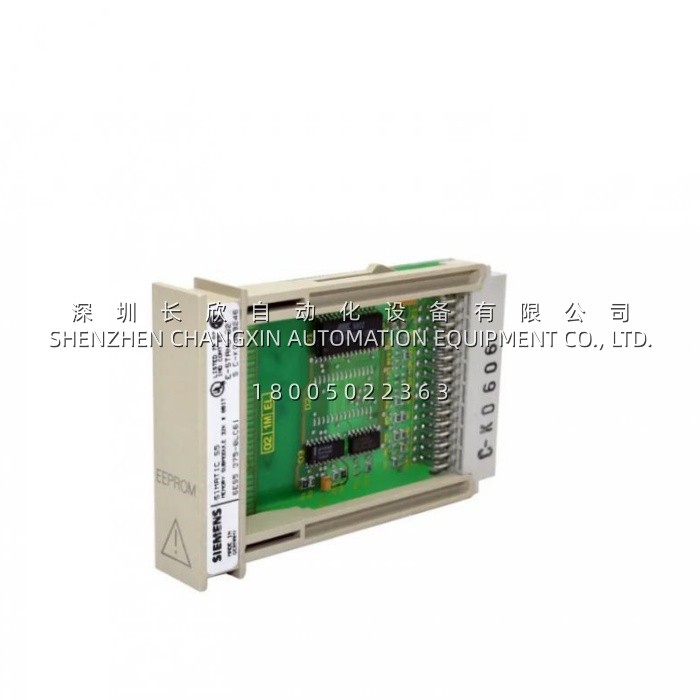
Main Features and Advantages
Battery-free permanent data retention. Unlike RAM-based S5 memory submodules (the 0LDxx series) that lose content the moment the backup battery weakens or cabinet power is removed for extended maintenance, the 6ES5375-0LC61 stores the loaded Step 5 project in EEPROM cells that hold state indefinitely without any auxiliary energy source. For plants that suffer from neglected battery replacement schedules — a very common root cause of unplanned S5 crashes — swapping a volatile submodule for the 6ES5375-0LC61 is a low-cost insurance policy against “lost program, unknown last change” scenarios on Monday morning startups.5 V in-system programming, no external HV required. The earlier 6ES5375-1LAxx CMOS EPROM siblings demand 21 V on the programming pin, meaning you either need a vintage Siemens PG or a programmer that explicitly supports that rail. By contrast, the 6ES5375-0LC61 is written and erased purely through the 5 V backplane, so any modern USB-to-S5 adapter that correctly enumerates the S5 memory catalogue can handle it. Transferring blocks from a .S5D project file via Step 5 → Block → Transfer → To EPROM/EEPROM is straightforward, with post-write verify enabled as standard practice.Right-sized 32 KB for classic S5 workloads. In the S5-375 submodule family the EEPROM line scales 2 / 4 / 8 / 16 / 32 KB (0LC11 through 0LC61). The 32 KB ceiling of the 6ES5375-0LC61 matches what S5-115U / 135U / 155U engineers typically need — ladder logic, DBs, FB/FC blocks for motor control, PID loops, sequencing, and I/O mapping in a mid-size line don’t usually exceed this. Overspecifying to a 128 KB EPROM is unnecessary cost; underspecifying below 32 KB risks running out during a later logic expansion. The 6ES5375-0LC61 lands precisely on the sweet spot.Drop-in mechanical compatibility. The submodule slides into the dedicated memory slot on the CPU rear panel, latches mechanically, and requires no separate cabling, termination, or DIP configuration beyond the onboard write-protect switch that some S5 memory carriers expose. Because it conforms to the S5-375 mechanical standard (DIN 41494), the 6ES5375-0LC61 can be swapped hot only in the sense that the CPU must be powered for programming, but the physical insertion is a seconds-long operation during a planned rack access.Field-service friendly for obsolescence management. Many S5 racks today are twenty-five to thirty-five years old. When a CPU reports memory errors or a site wants to duplicate a running program onto a cold-standby CPU, the 6ES5375-0LC61 is the submodule most frequently specified because EEPROM avoids both the UV-erasure rigmarole of EPROM and the battery-dependence of RAM. Refurbished and tested units, when sourced from specialist S5 inventory holders, typically carry 12–24 month warranties — remarkable for a discontinued series, and a testament to how electrically simple and mechanically robust the 6ES5375-0LC61 design is.
Application Field
The 6ES5375-0LC61 lives almost exclusively in brownfield SIMATIC S5 environments where the control architecture has been qualified for decades and a migration to S7-300/400/1500 or to a modern DCS has not been authorised due to downtime cost, requalification burden, or simply “it’s still running fine.” The three CPU families it primarily serves — S5-115U, S5-135U, S5-155U — were the workhorses of 1980s–1990s European machinery exports and remain dense in steel rolling mills, cement rotary lines, power-plant balance-of-plant auxiliaries, petrochemical batch units, water/wastewater lift stations, and legacy packaging lines worldwide.A typical application scenario: a S5-155U rack in a blast-furnace cooling-water pump station controls eight staged pumps via analog PID and digital interlocks, with the approved logic frozen since 1998. The original 6ES5375-1LA41 EPROM submodule is still present, but the site’s last Siemens PG with 21 V EPROM programming capability was retired five years ago, and the engineer wants to make a small timer tweak. Swapping in the 6ES5375-0LC61 lets him read the existing blocks out via Step 5, modify online or offline, and write back at 5 V through a commodity USB-S5 cable — no UV eraser, no HV supply. After verification, the 6ES5375-0LC61 stays in place as the new permanent program carrier.Another common case is spare-part parity for cold-standby redundancy. Plants that keep a mirrored S5 rack for rapid CPU swap often find that the RAM submodule in the standby loses its contents because the standby rack’s battery was never maintained. Replacing that standby’s memory with the 6ES5375-0LC61 means the cold rack wakes up byte-identical to the live rack the moment it’s powered, no battery, no reload.A third scenario is S5-95U compact CPU users on firmware 8MA03 / 8MD03 who discover that Step 5 V7.23 hides the 0LC61 in the EPROM device list unless the CPU firmware is EPROM-aware. For those qualified CPUs, the 6ES5375-0LC61 still works and is widely used, but the procurement spec needs to note the firmware caveat so the buyer doesn’t confuse it with the smaller 0LC11/0LC21 that some S5-95U builds do explicitly list. In all these contexts — steel, cement, pharma batch, water treatment, legacy OEM machinery — the 6ES5375-0LC61 is less a “component purchase” than a continuity enabler.