WhatsApp:+86 18005022363 WeChat: +86 18005022363
  Email:
Description
Application Scenarios
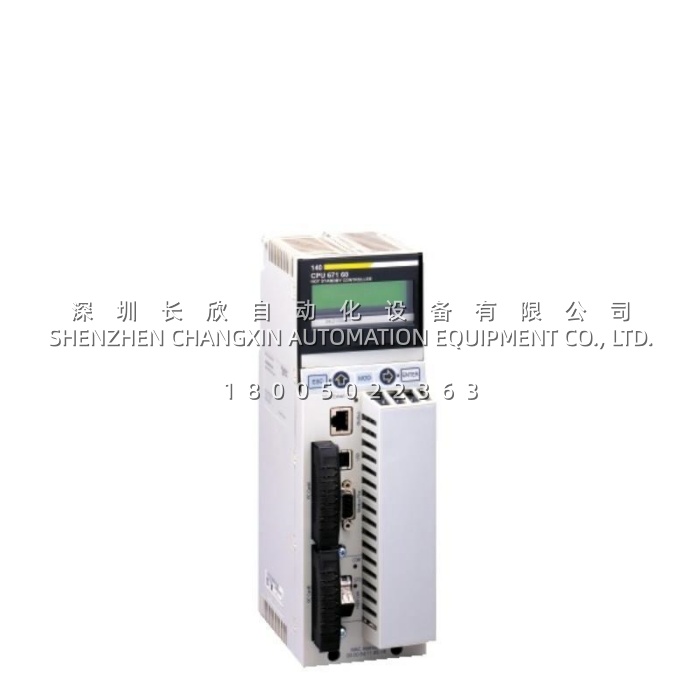
In the demanding environment of a petrochemical refining complex, unplanned downtime is unacceptable. A single control system failure can lead to production losses, safety incidents, and significant financial penalties. The 140CPU67160 directly addresses this critical pain point through its Unity Hot Standby architecture. When a leading chemical plant upgraded its distillation column controls, they deployed a pair of 140CPU67160 processors linked by a multimode fiber-optic cable. In the event of a primary CPU fault, the system executes a “bumpless” automatic switchover—transferring application execution and I/O control to the standby unit within milliseconds, with a fully synchronized data context . Operators reported that the transition was completely transparent to the process, preventing any disruption to production.
Another common scenario is in water and wastewater treatment facilities, where continuous monitoring and pumping operations are critical for regulatory compliance and public health. The 140CPU67160 enables engineers to perform firmware updates and preventive maintenance on the standby processor without interrupting the primary unit’s operation . This “no-downtime” maintenance capability is a transformative feature for facilities that cannot afford planned shutdowns. The front-panel mini-terminal of the 140CPU67160 allows on-site technicians to verify system status, force redundancy states, and diagnose issues without needing a connected PC, significantly accelerating response times during routine checks .
Parameters
| Main Parameters | Value/Description |
|---|---|
| Product Model | 140CPU67160 |
| Manufacturer | Schneider Electric |
| Product Category | Unity Hot Standby Processor (CPU) |
| Platform | Modicon Quantum Automation Platform |
| Clock Frequency | 266 MHz |
| Internal RAM | 1024 KB (512 KB dedicated for data) |
| Expandable Program Memory | 7168 KB with PCMCIA card |
| File Storage | 8 MB via PCMCIA card |
| Local Racks Supported | 2 |
| Remote I/O Stations | Up to 31 |
| Distributed I/O Stations | Up to 63 (Modbus Plus network) |
| Discrete I/O Capacity | 31,744 Inputs / 31,744 Outputs (Remote) |
| Integrated Communication | 1x Ethernet TCP/IP (RJ45), 1x Modbus Plus (SUB-D 9), 1x Modbus (RJ45), 1x USB |
| Redundancy Link | 1x MT-RJ Multimode Fiber Optic (max 4 km distance) |
| User Interface | LCD Display, Key Switch (Run/Stop/Memory), Status LEDs |
| Programming Software | Unity Pro XL / EcoStruxure Control Expert |
| Operating Temperature | 0°C to +60°C |
| Bus Current Requirement | 2500 mA |
Technical Principles and Innovative Values
The 140CPU67160 operates on the principle of synchronous redundancy. In a Hot Standby configuration, the primary PLC executes the application program and controls I/O, while the standby PLC remains synchronized. At the beginning of each scan cycle, the primary 140CPU67160 transfers the complete application data context—including the state of all referenced variables and I/O image tables—to the secondary unit via the dedicated fiber-optic link . This ensures the standby holds an exact, up-to-the-second copy of the process state, ready for instantaneous takeover.
Innovation Point 1: Bumpless Failover with Transparent Operation.
The core innovation of the 140CPU67160 is its ability to perform a switchover with zero “bumps” on the outputs. The transition is managed so seamlessly that the process remains unaffected by a hardware failure on the primary unit . This is a significant differentiation from simpler redundancy schemes that may cause momentary output glitches or require manual intervention, which can upset sensitive continuous processes.
Innovation Point 2: System Registers and Flexible Control.
The redundancy system of the 140CPU67160 is managed via dedicated internal system registers—a Command Register for user requests and a Status Register for system feedback . This architecture allows operators to control redundancy (e.g., invalidating front-panel commands, forcing a standby state) through both the configuration dialogue and the front-panel mini-terminal. This dual-channel control offers exceptional flexibility, enabling both remote software management and local physical intervention, a feature rarely matched by competitors in the same class.
Innovation Point 3: Live Firmware Updates and Hot Maintenance.
The Hot Standby architecture of the 140CPU67160 supports updating the processor firmware without interrupting application processing . In critical infrastructure such as power generation or oil & gas pipelines, this capability alone is invaluable. It allows engineering teams to apply security patches and performance enhancements during production hours, eliminating the need for expensive and operationally disruptive shutdowns for maintenance.
.jpg)