WhatsApp:+86 18005022363 WeChat: +86 18005022363
  Email:
Description
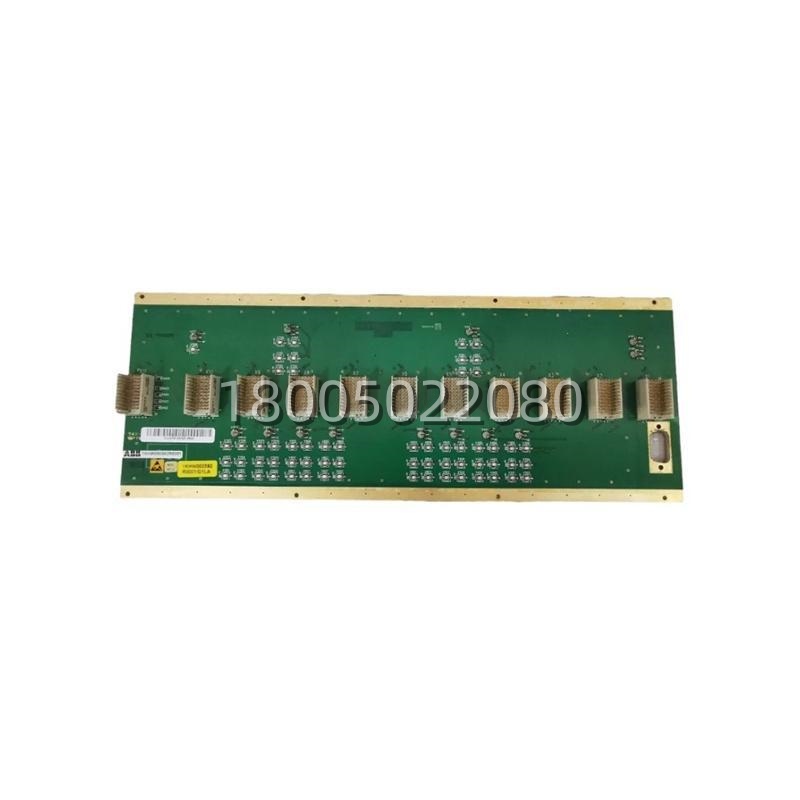
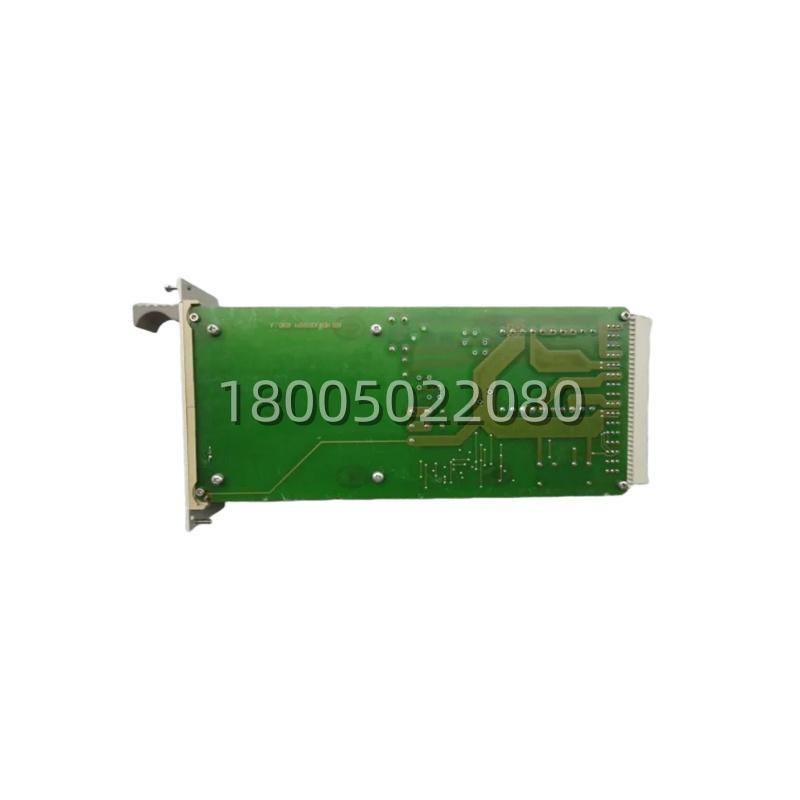
The ABB P3LC HENF209650R1 is a drive control / pulse-driver board manufactured by ABB, designed to sit in the power-unit rack of ABB ACS600 / ACS800-family medium-voltage drives or alongside an AC800PEC pulse controller in excitation and thyristor-rectifier applications. It bridges the “compute world” (DSP / AC800PEC host) and the “power world” (IGBT or thyristor gate drives): on the front end it samples 3-phase sync voltage (100 V AC),励磁 CT secondary (±10 mV), and RTD temperatures; on the back end it emits optically isolated fiber trigger pulses to the power semiconductors and reports fault data back over the CEX backplane. A 32-bit DSP on board runs space-vector PWM, dead-time compensation, desat detection, and DTC/vector protection logic (OV/OC/OT/UV).Application ScenariosA 350 MW hydro unit running ABB AC800PEC-based static excitation hit a recurring “Loss of Pulse” trip during peak load swings: the thyristor rectifier bridge would drop two phases for ~300 ms whenever the unit crossed 280 MW, and the excitation ceiling would clamp, forcing a load-shed. Root cause traced to one ABB P3LC HENF209650R1 in the pulse rack whose fiber-emitter optocoupler had aged — its drive current margin had dropped below the 5 mA threshold at 50 °C deck temperature, and the 280 MW crossing pushed the rectifier firing angle into the region where the marginal emitter couldn’t sustain the 100 kHz trigger burst. The plant E&I swapped the P3LC HENF209650R1 during a scheduled load-pull (the CEX backplane supports hot-swap on the pulse rack — pop the old, rack the new, the AC800PEC PPD113 re-enumerates within two scans). Post-swap, the unit ran 310 MW / 290 MW swing cycles for 72 hours straight with zero pulse-loss. The lead noted the RS-232 front port let them hook DriveWindow laptop liveduring the swing test and watch the ±10 mV CT channel and 100 V sync waveform without pulling the board — something the old analog pulse rack never allowed.
Parameter
| Main Parameters | Value/Description |
|---|---|
| Product Model | ABB P3LC HENF209650R1 |
| Manufacturer | ABB |
| Product Category | Drive Control / Pulse Driver Board (Excitation & Drive Power Unit) |
| Target System | ABB ACS600 / ACS800 power units; AC800PEC pulse racks (PPD113 / UAD215) |
| Control Core | 32-bit DSP / microprocessor (batch-dependent) |
| Sync Input | 3 × 100 V AC (phase-to-phase), for PLL / loss-of-mains / overvoltage |
| Current Sense | Exciter CT secondary, ±10 mV precision divider |
| Temperature Input | RTD (power module / heatsink monitoring) |
| Pulse Output | Multi-channel fiber emitters → thyristor/IGBT gate (galvanic isolation) |
| Digital I/O | 16 DI (24 V DC): fuse-blow, fan-fail, door-switch, local E-stop; 4 DO relay (250 V AC / 5 A): trip-breaker, alarm horn |
| Backplane | CEX proprietary (to PPD113 / UAD215), hot-swap capable |
| Debug Port | RS-232 (DriveWindow: param load, fault recording, firmware update) |
| Control Modes | Vector + DTC (where applicable), V/F, torque mode |
| Protection | OC / OV / UV / OT / desat / short |
| PWM Tech | Space-vector PWM (SVPWM) with dead-band |
| Supply Voltage | 24 V DC (from power-unit / pulse-rack PSU) |
| Operating Temp | -10 to +50 °C (deck), some batches -20 to +60 °C |
| Dimensions (approx.) | 160 × 220 × 32 mm (varies by carrier) |
| Weight | 0.8–1.2 kg |
Technical Principles and Innovative Values
- Innovation Point 1: Fiber-Isolated Pulse Emission → Zero HV Crosstalk. The P3LC HENF209650R1 doesn’t drive gate copper directly — it emits trigger bursts over multi-channel fiber ports to the thyristor/IGBT gate heads. This means the 100 V sync, ±10 mV CT, and 24 V logic world are galvanically invisible to the 4–6 kV anode/cathode swing on the rectifier — a desat or shoot-through on the power side can’t back-feed into the DSP. For excitation racks sitting 2 m from a 18 kV thyristor bridge, this isolation is non-negotiable.
- Innovation Point 2: CEX Backplane Hot-Swap with < 2-Scan Re-Enumeration. The P3LC HENF209650R1 lands on ABB’s CEX (Control EXpansion) backplane, the same bus the AC800PEC PPD113 master and UAD215 analog-acquisition board share. If a P3LC fails live, you can pop it and rack a replacement — the PPD113 sees the CEX node drop, re-enumerates on the next scan, and the pulse rack is back. No full rack power cycle, no DriveWindow download (unless you’re changing firmware). This is why the hydro unit above swapped during a 280→310 MW load-pull instead of waiting for a shutdown.
- Innovation Point 3: 100 V AC 3-Phase Sync + ±10 mV CT on the Same Front End. Most drive boards separate “sync card” and “CT card” — the P3LC HENF209650R1 crams both onto the same PCB: Euro/D-sub front connectors land 3×100 V AC (transformer secondary from the generator PTs) for PLL locking and loss-of-mains detection, and the CT ±10 mV channels (shunted 75 mV / 150 mV class) for real-time Id/Iq current-loop feedback. One board, one CEX slot, one DriveWindow node.