WhatsApp:+86 18150087953 WeChat: +86 18150087953
  Email:

Description:
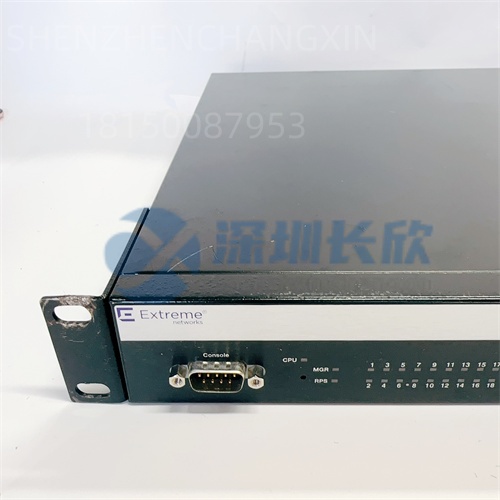
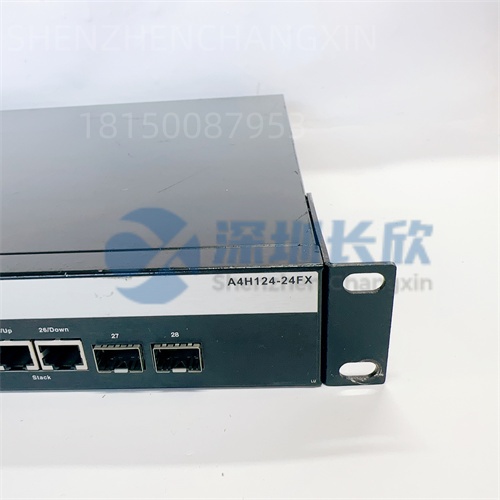
The ENTERASYS A4H124-24FX P0973JN (also referenced under FOXBORO branding) is a highly reliable, industrial-grade Fast Ethernet edge switch from Extreme Networks’ A4 series (originally Enterasys). This 24-port fiber management switch is engineered to deliver scalable, wire-speed performance for bandwidth-intensive and latency-sensitive applications in demanding industrial and enterprise environments . With its robust design, advanced management features, and support for stacking and redundancy, it serves as a critical network infrastructure component for process automation, data centers, and campus networks .
Application Scenarios:
At a large natural gas processing plant, the Distributed Control System (DCS) required a network backbone that was immune to electromagnetic interference from high-voltage equipment and capable of spanning long distances between control rooms and remote field installations. The existing copper-based network suffered from signal degradation and occasional data loss during electrical storms. The engineering team deployed the ENTERASYS A4H124-24FX P0973JN switches to create a fiber-optic ring topology connecting all critical control nodes . The switch’s 24 100Base-FX ports provided the necessary density for connecting various controllers and I/O servers, while its fiber optic nature eliminated EMI issues entirely. During a plant-wide power quality event that caused voltage sags, the network remained fully operational, ensuring continuous monitoring and control. The plant’s network administrator noted that the switch’s “silent, fanless operation and wide temperature tolerance made it ideal for installation directly in electrical substations,” solving the dual pain points of environmental resilience and signal integrity .
Technical Principles and Innovative Values:
The ENTERASYS A4H124-24FX P0973JN distinguishes itself in the competitive edge switch market through a focus on deterministic performance, operational resilience, and simplified management in harsh conditions.
Innovation Point 1: Deterministic, Non-Blocking L2 Architecture for Industrial Timing. Unlike standard commercial switches that may introduce variable latency under load, this switch employs a purpose-built, non-blocking Layer 2 switching fabric with a guaranteed switching capacity of up to 17.6 Gbps . Coupled with its intelligent queuing mechanism, it provides strict priority to time-sensitive control traffic (like PROFINET or Modbus TCP frames), ensuring that critical I/O scan cycles and safety system communications are never delayed by routine network broadcasts or bulk data transfers. This determinism is crucial for real-time industrial control.
Innovation Point 2: Converged Management for Mixed IT/OT Environments. The switch features a unified management plane that supports both traditional IT protocols (SNMP, CLI) and operational technology (OT) needs. Its “NetSight” and “WebView” interfaces allow network engineers and control system integrators to collaborate using familiar tools . More importantly, it supports the “Extreme Networks Policy,” enabling the creation of role-based access control policies that can be applied automatically based on device type (e.g., a PLC gets a high-priority, locked-down policy, while an engineer’s laptop gets a different one), bridging the security and management gap between IT and OT networks .
Innovation Point 3: Passive Cooling and Component Hardening for Extreme Environments. To achieve its -40°C to +85°C operating range without failure, the switch utilizes a completely fanless, conduction-based cooling design . Critical components like capacitors, oscillators, and the power supply are selected from industrial-grade parts with extended temperature ratings and higher mean time between failures (MTBF). This design eliminates the most common point of failure in industrial electronics—the cooling fan—and allows deployment in locations like outdoor substations, factory floors, and pipeline stations where dust, vibration, and temperature extremes are normal.
Innovation Point 4: Virtual Stacking with Single IP Management. The switch’s SecureStack technology allows up to eight physical units to be interconnected and managed as a single logical switch with one IP address . This simplifies network topology, reduces management overhead, and creates a resilient ring or chain topology. If one unit in the stack fails, control traffic can be automatically rerouted through alternative paths within the stack, enhancing network availability without requiring complex spanning tree protocol configurations.
Application Cases and Industry Value:
A major university hospital embarked on a digital transformation to integrate its building management system (BMS), medical device networks, and patient record systems onto a converged network to improve operational efficiency and patient care. The project faced the challenge of creating a network that was both high-performance for data-intensive medical imaging and deterministic for critical life-safety systems like HVAC control in operating rooms and isolation wards.
The network core and edge were built using ENTERASYS A4H124-24FX P0973JN switches. In the hospital’s new wing, these switches were deployed in wiring closets, using their fiber uplinks to connect to the core and their 100Base-FX ports to connect to IP-enabled HVAC controllers, nurse call systems, and equipment monitors via media converters. The switch’s robust QoS policies ensured that emergency page announcements and alarm signals from critical care units were never dropped or delayed, even during daily backups that saturated the network.
During a scheduled stress test, the network successfully handled a simulated surge of data from multiple MRI and CT scanners while maintaining sub-10ms latency for the BMS control traffic. The hospital’s IT director stated that the “combination of fiber optic reliability, silent operation for patient areas, and the ability to prioritize life-safety traffic provided a future-proof foundation for our smart hospital initiatives.” The project demonstrated a direct return on investment through reduced cabling costs, lower energy consumption from optimized HVAC control, and, most importantly, an enhanced capability to support critical healthcare services .
Related Product Combination Solutions:
A complete industrial network solution often integrates the A4H124-24FX P0973JN with these complementary components:
Extreme Networks/Enterasys A2H124-24FX: A similar control module or switch from the A2 series, often used in hierarchical network designs for different zones or as a backup aggregation point .
FOXBORO/Invensys Control System Components: As the P0973JN part number is associated with FOXBORO, it is commonly integrated with FOXBORO DCS controllers, I/O modules, and workstations as part of a vendor-specific automation solution.
Redundant Power Supply (e.g., STK-RPS-150PS): An external RPS unit that provides backup power to one or more switches, ensuring continuous operation during a main power supply failure .
SFP/Gigabit Interface Converters (GBICs): Various 1000Base-SX/LX SFP modules are used in the two gigabit uplink ports for connecting to network cores or other switches over single-mode or multi-mode fiber.
100Base-FX to 10/100Base-TX Media Converters: These devices allow the switch’s fiber ports to connect to copper-based field devices like PLCs, RTUs, or IP cameras, extending the reach of the fiber network.
Network Management Software (e.g., Extreme Networks NetSight): Centralized software for provisioning, monitoring, and troubleshooting the entire network of A4 series switches and other Extreme/Enterasys devices.
Installation, Maintenance, and Full-Cycle Support:
Installation of the ENTERASYS A4H124-24FX P0973JN is designed for flexibility. It can be mounted in a standard 19-inch rack using its 1U bracket or placed on a desktop in non-rack environments. Fiber optic cabling with MT-RJ or LC connectors (depending on SFP modules) is routed to the front-panel ports. For stacking, standard Cat5e or better UTP cables connect the dedicated RJ-45 stacking ports on the front panel, allowing for daisy-chain or redundant ring configurations . Initial configuration is typically performed via the serial console port (DB-9) or out-of-band management port, after which the switch can be managed over the network via its web interface or CLI.
Maintenance is notably low due to the fanless, solid-state design. Primary tasks involve periodic visual inspection of status LEDs and ensuring ventilation is not obstructed. The switch’s comprehensive SNMP and RMON support enables proactive monitoring of traffic patterns, error rates, and temperature from a central network management station. Should a unit fail, its hot-swappable capability (when used with an RPS) or modular design allows for rapid replacement without network downtime. Extreme Networks provides strong lifecycle support for its A4 series, including long-term availability of spare parts, firmware updates, and access to technical support. The product often comes with a limited lifetime warranty, underscoring its designed reliability and the manufacturer’s commitment to long-term support for industrial and enterprise networks .