WhatsApp:+86 18005022363 WeChat: +86 18005022363
 Email:

Technical Specifications
| Parameter | Value |
|---|---|
| Product Model | MMII-PD-1-2-120 |
| Manufacturer | GE Multilin (GE Automation & Controls, Markham, Ontario) |
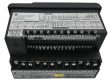
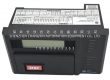
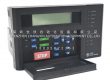
| Product Type | Intelligent Motor Management & Protection Relay (Motor Manager II / MM2) |
| Control / Aux Supply | 120 VAC, 80–135 VAC operating window, 50/60 Hz |
| Power Consumption | < 15 W (typical 10–15 W depending on display and I/O load) |
| Current Inputs | 3-phase CT secondary (RMS measurement, CT ratio programmable) |
| Protection Elements | I²t thermal overload, phase loss, phase unbalance, locked rotor / stall, ground fault, underload, overcurrent, contactor weld / dropout detect |
| Thermal Model | I²t winding-heat model with start-count and cool-down; thermal capacity displayed as % |
| Temperature Input | Thermistor / RTD winding-temperature monitoring (Option 2) |
| Process Input | 1 × 4–20 mA analogue input, ±2% accuracy (Option 1) |
| Discrete Inputs | 6 fixed control inputs + 10 programmable process inputs (configurable start/stop, reset, inhibit, etc.) |
| Relay Outputs | 4 relay outputs: 2 starter/contactor control + 2 programmable alarm/trip (Form-C dry contacts) |
| Contact Rating | 250 VAC, 5 A resistive (per output group; application-derate advised) |
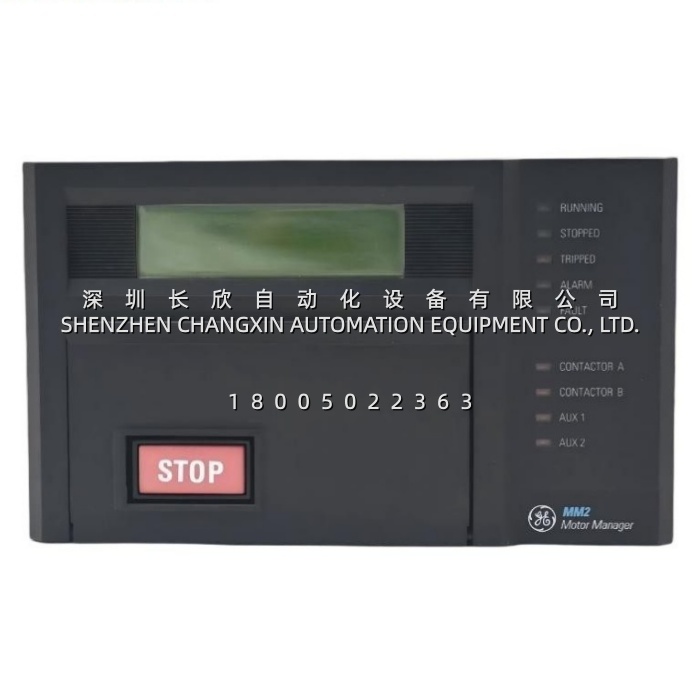
| Local Interface | 2-line × 40-character alphanumeric LCD with backlight + tactile keypad and status LEDs |
| Communication | RS-485, 2-wire half-duplex, Modbus RTU, 1200–19200 baud |
| Memory | Non-volatile: configuration, event log, last-fault / pre-fault data, run-time and start-count retained through power loss |
| Starter Compatibility | FVNR, reversing, two-speed and reduced-voltage starter schemes, configurable |
| Configuration Software | GE EnerVista MMII |
| Operating Temperature | 0 °C to +60 °C |
| Storage Temperature | –40 °C to +85 °C |
| Humidity | 5% to 95% RH, non-condensing |
| Front Panel Rating | IP53 (NEMA 1 / Type 12 bezel class, per build) |
| Terminal / Body Rating | IP20 at terminations |
| Mounting | Panel / cutout mount (PD style); DIN-rail adapter MMII-DIN-ADPTR available |
| Dimensions | 188 × 112 × 127 mm (7.4 × 4.4 × 5.0 in.) |
| Weight | approx. 1.36–1.8 kg |
| Agency / Standard | UL 508, CSA, CE; designed to IEC 60947-4-1 and relevant EMC / EMI class |
| Status | Discontinued OEM product; supplied as new-surplus or reconditioned |
Main Features and Advantages
One device, one calibration, one fault trail. The single biggest win of the GE MMII-PD-1-2-120 is that protection, control and recording now share a single set of inputs and a single configuration. There is no longer a bimetal element set to 1.05 × FLA, a separate phase-loss relay with its own CT and a timer with its own calibration drift. Set the motor FLA and the CT ratio once in EnerVista or from the keypad, and every element — overload, unbalance, stall, ground fault and temperature — scales from that same truth. When a trip happens, the LCD shows not just “trip,” but which element, at what current, and with how much thermal capacity was left. That is the difference between a ten-minute fix and a day-long autopsy.Option 1 and Option 2 are why this exact suffix matters. A plain MMII-PD-120 is not the same spare. The -1- in the MMII-PD-1-2-120 brings the process-control and enhanced-diagnostics package: the 4–20 mA process input, programmable process inputs, undervoltage auto-restart and the richer event set that lets the relay decide “restart the pump after the brownout” instead of making the DCS write that logic. The -2- adds the ground-fault element, the locked-rotor/stall logic and the thermistor/RTD winding input. Together they turn the unit from a smarter overload relay into a small protection scheme. Swapping in a lesser suffix silently loses functions the rest of the starter and the DCS were counting on.Thermal modelling instead of thermal guessing. The I²t engine inside the GE Multilin MMII-PD-1-2-120 does not trip on a fixed current threshold; it integrates heating against the motor’s own thermal inertia, counts starts, tracks cool-down, and distinguishes a long steady overload from a start that is still inside the allowable duty. The front panel’s “thermal capacity %” is genuinely useful on a hot day — an operator can see a pump drifting toward 90% and intervene before the relay makes the decision for him. For a motor on a cyclic duty, that visibility alone prevents the slow, cumulative cooking that never shows up as a single dramatic trip.Ground fault and stall without the usual blind spots. Ground-fault protection in the MM2 reads the zero-sequence path and is shaped independently of the phase overcurrent, so a low-level insulation leak is caught long before it becomes a phase-to-ground fault that takes out the bucket. The stall/locked-rotor element, meanwhile, is start-aware: it rides through the high inrush of a healthy acceleration and only asserts once the motor should already be at speed. That discrimination is what stops the classic complaint — “the overload trips every time we start the pump” — because in almost every such case the old device was timing the start as a fault, and the MMII-PD-1-2-120 is configured to understand it.A 120 VAC control world, no transformer required. The suffix is a constraint, and it is also a convenience. In North American and export MCCs the 120 VAC control circuit is already there, so the GE MMII-PD-1-2-120 lands directly on the control transformer secondary with no buck-boost, no DC supply and no 240 VAC run back to the panel. The trade-off is absolute: do not fit a 240 VAC unit here and do not “just try” a 120. The supply tolerance is 80–135 VAC; outside that, the relay may power the display while the outputs misbehave, which is worse than a clean failure.Modbus out, guessing gone. The RS-485 port is not a marketing port. Once landed on a Modbus master — a GE DCS, a PLC or a small gateway — the relay hands up phase currents, thermal capacity, ground-fault current, alarm and trip status, run hours and start count. That stream is what turns a motor into a predictably maintained asset: trend the thermal capacity, watch the start count climb, catch the ground-fault residual rising over a wet season. It also means the DCS can inhibit a restart or log an operator action without anyone touching the bucket door.