WhatsApp:+86 18005022363 WeChat: +86 18005022363
  Email:
Description
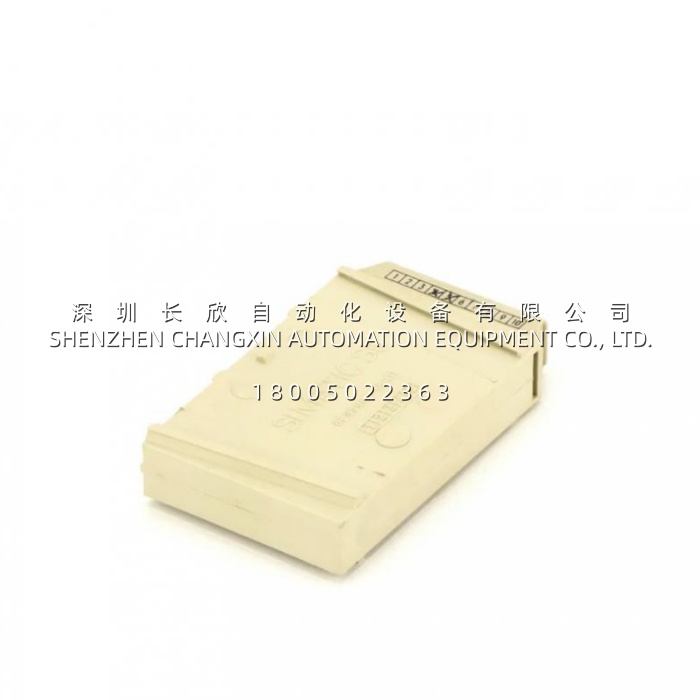
Technical Specifications
| Parameter | Value |
|---|---|
| Product Model | 6ES5377-0AB41 |
| Manufacturer | Siemens (SIEMENS) |
| Product Type | RAM Memory Submodule (SIMATIC S5-377 Series) |
| Storage Capacity | 64 KB (load memory – user program + retentive data) |
| Memory Type | Volatile RAM, battery-backed via S5 rack backup battery |
| Compatible CPU | S5-115U, S5-135U, S5-155U (rear memory expansion slot) |
| Operating Voltage | DC 5 V (CPU backplane) |
| Backup Requirement | S5 rack backup battery (e.g. 6ES5795-0BA00 3.6 V Li, or 6ES5795-0AA00 AA holder) |
| Data Retention (battery good) | Indefinite while backup battery healthy |
| Data Retention (battery dead / removed) | Lost on backplane power loss |
| Power Dissipation | Typ. ~0.6–0.8 W (backplane) |
| Working Temperature | 0 °C to +60 °C |
| Storage Temperature | -40 °C to +70 °C |
| Protection Class | IP20 |
| Mechanical Form | Plug-in submodule, DIN 41494 |
| Weight | approx. 0.055 kg |
| HS / Commodity Code | 85389091 |
Main Features and Advantages
High 64 KB capacity for complex S5 loads. In the S5-377 RAM family the capacity steps run 8 / 16 / 32 / 64 KB across the 0AAxx and 0ABxx suffixes, with the 6ES5377-0AB41 sitting at the top of that ladder. A S5-155U controlling a multi-motor drive train with a dozen FB, tens of FC, and multiple DB for setpoints/recipes can easily consume 35–55 KB; the 32 KB EEPROM ceiling of a 6ES5375-0LC41 would be tight, and the 128 KB EPROM 0LA71 exists but forces 21 V programming and UV erasure. The 6ES5377-0AB41 splits the difference — large enough for real-world S5-135U/155U projects, writable from any PG or USB-S5 adapter at 5 V, no HV, no UV.Unlimited write cycles — ideal for active development racks. Unlike the EEPROM 6ES5375-0LC61, which nominally endures ~10,000–100,000 erase/write cycles, the 6ES5377-0AB41 is RAM — every block download from Step 5 simply overwrites SRAM cells with no wear mechanism to track. For OEM machine builders who still support legacy S5 lines and issue occasional logic patches, or for plant engineers who tune PID constants and interlock logic during commissioning, the 6ES5377-0AB41 removes the “how many writes left?” anxiety entirely. Download, test, download again — the submodule doesn’t care.Direct Step 5 workflow, no special programmer needed. Loading a project into the 6ES5377-0AB41 is the same Block → Transfer → To PLC path used for internal CPU RAM, except the target is the expanded load memory slot. No EPROM programmer, no UV eraser box, no 21 V rail. Any PG720/PG740/PG760 legacy laptop or any modern PC with a USB-MPI adapter and Step 5 V7.x sees the 6ES5377-0AB41 natively in the memory layout. This is why many service contractors standardise on 377 RAM submodules for their “truck stock” S5 kits — one part, one cable, one software install covers 90% of field calls.Cost-effective vs. large EPROM for mid-capacity needs. A 128 KB S5-375/376 EPROM submodule commands a premium on the secondary market because it’s the only path to >64 KB on S5-115U/135U/155U. But most S5 applications never breach 64 KB. For those, the 6ES5377-0AB41 delivers the needed headroom at a fraction of the EPROM price, with the only operational trade-off being battery dependence — a manageable one when the rack already carries a backup battery for the CPU’s own work-memory retention anyway.Drop-in mechanical, zero configuration. Like all S5-37x submodules, the 6ES5377-0AB41 slides into the CPU rear memory slot, keys physically, and is enumerated by the CPU at boot based on the ID ROM the submodule carries. No DIP switches, no jumper, no “format” step. Power up, Step 5 sees the 64 KB load memory extent, and the engineer transfers blocks. In a panic Saturday-night swap — the most common real-world deployment of the 6ES5377-0AB41 — this simplicity matters.Obsolescence-aware sourcing. Because the S5-377 series has been out of active Siemens production for years, the 6ES5377-0AB41 today trades almost entirely as NOS or professionally refurbished. Reputable suppliers will cycle-test the submodule on a S5-135U/155U rack (write 64 KB of patterned blocks, verify, power-cycle with battery, verify again) before shipment. At this age, the weak component isn’t the submodule PCB itself — it’s the backup-battery discipline on the customer side. A 6ES5377-0AB41 supplied with a fresh 6ES5795-0BA00 lithium cell and a battery-change sticker on the cabinet door is a far better deliverable than the submodule alone.
Application Field
The 6ES5377-0AB41 is deployed wherever a S5-115U, S5-135U or S5-155U CPU needs more than 32 KB of load memory and the site accepts battery-backed RAM as the storage class. The canonical industries are the same as the wider S5 footprint: steel (rolling-mill stands, furnace cooling, coke-side emissions), cement (rotary kiln auxiliary drives, bag-house sequencing), power generation (BOP feedwater, circulating-water pumps, ash-handling), petrochemical (batch reactor interlocks, compressor antisurge logic), water/wastewater (lift-station staging, clarifier drive control), and discrete manufacturing (injection moulding, stamping press, crane/hoist SE-PLC hybrids).A representative scenario: a S5-155U rack on a four-stand wire-rod mill runs the main drive sequencing, looper PID, and shear timing across ~48 FB and ~120 FC, consuming ~52 KB of load memory. The original 32 KB EEPROM was overflowing, so the engineer specified the 6ES5377-0AB41 — 64 KB clears the headroom, RAM means he can patch a FC during a 4-hour weekly window without hauling a UV eraser or 21 V programmer to the pulpit. The rack already carries a 6ES5795-0BA00 lithium on the PS/rack, so backup retention is covered. After the swap, the 6ES5377-0AB41 becomes the permanent load-memory home; the internal CPU RAM still holds work memory per scan, and the battery protects both.Another scenario: an OEM that still ships legacy S5-based panels to a handful of markets (Asia, Africa, Eastern Europe) keeps a stock of 6ES5377-0AB41 for final-program load at the test bench. Each panel gets a known-good 64 KB RAM submodule, the Step 5 project is transferred, the battery is fitted, and the panel ships. Six months later at site commissioning, the OEM tech powers up, verifies the battery LED, and the 6ES5377-0AB41 is still byte-identical — no surprise, no reload.A third pattern is the “development rack” use case. Engineering offices that maintain S5 competence for legacy support often keep a S5-135U rack on the bench with a 6ES5377-0AB41 permanently installed. Customer .S5P/.S5D archives are pulled, loaded into the bench rack for simulation or minor edit, then re-transferred to a replacement EEPROM/EPROM for the field unit. The RAM submodule’s unlimited write endurance makes it the right bench tool; the 6ES5377-0AB41 is the specific 64 KB variant so the bench can handle the largest customer projects without “memory full” abort.One caveat worth noting in application planning: the 6ES5377-0AB41 is not suitable for sites with unreliable battery discipline or where the rack may be powered off for months (e.g., seasonal plant). In those cases the 375 EEPROM route is safer despite the lower capacity ceiling. The submodule choice is therefore application-driven, not hierarchical — both the 6ES5377-0AB41 and the 6ES5375-0LC61 coexist in the same spare-parts catalogue for different site profiles.
.jpg)