WhatsApp:+86 18005022363 WeChat: +86 18005022363
  Email:
Description
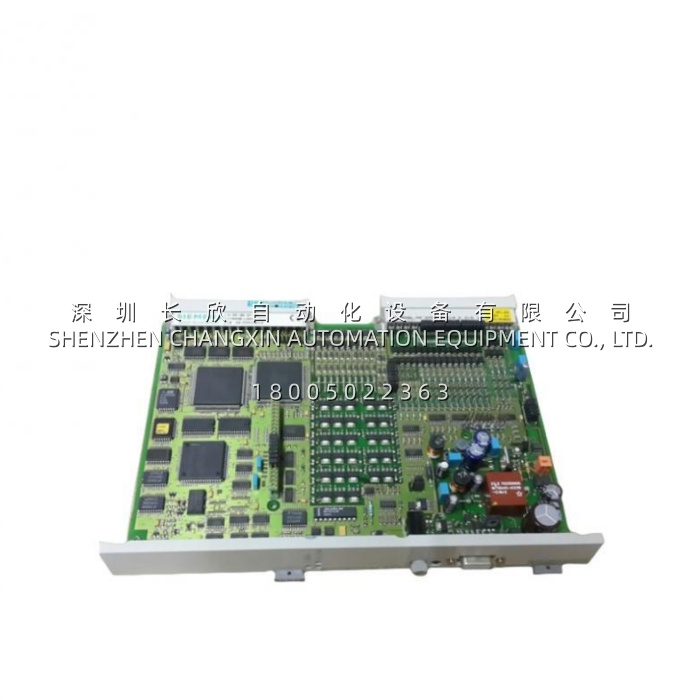
Technical Specifications
| Product Model | 6DS1723-8RU |
|---|---|
| Manufacturer | Siemens |
| Product Type | Signal Control Module |
| Supply Voltage | 24 V DC (backplane) |
| I/O Footprint | 16 bytes |
| Channel Structure | 16-bit input/output |
| Base Address Selection | 8-way S1 DIL switch |
| Operating Temperature | –25 °C … +60 °C |
| Storage Temperature | –40 °C … +85 °C |
| Relative Humidity | 5 % … 95 % (non-condensing) |
| Dimensions (approx.) | 203 × 76 × 254 mm |
| Weight (approx.) | 0.4 kg |
| Mounting | 6DS rack, standard slot |
| Protection Class | IP20 (cabinet installation) |
| Isolation | Channel ↔ backplane, galvanic |
| Interface | Teleperm M backplane bus / DP-class communication |
Main Features and Advantages
The 6DS1723-8RU earns its keep by sitting in the signal path where noise, ground loops, and wiring asymmetries do their worst. Siemens’s internal filtering and isolation architecture on the module actively rejects common-mode noise from the field side before the data ever reaches the DCS logic layer—this is what keeps Teleperm M racks stable on turbine decks where variable-frequency drives, breaker switching, and lightning transients are daily occurrences. A 6DS1723-8RU that is performing well makes the rest of the I/O train look cleaner than it really is, because the dirty work happens on the signal-control card instead of upstream at the CPU or downstream at the termination panel.Configuration simplicity is the second differentiator. The 8-way S1 DIL switch for base-address selection means a maintenance engineer can relocate the 6DS1723-8RU to a different I/O slot or replace a failed unit without opening an engineering workstation, pulling a project file, or worrying about firmware version mismatches. In outage scenarios where the control room may be inaccessible or the ES station is itself under maintenance, being able to set address via hardware alone keeps the repair path short. The 16-byte I/O footprint is deliberately modest, letting the 6DS1723-8RU coexist with denser AI/AO and DI/DO cards without stealing address space needed for process loops.From a lifecycle angle, the 6DS1723-8RU is squarely in the “obsolete-but-still-critical” category. Siemens 6DS hardware is long out of active commercial flow, yet thousands of Teleperm M racks remain online because the control strategies they host are validated, safety-reviewed, and embedded in plant operating licenses. In that context the value of a 6DS1723-8RU is not feature innovation—it is drop-in determinism. A tested replacement restores the signal lane exactly as the original MLFB defined it, with no requalification, no logic recompile, and no retagging. For plants managing 6DS obsolescence, stocking two or three 6DS1723-8RU modules per rack cluster is usually cheaper than a single emergency expedite fee from a surplus broker during a forced outage.
Application Field
The 6DS1723-8RU belongs inside Siemens 6DS racks deployed across industries that standardized on Teleperm M in the 1990s–2000s and have since migrated partially or fully to SPPA-T3000 without ripping out every legacy rack. The heaviest concentration is power generation—coal, combined-cycle, and nuclear auxiliary trains where Teleperm M still governs burner management, turbine auxiliary loops, and balance-of-plant logic that was never worth re-implementing in a newer platform. In these panels the 6DS1723-8RU typically handles signal-conditioning duties between field marshalling and the CPU layer, cleaning thermocouple/mA returns, limit-switch dry contacts, and analog positioner feedback before they hit the voted I/O bus.Petrochemical and refining is the second major footprint. FCCU, hydrotreater, and reformer units that were DCS-ed with Teleperm M decades ago still run the same 6DS racks, and the 6DS1723-8RU shows up wherever mixed-signal conditioning is needed without burning a full dedicated AI or DI termination card. Cement, metallurgy, and pulp & paper round out the user base—anywhere a 20- to 30-year DCS asset is being life-extended rather than replaced.A growing application niche is obsolescence-driven sparing. As 6DS series lead times stretch or allocations go to zero through standard Siemens channels, EPCs and plant maintenance teams proactively secure 6DS1723-8RU units—new-old-stock, surplus pulls, or functionally tested refurbished—to cover the remaining 5–10 years of plant life. In this context the module’s “application” is less about a new design-in and more about keeping a licensed process unit online without a forced migration. System integrators also use the 6DS1723-8RU when replicating legacy panel builds for spare skids, training simulators, or sister-plant clones where the original I/O map must be preserved byte-for-byte.