WhatsApp:+86 18005022363 WeChat: +86 18005022363
  Email:
Description
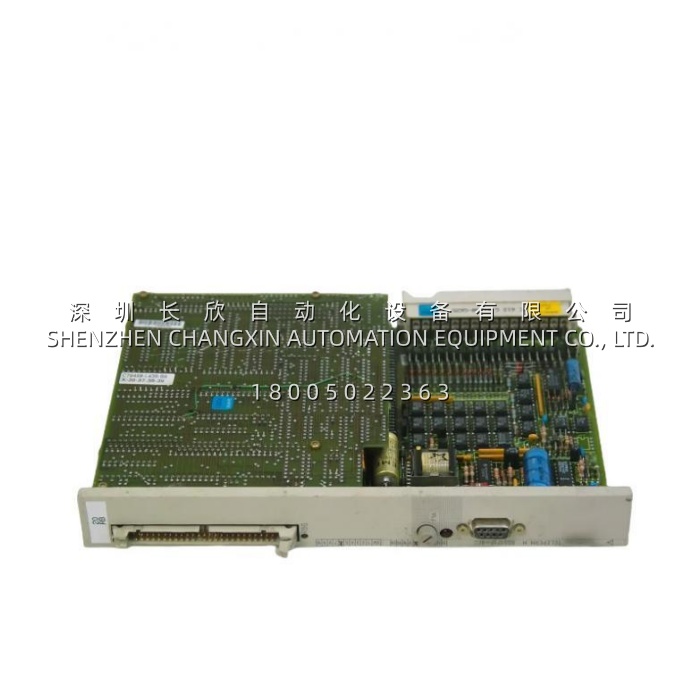
Technical Specifications
| Parameter | Value |
|---|---|
| Product Model | 6DS1717-8RR |
| Manufacturer | Siemens |
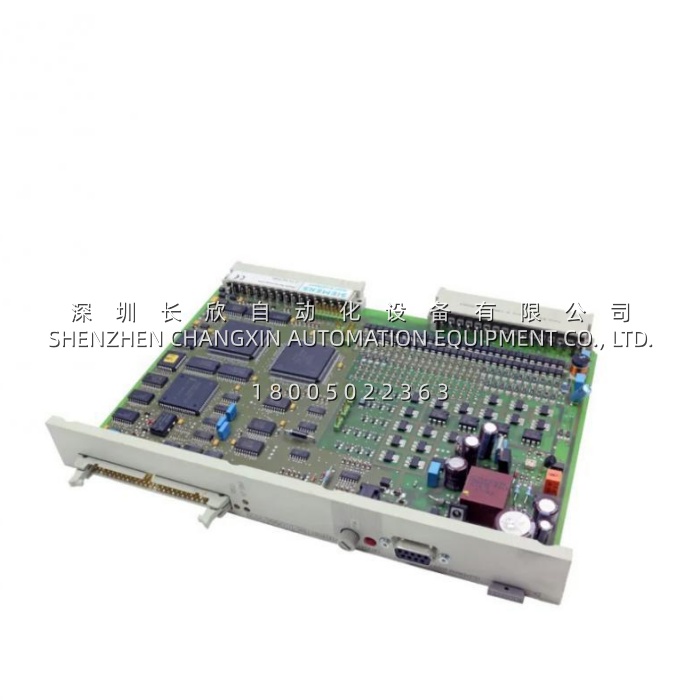
| Product Type | Binary Calculation Module (FUM232) |
| Platform | Teleperm M / Teleperm ME DCS |
| Supply Voltage | 24 V DC (–20 % / +25 %) |
| Power Consumption | ~3.5 W typical |
| Logic Functions | AND, OR, NOT, XOR, NAND, NOR, Flip-Flops |
| Timing / Counting | Multifunction timer, counter, shift register |
| Bus Interface | Nahbus (Siemens Teleperm M FUM bus, private) |
| Operating Temperature | 0 … +60 °C |
| Storage Temperature | –25 … +70 °C |
| Humidity | 5 … 95 % RH, non-condensing |
| Mounting | Teleperm M FUM rack slot / DIN-compatible carrier |
Main Features and Advantages
Rich binary-logic library executed at the FUM layer. The 6DS1717-8RR isn’t a dumb I/O expander—it embeds a full suite of gate-level and sequential primitives (AND/OR/NOT/XOR/NAND/NOR plus flip-flops) that let panel engineers build ladder-style trip logic directly on the function-module bus without consuming AS CPU scan time. In a turbine-startup sequence where ten or twelve permissive contacts must be evaluated, debounced, and timed before a fuel-valve enable, the 6DS1717-8RR keeps that evaluation deterministic on the Nahbus while the AS worries about process-loop control. For retrofit engineers, this means the binary logic “personality” of an old Teleperm M cabinet survives even if the AS is partially modernized upstream.Integrated timers, counters and shift registers. Beyond pure combinational logic, the 6DS1717-8RR carries multifunction timer blocks and counter stages, plus shift-register capability for sequenced stepping (think boiler soot-blower train advance, or staged burner light-off). These blocks are configured through the Teleperm M engineering toolchain rather than runtime PLC code, which is why the module feels alien to S7-trained staff but perfectly natural to anyone who ever opened a Teleperm M FUM drawer. The 6DS1717-8RR therefore acts as both a logic executor and a lightweight sequence scheduler for机架-level tasks that predate modern ISaGRAF or CFC engines.Millisecond-class response for ESD and trip duty. In emergency-shutdown loops and protective interlocks, those few milliseconds between contact closure and trip-relay assert can be the difference between a clean coast-down and a forced outage. The 6DS1717-8RR executes its binary evaluation and timer/counter state machines fast enough that the dominant delay in the chain becomes the output relay or the tripping solenoid, not the logic module. Plants running forty-year-old Teleperm M in base-load power still trust the 6DS1717-8RR for bearing-over temp, overspeed, and low-lube-pressure trip ladders precisely because that determinism has never been patched or “firmware-updated” into regression.Self-diagnostics and fail-safe posture. The module continuously monitors its logic-execution state, input-debounce integrity and internal memory, and on detecting a fault it drives a safe-state output pattern rather than leaving the last value latched—critical for trip-duty where a “frozen” output could mask a genuine hazard. When the 6DS1717-8RR flags a fault, the Teleperm M OS logs it against the FUM slot, letting maintenance trace whether the issue is an input-wiring chatter, a Nahbus backplane contact, or the module itself, before pulling spares.Low-power, long-life Teleperm M footprint. At ~3.5 W on 24 V DC, the 6DS1717-8RR sits quietly in the rack without stressing the vintage Teleperm M 24 V distribution. No fans, no moving parts, no configuration EEPROM to lose its contents during a cabinet power cycle—just a private-logic workhorse that, once the FUM drawer is closed and the AS downloads the FUM parameter set, will run another decade. For obsolescence budgets, that is exactly the cost profile plants want: cheap to stock, expensive to be without.
Application Field
The 6DS1717-8RR belongs almost exclusively to brownfield Teleperm M / Teleperm ME installations—primarily fossil-fired power plants (coal, oil, gas), large combined-cycle units, and a scatter of refinery / petchem process units commissioned in the 1980s–2000s when Siemens pushed Teleperm M hard in Europe and globally. Its natural habitat is the FUM drawer in an AS rack where turbine-protection ladders, boiler interlocks, and sequenced auxiliary-start logic live. A typical 300 MW unit might carry two or three 6DS1717-8RR modules: one for the turbine-trip permit chain (overspeed, vibration, thrust-bearing temp, lube-oil pressure, generator-differential armed), one for the boiler side (drum level permissive, FD/ID fan interlocks, fuel-train purge timer), and one for auxiliary sequencing (soot-blower train advance via the shift-register blocks, or staged burner management). Because the module’s logic is Nahbus-native and parameterized through Teleperm M ES tools, these ladders survive AS CPU swaps, OS upgrades, and even partial Teleperm-M-to-SIMATIC gateway projects—provided the FUM drawer stays intact.Beyond power generation, the 6DS1717-8RR shows up in cement kiln combustion sequencing, large compressor-station anti-surge interlocks, and marine-propulsion protection cabinets that were originally spec’d with Teleperm M. Anywhere a plant engineer says “the trip logic is still in the FUM drawer, don’t touch it,” there is likely a 6DS1717-8RR behind that caution. For EPC obsolescence surveys, the module typically scores “medium risk”—not because it fails often (it hardly ever does), but because when a FUM232 does fail, the site usually has zero cold spares and the lead time from the legacy aftermarket can stretch into weeks while a turbine sits on turning gear. That asymmetry is why the 6DS1717-8RR commands the price it does in the Teleperm M spare market despite being a “simple” binary-logic card by modern standards.Retrofit scenarios deserve a note: plants migrating AS620 from Teleperm M to PCS 7 often keep the FUM drawer (and thus the 6DS1717-8RR) alive for another cycle because re-coding twenty-year-old trip ladders into CFC/FB is a validation nightmare. The module therefore bridges generations—too old for greenfield, too critical to rip out in brownfield.