WhatsApp:+86 18005022363 WeChat: +86 18005022363
  Email:
Description
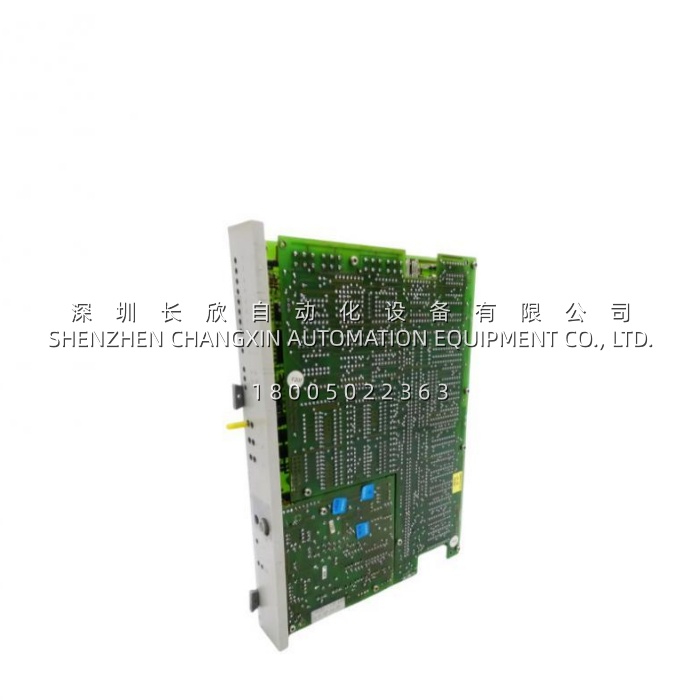
Application Scenarios
In a large-scale petrochemical plant, the central control room faced a critical challenge: ensuring the absolute reliability of emergency shutdown (ESD) signals from over 200 field sensors spread across a volatile cracking furnace unit. A single spurious trip could cost millions in lost production, while a failure to trip could lead to catastrophic consequences. The plant relied on the Siemens 6DS1618-8CA modules deployed in a 1-out-of-2 redundant architecture. Two physically separate Siemens 6DS1618-8CA modules read the same critical interlock signals; if one module faults, the system’s driver logic seamlessly ORs the two values, ensuring the plant operates on the single healthy channel without interruption. This approach, enabled by the PBE driver blocks, shifted maintenance from reactive to predictive. When the diagnostic engine of the Siemens 6DS1618-8CA flagged a potential signal degradation, the team could replace the module during a scheduled maintenance window, completely eliminating unplanned downtime attributable to input signal integrity issues.
Parameters
| Main Parameters | Value/Description |
|---|---|
| Product Model | 6DS1618-8CA |
| Manufacturer | Siemens |
| Product Category | Testable Binary Input Module (PBE) |
| Input Channels | 48 (High-density signal acquisition) |
| Nominal Voltage | 24 V DC ±20% |
| Response Time | ≤ 3 ms (Ensures rapid processing for interlocks) |
| Isolation | 1.5 kV AC (Channel group to ground) |
| System Compatibility | AS 235 H, TELEPERM M/ME DCS systems |
| Redundancy Support | 1-out-of-1, 1-out-of-2, 2-out-of-2 configurations |
| Status Indicators | Channel-level LED diagnostics for rapid fault localization |
| Module Fault Signal | BGF output for system-level health monitoring |
The 48-channel density provides a compact footprint, while the hardware fault detection procedures and channel-level LED diagnostics allow for swift elimination of hardware faults, significantly reducing mean time to repair (MTTR).
Technical Principles and Innovative Values
The Siemens 6DS1618-8CA stands apart from standard binary input modules through its specialized approach to system integrity and redundancy.
- Innovation Point 1: Testable Architecture (PBE). In contrast to other modules in the TELEPERM M range, the Siemens 6DS1618-8CA is a “PBE” (testable binary input) module that incorporates special hardware fault detection procedures. This design allows the system to detect and report internal module faults (via the BGF—module fault signal) in real-time. This diagnostic capability enables swift elimination of hardware faults, ensuring that signal integrity is not just assumed, but actively verified.
- Innovation Point 2: Flexible Redundancy Logic (1oo2 & 2oo2). The module supports complex redundancy structures through simple software configuration of the PBE and PRA driver blocks. In a 1-out-of-2 structure, the values from two Siemens 6DS1618-8CA modules are ORed, ensuring the process continues to operate if one module fails (high availability). Conversely, in a 2-out-of-2 structure, values are ANDed, ensuring a safety trip cannot be triggered by a single spurious fault (high safety). This architectural flexibility allows the Siemens 6DS1618-8CA to serve both critical safety and high-availability applications without hardware changes.
- Innovation Point 3: Legacy Reliability. As a proven workhorse for the TELEPERM M system, the Siemens 6DS1618-8CA offers unmatched backward compatibility for long-running process plants. Unlike modern IP-based systems, the Siemens 6DS1618-8CA provides deterministic response times (< 3 ms) necessary for hard real-time interlocking, ensuring that legacy control strategies continue to operate without costly migration.