WhatsApp:+86 18005022363 WeChat: +86 18005022363
  Email:
Description
Application Scenarios
A specialty-chemical batch plant in Jiangsu runs a 3-reactor suite on Honeywell ML200 (CPU 2MLJ-CPUxx, 2MLI DI, 2MLO DO, and two 2MLF-AD16A modules for analog). Reactor A/B/C each need: jacket-inlet temp (4–20mA RTD transmitter), reactor-base temp (same), agitator-motor current (4–20mA CT), jacket-pressure (0–10V from pressure transducer), and feed-flow (4–20mA Coriolis). That’s 15 AI loops total — fits on one 2MLF-AD16A with one spare, plus a second 2MLF-AD16A for the CIP skid and utility air-compressor rack sharing the same ML200 bay. Originally the E&I team had spec’d external 4–20mA isolators + 0–10V conditioners “just to be safe,” but the 2MLF-AD16A‘s optocoupled input-to-backplane isolation + 250 Ω current-input resistor + 1 MΩ voltage-input impedance handled the loops natively — they deleted 16 conditioning blocks from the BOM and saved ~€2.8k per reactor. The control engineer’s note after commissioning: “The 2MLF-AD16A just ate everything we threw at it — 4–20, 0–10, even a noisy 1–5V from a cheap pressure cell. One module, 16 channels, zero conditioners. Why didn’t we do this three skids ago?”
Parameter
| Main Parameters | Value / Description |
|---|---|
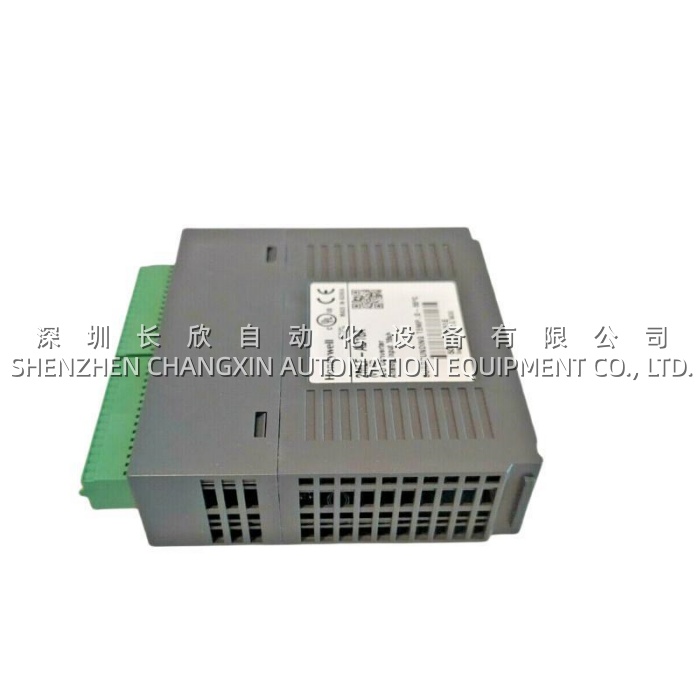
| Product Model | 2MLF-AD16A (also available as 2MLF-AD16A-CC with enhanced coating) |
| Manufacturer | Honeywell (Industrial Automation / ML200 Platform) |
| Product Category | 16-Channel Analog Input (A/D) Module |
| Compatible System | Honeywell MasterLogic-200 (ML200) PLC rack |
| Input Channels | 16 channels, single-ended (configurable per channel) |
| Current Ranges | 4–20 mA DC, 0–20 mA DC (input resistor 250 Ω) |
| Voltage Ranges | 0–5 V DC, 1–5 V DC, 0–10 V DC, ±10 V DC |
| Max Input (absolute) | ±30 mA (current), ±15 V (voltage) — do not exceed |
| Resolution | 16-bit A/D (1/16000, e.g. 0–10 V → ~0.625 mV/bit) |
| Conversion Speed | 500 μs per channel (max) |
| Accuracy | ±0.2% @ 25±5°C / ±0.3% @ 0–55°C |
| Isolation | Optocoupler: input terminals ↔ PLC backplane (channel-to-channel: NOT isolated — shared COM structure, verify per batch) |
| I/O Address Allocation | Fixed: 64 points / Variable: 16 points (selectable) |
| Power Consumption | 5 V DC, 330 mA (via ML200 backplane) |
| Connectivity | 32-point terminal block (2 terminals per channel + commons) |
| Operating Temp. | 0°C to +55°C |
| Storage Temp. | –25°C to +70°C |
| Humidity | 5%–95% RH, non-condensing |
| Dimensions (approx.) | 22 × 119 × 85 mm (W×H×D, module body) / ~172×120×114 mm package |
| Weight | ~115 g (module) / ~0.35 kg (shipping) |
| Mounting | ML200 rack slot (backplane bus), DIN-cabinet mounted as part of rack |
| Protection | IP20 (cabinet-only) |
Technical Principles and Innovative Values
Innovation Point 1 – Per-Channel Range Configurability Without Hardware Jumpers. The 2MLF-AD16A lets you mix 4–20 mA, 0–20 mA, 0–10 V, ±10 V, 1–5 V, 0–5 V on the same 16-channel module — each channel is set independently via software (MasterLogic programming tool) or DIP, no resistor changing, no jumper blocks. On a batch skid where Reactor A wants 4–20 mA (temp) + 0–10 V (pressure) + 1–5 V (cheap flow), you don’t need three different AI module types — one 2MLF-AD16A eats all three.Innovation Point 2 – 16-Bit at 500 μs/ch on a PLC Backplane. Most mid-range PLC AI modules in the ML200’s class (Siemens SM331, ABB S800 AI, etc.) sit around 12–14 bit or 1–2 ms/ch at this price point. The 2MLF-AD16A pushes 16-bit resolution with 500 μs max per channel — fast enough for closed-loop analog (pressure regulation, flow ratio) without needing a dedicated high-speed AI card. The ML200 CPU’s scan picks up the buffered words each cycle; no lost scans.Innovation Point 3 – Optocoupled Input-to-Backplane Isolation. The field-side terminals (32-point block) are optocoupled from the ML200 backplane 5 V / data bus. If a field transmitter shorts or a 24 V loop bleeds onto the AI wire, the backplane and CPU stay protected — the 2MLF-AD16A takes the hit, not the 2MLJ CPU. That said, channels are not isolated from each other (most batches share COM groups) — so don’t treat it like 16 independent galvanic islands. Wire your loops with a common reference (or use isolated transmitters) if your field grounds are messy.Innovation Point 4 – 64-Fixed / 16-Variable Address Modes. The 2MLF-AD16A can occupy 64 consecutive I/O addresses (one per “point” in Honeywell’s older fixed mapping — 16 ch × 4 “points” incl. status/high/low/alarm) or 16 addresses (one per channel, variable mapping, cleaner if you’re tight on address space). This flexibility matters on ML200 racks that also host 2MLI (DI) and 2MLO (DO) where the fixed-map approach burns addresses fast.
Application Cases and Industry Value
Case – Municipal Water Treatment (Pharmaceutical-Grade Water Loop, EU). A PW (purified water) skid feeding a biologics suite runs on ML200 (utility-grade PLC, cheaper than putting the skid on the plant’s main DCS). The PW loop needs: RO inlet pressure (4–20), RO outlet conductivity (0–10 V from the analyzer), tank level (4–20), UV intensity (4–20), recirculation flow (4–20), distribution-loop pressure (4–20), and 3× spare. That’s 7 AI — one 2MLF-AD16A covers it with 9 to spare. The skid OEM originally spec’d a mix of 8-ch AI cards (two slots) “because 4–20 and 0–10 shouldn’t mix on one card” — the ML200 programmer pointed out the 2MLF-AD16A handles mixed ranges per channel, consolidated to one slot, and freed a rack slot for a future 2MLO DO expansion (solenoid bank). Commissioning: the 0–10 V conductivity loop initially read noisy (analyzer ground was floating 2 V above skid ground) — the fix was an isolated 4–20 mA barrier transmitter-side, not a card swap. The 2MLF-AD16A itself was fine; the lesson: channel-to-ch isolation isn’t there, so watch your field grounds.Case – Edible-Oil Batch Reactor (SE Asia). A 10-ton batch reactor for refined-oil blending ran on ML200 with two 2MLF-AD16A modules: Module A = 8× temp (PT100→4–20 transmitters) + 4× 0–10 V load-cell weigh (jacket + agitator + feed), Module B = 4× flow (Coriolis 4–20) + 4× pressure (0–10 V) + 4× steam-header pressure (1–5 V from a legacy transducer they didn’t want to replace). Three years in, one 2MLF-AD16A developed a stuck-high on channel 7 (turned out to be a corroded 32-point terminal pin, not the A/D chip). Swapped the module in 8 minutes (ML200 rack, hot-swap capable if CPU config permits; they did a controlled stop anyway) and the batch resumed. The plant’s spares: two cold-spare 2MLF-AD16A for four reactors. Cost of the spare: ~€340. Cost of a reactor down for 4 hours waiting for a courier from the capital: ~€8k in batch discard. The math writes itself.